

R E G E N E R A T I O N IN LOWER PLANTS
135
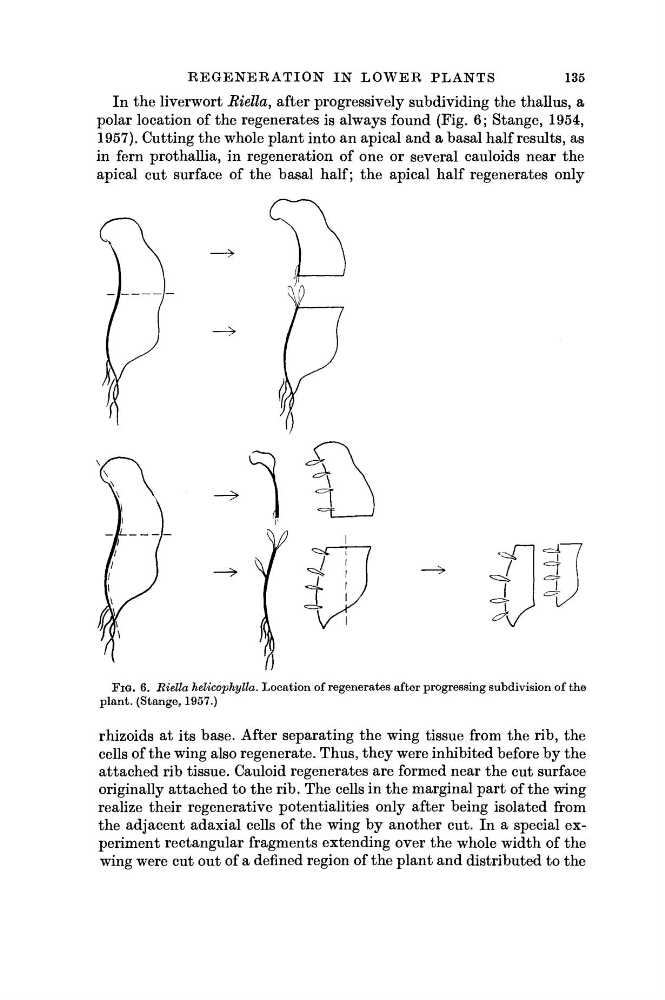
In the liverwort Biella, after progressively subdividing the thallus, a
polar location of the regenerates is always found (Fig. 6; Stange, 1954,
1957). Cutting the whole plant into an apical and a basal half results, as
in fern prothallia, in regeneration of one or several eauloids near the
apical cut surface of the basal half; the apical half regenerates only
if
1
A
F I G . 6. Biella helicophylla. Location of regenerates after progressing subdivision of the
plant. (Stange, 1957.)
rhizoids at its base. After separating the wing tissue from the rib, the
cells of the wing also regenerate. Thus, they were inhibited before by the
attached rib tissue. Cauloid regenerates are formed near the cut surface
originally attached to the rib. The cells in the marginal part of the wing
realize their regenerative potentialities only after being isolated from
the adjacent adaxial cells of the wing by another cut. In a special experiment rectangular fragments extending over the whole width of the
wing were cut out of a defined region of the plant and distributed to the
135
In the liverwort Biella, after progressively subdividing the thallus, a
polar location of the regenerates is always found (Fig. 6; Stange, 1954,
1957). Cutting the whole plant into an apical and a basal half results, as
in fern prothallia, in regeneration of one or several eauloids near the
apical cut surface of the basal half; the apical half regenerates only
if
1
A
F I G . 6. Biella helicophylla. Location of regenerates after progressing subdivision of the
plant. (Stange, 1957.)
rhizoids at its base. After separating the wing tissue from the rib, the
cells of the wing also regenerate. Thus, they were inhibited before by the
attached rib tissue. Cauloid regenerates are formed near the cut surface
originally attached to the rib. The cells in the marginal part of the wing
realize their regenerative potentialities only after being isolated from
the adjacent adaxial cells of the wing by another cut. In a special experiment rectangular fragments extending over the whole width of the
wing were cut out of a defined region of the plant and distributed to the