

84
ENRICO URBANI
tended to determine to what extent, if any, different growth rates affect
the uptake of total lipids, carbohydrates and nitrogen.
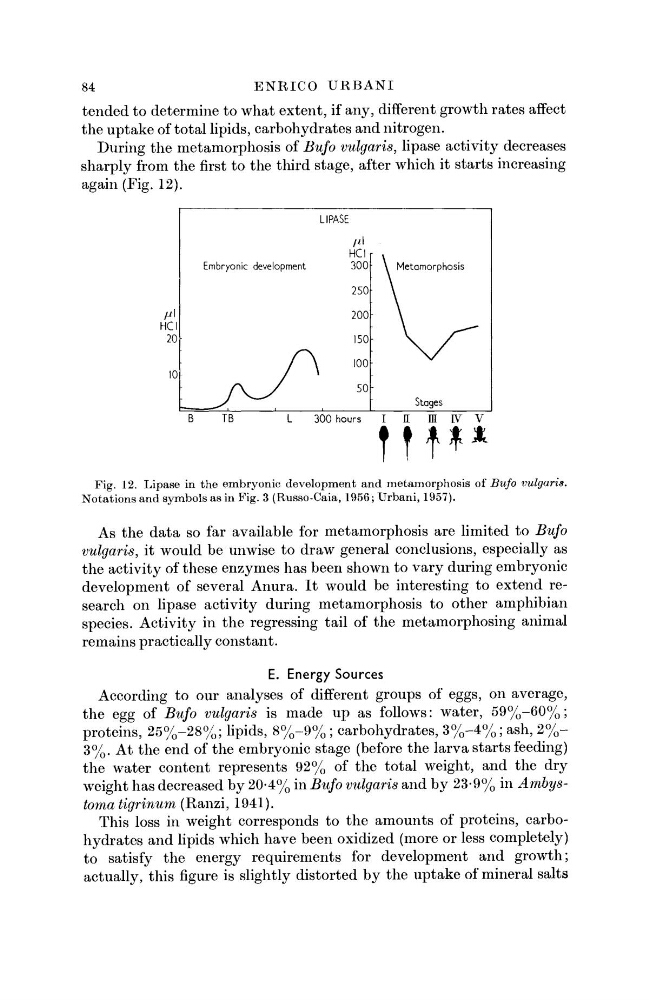
During the metamorphosis of Bufo vulgaris, lipase activity decreases
sharply from the first to the third stage, after which it starts increasing
again (Fig. 12).
μ\
HCI
20
10
Embryonic development
LIPASE
μ\
HCI
300
250
200
150
\
100
50
\ Metamorphosis
:
\
^
Stages
TB
300 hours
I Π IH IV V
T T i 'T
1 '^
Fig. 12. Lipase in the embryonic development and metamorphosis of Bufo
Notations and symbols as in Fig. 3 (Russo-Caia, 1956; Urbani, 1957).
As the data so far available for metamorphosis are limited to Bufo
vulgaris, it would be unwise to draw general conclusions, especially as
the activity of these enzymes has been shown to vary during embryonic
development of several Anura. It would be interesting to extend research on lipase activity during metamorphosis to other amphibian
species. Activity in the regressing tail of the metamorphosing animal
remains practically constant.
E. Energy Sources
According to our analyses of different groups of eggs, on average,
the egg of Bufo vulgaris is made up as follows: water, 59%-60%;
proteins, 25%-28%; lipids, 8%-9%; carbohydrates, 3 % - 4 % ; ash, 2 % -
3 % . At the end of the embryonic stage (before the larva starts feeding)
the water content represents 92% of the total weight, and the dry
weight has decreased by 20-4% in Bufo vulgaris and by 23-9% in Ambystoma tigrinum (Ranzi, 1941).
This loss in weight corresponds to the amounts of proteins, carbohydrates and lipids which have been oxidized (more or less completely)
to satisfy the energy requirements for development and growth;
actually, this figure is slightly distorted by the uptake of mineral salts
ENRICO URBANI
tended to determine to what extent, if any, different growth rates affect
the uptake of total lipids, carbohydrates and nitrogen.
During the metamorphosis of Bufo vulgaris, lipase activity decreases
sharply from the first to the third stage, after which it starts increasing
again (Fig. 12).
μ\
HCI
20
10
Embryonic development
LIPASE
μ\
HCI
300
250
200
150
\
100
50
\ Metamorphosis
:
\
^
Stages
TB
300 hours
I Π IH IV V
T T i 'T
1 '^
Fig. 12. Lipase in the embryonic development and metamorphosis of Bufo
Notations and symbols as in Fig. 3 (Russo-Caia, 1956; Urbani, 1957).
As the data so far available for metamorphosis are limited to Bufo
vulgaris, it would be unwise to draw general conclusions, especially as
the activity of these enzymes has been shown to vary during embryonic
development of several Anura. It would be interesting to extend research on lipase activity during metamorphosis to other amphibian
species. Activity in the regressing tail of the metamorphosing animal
remains practically constant.
E. Energy Sources
According to our analyses of different groups of eggs, on average,
the egg of Bufo vulgaris is made up as follows: water, 59%-60%;
proteins, 25%-28%; lipids, 8%-9%; carbohydrates, 3 % - 4 % ; ash, 2 % -
3 % . At the end of the embryonic stage (before the larva starts feeding)
the water content represents 92% of the total weight, and the dry
weight has decreased by 20-4% in Bufo vulgaris and by 23-9% in Ambystoma tigrinum (Ranzi, 1941).
This loss in weight corresponds to the amounts of proteins, carbohydrates and lipids which have been oxidized (more or less completely)
to satisfy the energy requirements for development and growth;
actually, this figure is slightly distorted by the uptake of mineral salts