

AMPHIBIAN AND INVERTEBRATE DEVELOPMENT 83
LIPASE
Bufo vulgaris
{
Bufo viridis
Rana escu/enta
Rana dalmatina
Time of development
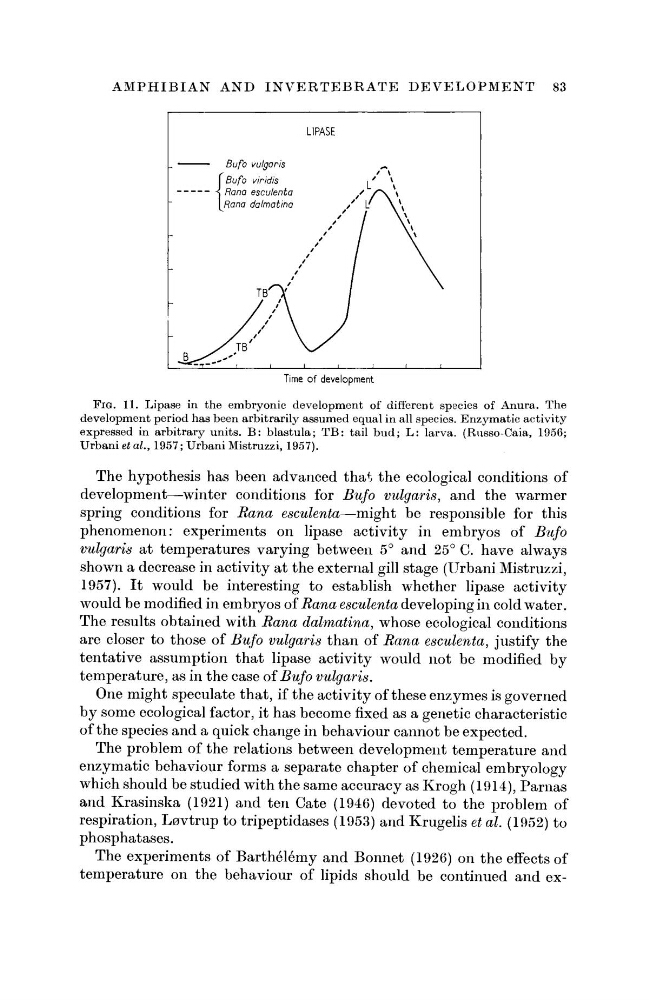
FIG. 11. Lipase in the embryonic development of different species of Anura. The
development period has been arbitrarily assumed equal in all species. Enzymatic activity
expressed in arbitrary units. B : blastula; T B : tail bud; L: larva. (Russo-Caia, 1956;
Urbani et al., 1957; Urbani Mistruzzi, 1957).
The hypothesis has been advanced that the ecological conditions of
development—winter conditions for Bufo vulgaris, and the warmer
spring conditions for Rana esculenta—might be responsible for this
phenomenon: experiments on lipase activity in embryos of Bufo
vulgaris at temperatures varying between 5° and 25° C. have always
shown a decrease in activity at the external gill stage (Urbani Mistruzzi,
1957). It would be interesting to establish whether lipase activity
would be modified in embryos of Rana esculenta developing in cold water.
The results obtained with Rana dalmatina, whose ecological conditions
are closer to those of Bufo vulgaris than of Rana esculenta, justify the
tentative assumption that lipase activity would not be modified by
temperature, as in the case ofBufo vulgaris.
One might speculate that, if the activity of these enzymes is governed
by some ecological factor, it has become fixed as a genetic characteristic
of the species and a quick change in behaviour cannot be expected.
The problem of the relations between development temperature and
enzymatic behaviour forms a separate chapter of chemical embryology
which should be studied with the same accuracy as Krogh (1914), Parnas
and Krasinska (1921) and ten Cate (1946) devoted to the problem of
respiration, L.0vtrup to tripeptidases (1953) and Krugelis et al. (1952) to
phosphatases.
The experiments of Barthelemy and Bonnet (1926) on the effects of
temperature on the behaviour of lipids should be continued and ex-
LIPASE
Bufo vulgaris
{
Bufo viridis
Rana escu/enta
Rana dalmatina
Time of development
FIG. 11. Lipase in the embryonic development of different species of Anura. The
development period has been arbitrarily assumed equal in all species. Enzymatic activity
expressed in arbitrary units. B : blastula; T B : tail bud; L: larva. (Russo-Caia, 1956;
Urbani et al., 1957; Urbani Mistruzzi, 1957).
The hypothesis has been advanced that the ecological conditions of
development—winter conditions for Bufo vulgaris, and the warmer
spring conditions for Rana esculenta—might be responsible for this
phenomenon: experiments on lipase activity in embryos of Bufo
vulgaris at temperatures varying between 5° and 25° C. have always
shown a decrease in activity at the external gill stage (Urbani Mistruzzi,
1957). It would be interesting to establish whether lipase activity
would be modified in embryos of Rana esculenta developing in cold water.
The results obtained with Rana dalmatina, whose ecological conditions
are closer to those of Bufo vulgaris than of Rana esculenta, justify the
tentative assumption that lipase activity would not be modified by
temperature, as in the case ofBufo vulgaris.
One might speculate that, if the activity of these enzymes is governed
by some ecological factor, it has become fixed as a genetic characteristic
of the species and a quick change in behaviour cannot be expected.
The problem of the relations between development temperature and
enzymatic behaviour forms a separate chapter of chemical embryology
which should be studied with the same accuracy as Krogh (1914), Parnas
and Krasinska (1921) and ten Cate (1946) devoted to the problem of
respiration, L.0vtrup to tripeptidases (1953) and Krugelis et al. (1952) to
phosphatases.
The experiments of Barthelemy and Bonnet (1926) on the effects of
temperature on the behaviour of lipids should be continued and ex-