

AMPHIBIAN AND INVERTEBRATE DEVELOPMENT 81
1 Acid proteinase
/ \
3 AG dipeptidase
j
'
5 Amylase
/
2 Acid proteinase
/
4 AC dipeptidase
/
B
G TB
L
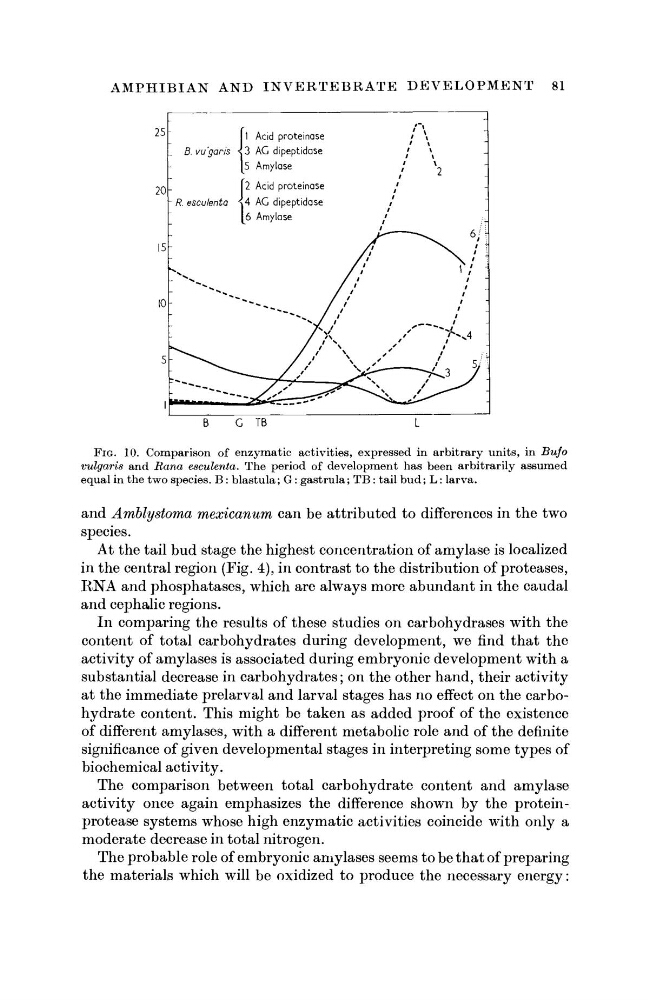
FIG. 10. Comparison of enzymatic activities, expressed in arbitrary units, in Bufo
vulgaris and Rana esculenta. The period of development has been arbitrarily assumed
equal in the two species. B : blastula; G: gastrula; T B : tail bud; L: larva.
and Amblystoma mexicanum can be attributed to differences in the two
species.
At the tail bud stage the highest concentration of amylase is localized
in the central region (Fig. 4), in contrast to the distribution of proteases,
RNA and phosphatases, which are always more abundant in the caudal
and cephalic regions.
In comparing the results of these studies on carbohydrases with the
content of total carbohydrates during development, we find that the
activity of amylases is associated during embryonic development with a
substantial decrease in carbohydrates; on the other hand, their activity
at the immediate prelarval and larval stages has no effect on the carbohydrate content. This might be taken as added proof of the existence
of different amylases, with a different metabolic role and of the definite
significance of given developmental stages in interpreting some types of
biochemical activity.
The comparison between total carbohydrate content and amylase
activity once again emphasizes the difference shown by the proteinprotease systems whose high enzymatic activities coincide with only a
moderate decrease in total nitrogen.
The probable role of embryonic amylases seems to be that of preparing
the materials which will be oxidized to produce the necessary energy:
1 Acid proteinase
/ \
3 AG dipeptidase
j
'
5 Amylase
/
2 Acid proteinase
/
4 AC dipeptidase
/
B
G TB
L
FIG. 10. Comparison of enzymatic activities, expressed in arbitrary units, in Bufo
vulgaris and Rana esculenta. The period of development has been arbitrarily assumed
equal in the two species. B : blastula; G: gastrula; T B : tail bud; L: larva.
and Amblystoma mexicanum can be attributed to differences in the two
species.
At the tail bud stage the highest concentration of amylase is localized
in the central region (Fig. 4), in contrast to the distribution of proteases,
RNA and phosphatases, which are always more abundant in the caudal
and cephalic regions.
In comparing the results of these studies on carbohydrases with the
content of total carbohydrates during development, we find that the
activity of amylases is associated during embryonic development with a
substantial decrease in carbohydrates; on the other hand, their activity
at the immediate prelarval and larval stages has no effect on the carbohydrate content. This might be taken as added proof of the existence
of different amylases, with a different metabolic role and of the definite
significance of given developmental stages in interpreting some types of
biochemical activity.
The comparison between total carbohydrate content and amylase
activity once again emphasizes the difference shown by the proteinprotease systems whose high enzymatic activities coincide with only a
moderate decrease in total nitrogen.
The probable role of embryonic amylases seems to be that of preparing
the materials which will be oxidized to produce the necessary energy: