

80
ENRICO URBANI
y
400
200
Embryonic development
.
:
N - / ^
AMYLASE
Y
1200
1000
800
600
400
200
Metamorphosis
Stages
B
TB 200 L
400 hours
I
Π Ιϊΐ
IV V
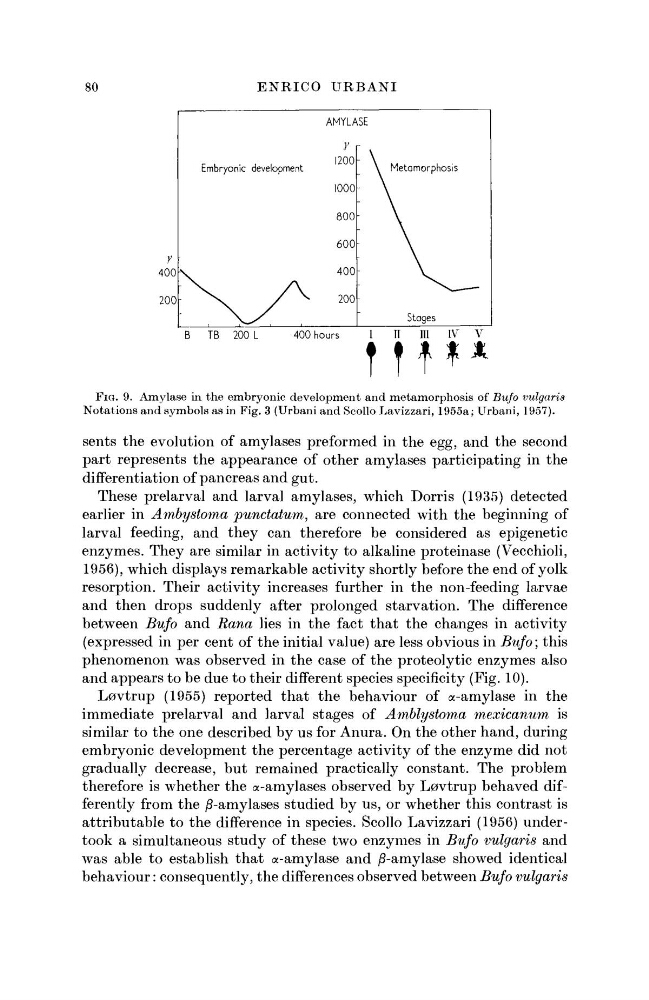
FIG. 9. Amylase in the embryonic development and metamorphosis of Bufo vulgaris
Notations and symbols as in Fig. 3 (Urbani and Scollo Lavizzari, 1955a; Urbani, 1957).
sents the evolution of amylases preformed in the egg, and the second
part represents the appearance of other amylases participating in the
differentiation of pancreas and gut.
These prelarval and larval amylases, which Dorris (1935) detected
earlier in Amhystoma punctatum, are connected with the beginning of
larval feeding, and they can therefore be considered as epigenetic
enzymes. They are similar in activity to alkaline proteinase (Vecchioli,
1956), which displays remarkable activity shortly before the end of yolk
resorption. Their activity increases further in the non-feeding larvae
and then drops suddenly after prolonged starvation. The difference
between Bufo and Bana lies in the fact that the changes in activity
(expressed in per cent of the initial value) are less obvious in Bufo; this
phenomenon was observed in the case of the proteolytic enzymes also
and appears to be due to their different species specificity (Fig. 10).
L0vtrup (1955) reported that the behaviour of α-amylase in the
immediate prelarval and larval stages of Amblystoma mexicanum is
similar to the one described by us for Anura. On the other hand, during
embryonic development the percentage activity of the enzyme did not
gradually decrease, but remained practically constant. The problem
therefore is whether the α-amylases observed by Lovtrup behaved differently from the ß-amylases studied by us, or whether this contrast is
attributable to the difference in species. Scollo Lavizzari (1956) undertook a simultaneous study of these two enzymes in Bufo vulgaris and
was able to establish that α-amylase and ß-amylase showed identical
behaviour: consequently, the differences observed between Bufo vulgaris
ENRICO URBANI
y
400
200
Embryonic development
.
:
N - / ^
AMYLASE
Y
1200
1000
800
600
400
200
Metamorphosis
Stages
B
TB 200 L
400 hours
I
Π Ιϊΐ
IV V
FIG. 9. Amylase in the embryonic development and metamorphosis of Bufo vulgaris
Notations and symbols as in Fig. 3 (Urbani and Scollo Lavizzari, 1955a; Urbani, 1957).
sents the evolution of amylases preformed in the egg, and the second
part represents the appearance of other amylases participating in the
differentiation of pancreas and gut.
These prelarval and larval amylases, which Dorris (1935) detected
earlier in Amhystoma punctatum, are connected with the beginning of
larval feeding, and they can therefore be considered as epigenetic
enzymes. They are similar in activity to alkaline proteinase (Vecchioli,
1956), which displays remarkable activity shortly before the end of yolk
resorption. Their activity increases further in the non-feeding larvae
and then drops suddenly after prolonged starvation. The difference
between Bufo and Bana lies in the fact that the changes in activity
(expressed in per cent of the initial value) are less obvious in Bufo; this
phenomenon was observed in the case of the proteolytic enzymes also
and appears to be due to their different species specificity (Fig. 10).
L0vtrup (1955) reported that the behaviour of α-amylase in the
immediate prelarval and larval stages of Amblystoma mexicanum is
similar to the one described by us for Anura. On the other hand, during
embryonic development the percentage activity of the enzyme did not
gradually decrease, but remained practically constant. The problem
therefore is whether the α-amylases observed by Lovtrup behaved differently from the ß-amylases studied by us, or whether this contrast is
attributable to the difference in species. Scollo Lavizzari (1956) undertook a simultaneous study of these two enzymes in Bufo vulgaris and
was able to establish that α-amylase and ß-amylase showed identical
behaviour: consequently, the differences observed between Bufo vulgaris