

76
ENRICO URBANI
enzymes during embryonic development and metamorphosis. Leaving
aside the technical details, which have been described previously
(Baldisserotto and Ugurgieri, 1958; De Cesaris Coromaldi, 1959), our
experiments have shown that the enzyme or enzymes responsible for
autolysis in the embryonic stages are not to be identified with the proteinase which hydrolyses casein at pH 4-9. During metamorphosis
(Fig. 7), there was marked increase in proteinase activity and a marked
decrease in autolytic activity, studied during short incubation periods
of an hour and a half hour; we came to the conclusion that their functions at the same morphological stages are quite different. On the other
hand, acid proteinase and autolytic enzymes in the tail follow similar
changes in activity, both of them showing a marked decrease as the tail
regresses.
B. Ribonucleic Acid and Phosphatases
Changes in the activity of proteolytic enzymes and in the content of
ribonucleic acids have been shown to follow similar courses in many
species. This is an interesting finding, since pentose nucleic acids are
known to play a part in protein synthesis (see Brächet, 1947, 1957,
1960a, b); there is some indication from the available data that proteolytic enzymes participate in protein synthesis. We therefore decided to
study changes in RNA content during embryonic development and
metamorphosis of Bufo vulgar is.
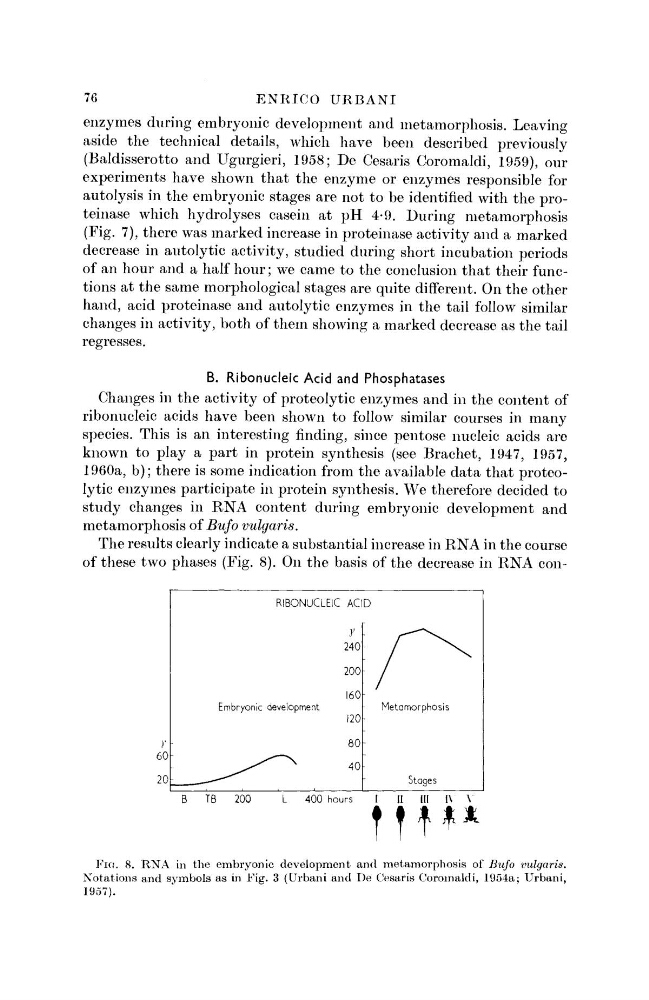
The results clearly indicate a substantial increase in RNA in the course
of these two phases (Fig. 8). On the basis of the decrease in RNA conRIBONUCLEIC ACID
Embryonic development
200,
I60
1
120)60
40i
Metamorphosis
Stages
B
TB
200
L
400 hours
I
II
III IV V"
Mt*
F I G . 8.
Notations
1957).
RNA in the embryonic development and metamorphosis of Bufo vulgaris.
and symbols as in Fig. 3 (Urbani and De Cesaris Coromaldi, 1954a; Urbani,
ENRICO URBANI
enzymes during embryonic development and metamorphosis. Leaving
aside the technical details, which have been described previously
(Baldisserotto and Ugurgieri, 1958; De Cesaris Coromaldi, 1959), our
experiments have shown that the enzyme or enzymes responsible for
autolysis in the embryonic stages are not to be identified with the proteinase which hydrolyses casein at pH 4-9. During metamorphosis
(Fig. 7), there was marked increase in proteinase activity and a marked
decrease in autolytic activity, studied during short incubation periods
of an hour and a half hour; we came to the conclusion that their functions at the same morphological stages are quite different. On the other
hand, acid proteinase and autolytic enzymes in the tail follow similar
changes in activity, both of them showing a marked decrease as the tail
regresses.
B. Ribonucleic Acid and Phosphatases
Changes in the activity of proteolytic enzymes and in the content of
ribonucleic acids have been shown to follow similar courses in many
species. This is an interesting finding, since pentose nucleic acids are
known to play a part in protein synthesis (see Brächet, 1947, 1957,
1960a, b); there is some indication from the available data that proteolytic enzymes participate in protein synthesis. We therefore decided to
study changes in RNA content during embryonic development and
metamorphosis of Bufo vulgar is.
The results clearly indicate a substantial increase in RNA in the course
of these two phases (Fig. 8). On the basis of the decrease in RNA conRIBONUCLEIC ACID
Embryonic development
200,
I60
1
120)60
40i
Metamorphosis
Stages
B
TB
200
L
400 hours
I
II
III IV V"
Mt*
F I G . 8.
Notations
1957).
RNA in the embryonic development and metamorphosis of Bufo vulgaris.
and symbols as in Fig. 3 (Urbani and De Cesaris Coromaldi, 1954a; Urbani,