

AMPHIBIAN AND INVERTEBRATE DEVELOPMENT 73
2. Proteinases
At least two proteinases can be shown to be present in the embryonic
development of Bufo vulgaris; they hydrolyse casein at pH 4-7-4-9 (acid
proteinase) and at p H 8-6 (alkaline proteinase).
The same enzymes were also studied in Rana esculenta, where, as was
the case with dipeptidases, the percentage increase in activity during
development was higher in the frog than in the toad (De Cesaris Coromaldi, 1954; Urbani and De Cesaris Coromaldi, 1954b, 1955; Vecchioli,
1956).
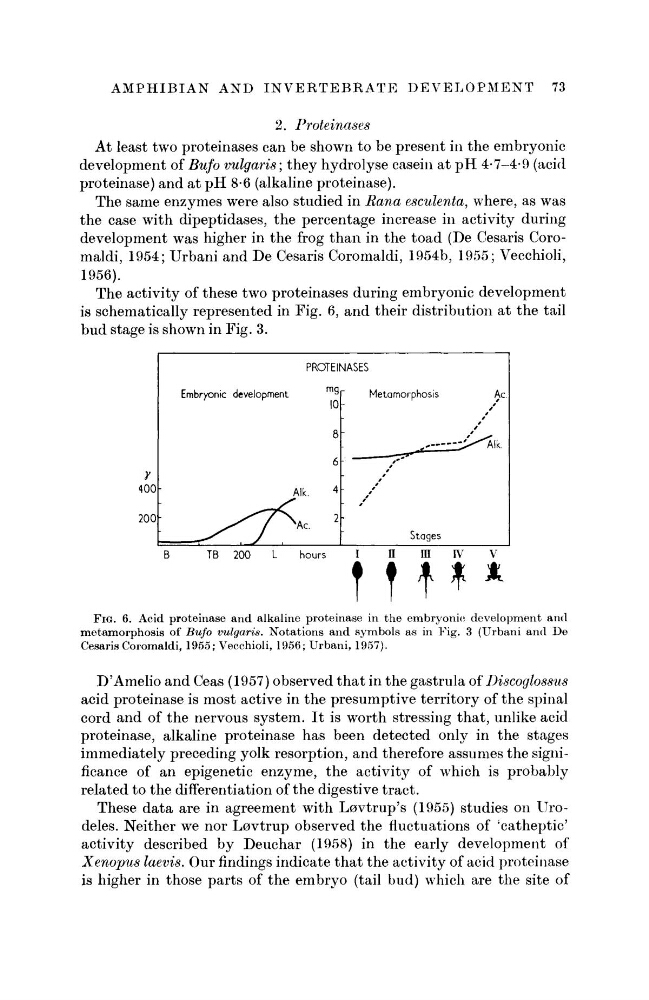
The activity of these two proteinases during embryonic development
is schematically represented in Fig. 6, and their distribution at the tail
bud stage is shown in Fig. 3.
y
4001
200
PROTEINASES
Embryonic development
^
10
8
6
\
Alk.
4
L _ ^ 7 ^
A C
2
Metamorphosis
■
s ^
/
/
/
Stages
Ac. *
*
*
*
/
B
TB 200
L
hours
I
Π
ΠΙ
IV
f i t * *
FIG. 6. Acid proteinase and alkaline proteinase in the embryonic development and
metamorphosis of Bufo vulgaris. Notations and symbols as in Fig. 3 (Urbani and De
Cesaris Coromaldi, 1955; Vecchioli, 1956; Urbani, 1957).
D'Amelio and Ceas (1957) observed that in the gastrula of Discoglossus
acid proteinase is most active in the presumptive territory of the spinal
cord and of the nervous system. It is worth stressing that, unlike acid
proteinase, alkaline proteinase has been detected only in the stages
immediately preceding yolk resorption, and therefore assumes the significance of an epigenetic enzyme, the activity of which is probably
related to the differentiation of the digestive tract.
These data are in agreement with Lovtrup's (1955) studies on Urodeles. Neither we nor L0vtrup observed the fluctuations of 'catheptic'
activity described by Deuchar (1958) in the early development of
Xenopus laevis. Our findings indicate that the activity of acid proteinase
is higher in those parts of the embryo (tail bud) which are the site of
2. Proteinases
At least two proteinases can be shown to be present in the embryonic
development of Bufo vulgaris; they hydrolyse casein at pH 4-7-4-9 (acid
proteinase) and at p H 8-6 (alkaline proteinase).
The same enzymes were also studied in Rana esculenta, where, as was
the case with dipeptidases, the percentage increase in activity during
development was higher in the frog than in the toad (De Cesaris Coromaldi, 1954; Urbani and De Cesaris Coromaldi, 1954b, 1955; Vecchioli,
1956).
The activity of these two proteinases during embryonic development
is schematically represented in Fig. 6, and their distribution at the tail
bud stage is shown in Fig. 3.
y
4001
200
PROTEINASES
Embryonic development
^
10
8
6
\
Alk.
4
L _ ^ 7 ^
A C
2
Metamorphosis
■
s ^
/
/
/
Stages
Ac. *
*
*
*
/
B
TB 200
L
hours
I
Π
ΠΙ
IV
f i t * *
FIG. 6. Acid proteinase and alkaline proteinase in the embryonic development and
metamorphosis of Bufo vulgaris. Notations and symbols as in Fig. 3 (Urbani and De
Cesaris Coromaldi, 1955; Vecchioli, 1956; Urbani, 1957).
D'Amelio and Ceas (1957) observed that in the gastrula of Discoglossus
acid proteinase is most active in the presumptive territory of the spinal
cord and of the nervous system. It is worth stressing that, unlike acid
proteinase, alkaline proteinase has been detected only in the stages
immediately preceding yolk resorption, and therefore assumes the significance of an epigenetic enzyme, the activity of which is probably
related to the differentiation of the digestive tract.
These data are in agreement with Lovtrup's (1955) studies on Urodeles. Neither we nor L0vtrup observed the fluctuations of 'catheptic'
activity described by Deuchar (1958) in the early development of
Xenopus laevis. Our findings indicate that the activity of acid proteinase
is higher in those parts of the embryo (tail bud) which are the site of