

72
E N R I C O U R B A N I
conditions, and specifically in the development temperature, which in
natural conditions is not the same for all of these species (Lovtrup,
1953c, d; Urbani Mistruzzi, 1957).
The activity of LG dipeptidase (Gaeta, 1957) is similar in pattern to
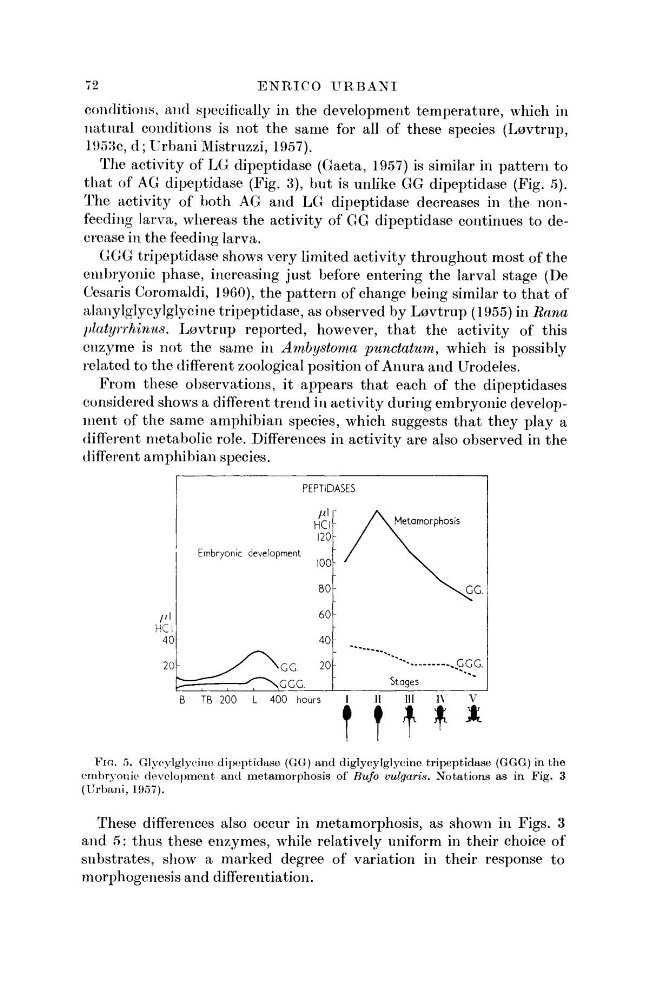
that of AG dipeptidase (Fig. 3), but is unlike GG dipeptidase (Fig. 5).
The activity of both AG and LG dipeptidase decreases in the nonfeeding larva, whereas the activity of GG dipeptidase continues to decrease in the feeding larva.
GGG tripeptidase shows very limited activity throughout most of the
embryonic phase, increasing just before entering the larval stage (De
Cesaris Coromaldi, 1960), the pattern of change being similar to that of
alanylglycylglycine tripeptidase, as observed by Lovtrup (1955) in Rana
platyrrhinus. L0vtrup reported, however, that the activity of this
enzyme is not the same in Ambystoma punctatum, which is possibly
related to the different zoological position of Anura and Urodeles.
From these observations, it appears that each of the dipeptidases
considered shows a different trend in activity during embryonic development of the same amphibian species, which suggests that they play a
different metabolic role. Differences in activity are also observed in the
different amphibian species.
HCI
40
20
B TB 200
L 400 hours
1
Jl
III
IV
V
f f f * *
FIG. 5. Glycylglycine dipeptidase (GG) and diglycylglycine tripeptidase (GGG) in the
embryonic development and metamorphosis of Bufo vulgaris. Notations as in Fig. 3
(Urbani, 1957).
These differences also occur in metamorphosis, as shown in Figs. 3
and 5: thus these enzymes, while relatively uniform in their choice of
substrates, show a marked degree of variation in their response to
morphogenesis and differentiation.
-
^z
Embryonic
PEPTIDASES
HCI
120
development
100
80
60
40
NCG.
20
■ ^ " X G G G .
r
/
/
-
-
-
' \
Metamorphosis
^ X G G
Stages
E N R I C O U R B A N I
conditions, and specifically in the development temperature, which in
natural conditions is not the same for all of these species (Lovtrup,
1953c, d; Urbani Mistruzzi, 1957).
The activity of LG dipeptidase (Gaeta, 1957) is similar in pattern to
that of AG dipeptidase (Fig. 3), but is unlike GG dipeptidase (Fig. 5).
The activity of both AG and LG dipeptidase decreases in the nonfeeding larva, whereas the activity of GG dipeptidase continues to decrease in the feeding larva.
GGG tripeptidase shows very limited activity throughout most of the
embryonic phase, increasing just before entering the larval stage (De
Cesaris Coromaldi, 1960), the pattern of change being similar to that of
alanylglycylglycine tripeptidase, as observed by Lovtrup (1955) in Rana
platyrrhinus. L0vtrup reported, however, that the activity of this
enzyme is not the same in Ambystoma punctatum, which is possibly
related to the different zoological position of Anura and Urodeles.
From these observations, it appears that each of the dipeptidases
considered shows a different trend in activity during embryonic development of the same amphibian species, which suggests that they play a
different metabolic role. Differences in activity are also observed in the
different amphibian species.
HCI
40
20
B TB 200
L 400 hours
1
Jl
III
IV
V
f f f * *
FIG. 5. Glycylglycine dipeptidase (GG) and diglycylglycine tripeptidase (GGG) in the
embryonic development and metamorphosis of Bufo vulgaris. Notations as in Fig. 3
(Urbani, 1957).
These differences also occur in metamorphosis, as shown in Figs. 3
and 5: thus these enzymes, while relatively uniform in their choice of
substrates, show a marked degree of variation in their response to
morphogenesis and differentiation.
-
^z
Embryonic
PEPTIDASES
HCI
120
development
100
80
60
40
NCG.
20
■ ^ " X G G G .
r
/
/
-
-
-
' \
Metamorphosis
^ X G G
Stages