

34
J. CLAVERT
chorion, one can orientate the position of the grey crescent, whether it
is formed through activation or fertilization. The authors set out to
demonstrate that the rotation of orientation did not determine a massrotation of the egg nor a rotation of the egg contents around its axis.
The rotation of orientation can act upon the orientation of the plane of
bilateral symmetry as long as the grey crescent is not formed; and the
symmetrizing effect is the more striking the greater the amplitude of
rotation. When the formation of the grey crescent begins, rotations are
without effect. When two directed rotations are made to act successively
but in opposite directions, only the second is determining; the effect
obtained by a directed rotation of orientation is not therefore definite,
but can be modified by one or several future rotations. Only the last
rotation is effective, as long as it is made before the beginning of the
rotation of fertilization. A rotation of orientation made in a particular
direction can annihilate the symmetrizing action of the spermatozoon,
if the amplitude is sufficient (180°-360°). The ascendancy of the rotation
of orientation over the spermatozoon varies in different eggs. It
increases with the amplitude of the rotation; it is greatest when the
plane in which it makes itself felt is nearest to the plane of fertilization
and it also increases with the hygrometric degree of the water in which
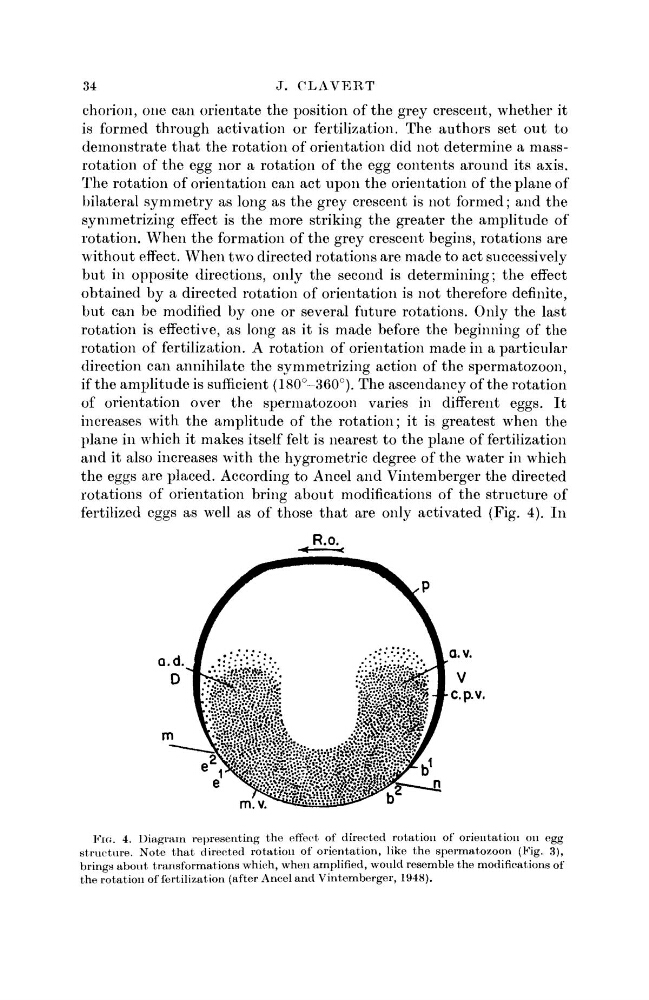
the eggs are placed. According to Ancel and Vintemberger the directed
rotations of orientation bring about modifications of the structure of
fertilized eggs as well as of those that are only activated (Fig. 4). In
FIG. 4. Diagram representing the effect of directed rotation of orientation on egg
structure. Note that directed rotation of orientation, like the spermatozoon (Fig. 3),
brings about transformations which, when amplified, would resemble the modifications of
the rotation of fertilization (after Ancel and Vintemberger, 1948).
J. CLAVERT
chorion, one can orientate the position of the grey crescent, whether it
is formed through activation or fertilization. The authors set out to
demonstrate that the rotation of orientation did not determine a massrotation of the egg nor a rotation of the egg contents around its axis.
The rotation of orientation can act upon the orientation of the plane of
bilateral symmetry as long as the grey crescent is not formed; and the
symmetrizing effect is the more striking the greater the amplitude of
rotation. When the formation of the grey crescent begins, rotations are
without effect. When two directed rotations are made to act successively
but in opposite directions, only the second is determining; the effect
obtained by a directed rotation of orientation is not therefore definite,
but can be modified by one or several future rotations. Only the last
rotation is effective, as long as it is made before the beginning of the
rotation of fertilization. A rotation of orientation made in a particular
direction can annihilate the symmetrizing action of the spermatozoon,
if the amplitude is sufficient (180°-360°). The ascendancy of the rotation
of orientation over the spermatozoon varies in different eggs. It
increases with the amplitude of the rotation; it is greatest when the
plane in which it makes itself felt is nearest to the plane of fertilization
and it also increases with the hygrometric degree of the water in which
the eggs are placed. According to Ancel and Vintemberger the directed
rotations of orientation bring about modifications of the structure of
fertilized eggs as well as of those that are only activated (Fig. 4). In
FIG. 4. Diagram representing the effect of directed rotation of orientation on egg
structure. Note that directed rotation of orientation, like the spermatozoon (Fig. 3),
brings about transformations which, when amplified, would resemble the modifications of
the rotation of fertilization (after Ancel and Vintemberger, 1948).