

SYMMETRIZATION OF THE EGG OF VERTEBRATES 33
own particularly precise method. In either case their conclusions were
identical: there is always a close relation between the entrance point of
the spermatozoon and the future plane of bilateral symmetry. They
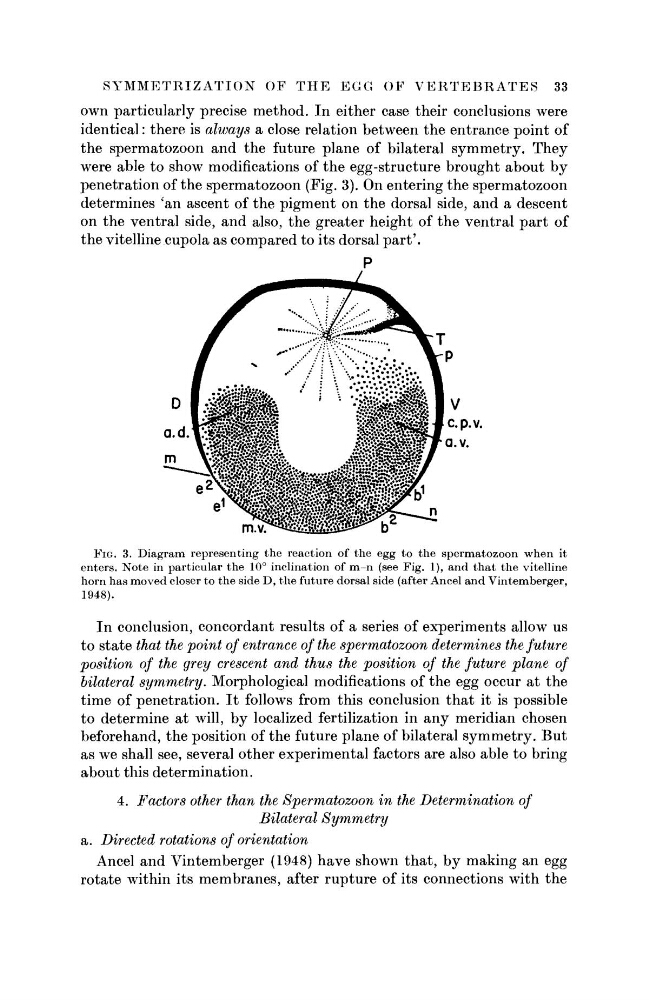
were able to show modifications of the egg-structure brought about by
penetration of the spermatozoon (Fig. 3). On entering the spermatozoon
determines 'an ascent of the pigment on the dorsal side, and a descent
on the ventral side, and also, the greater height of the ventral part of
the vitelline cupola as compared to its dorsal part'.
FIG. 3. Diagram representing the reaction of the egg to the spermatozoon when it
enters. Note in particular the 10° inclination o f m - n (see Fig. 1), and that the vitelline
horn has moved closer to the side D, the future dorsal side (after Ancel and Vintemberger,
1948).
In conclusion, concordant results of a series of experiments allow us
to state that the point of entrance of the spermatozoon determines the future
position of the grey crescent and thus the position of the future plane of
bilateral symmetry. Morphological modifications of the egg occur at the
time of penetration. It follows from this conclusion that it is possible
to determine at will, by localized fertilization in any meridian chosen
beforehand, the position of the future plane of bilateral symmetry. But
as we shall see, several other experimental factors are also able to bring
about this determination.
4. Factors other than the Spermatozoon in the Determination of
Bilateral Symmetry
a. Directed rotations of orientation
Ancel and Vintemberger (1948) have shown that, by making an egg
rotate within its membranes, after rupture of its connections with the
own particularly precise method. In either case their conclusions were
identical: there is always a close relation between the entrance point of
the spermatozoon and the future plane of bilateral symmetry. They
were able to show modifications of the egg-structure brought about by
penetration of the spermatozoon (Fig. 3). On entering the spermatozoon
determines 'an ascent of the pigment on the dorsal side, and a descent
on the ventral side, and also, the greater height of the ventral part of
the vitelline cupola as compared to its dorsal part'.
FIG. 3. Diagram representing the reaction of the egg to the spermatozoon when it
enters. Note in particular the 10° inclination o f m - n (see Fig. 1), and that the vitelline
horn has moved closer to the side D, the future dorsal side (after Ancel and Vintemberger,
1948).
In conclusion, concordant results of a series of experiments allow us
to state that the point of entrance of the spermatozoon determines the future
position of the grey crescent and thus the position of the future plane of
bilateral symmetry. Morphological modifications of the egg occur at the
time of penetration. It follows from this conclusion that it is possible
to determine at will, by localized fertilization in any meridian chosen
beforehand, the position of the future plane of bilateral symmetry. But
as we shall see, several other experimental factors are also able to bring
about this determination.
4. Factors other than the Spermatozoon in the Determination of
Bilateral Symmetry
a. Directed rotations of orientation
Ancel and Vintemberger (1948) have shown that, by making an egg
rotate within its membranes, after rupture of its connections with the