

348
Z. RYCHTER
2. Five-clip Combinations
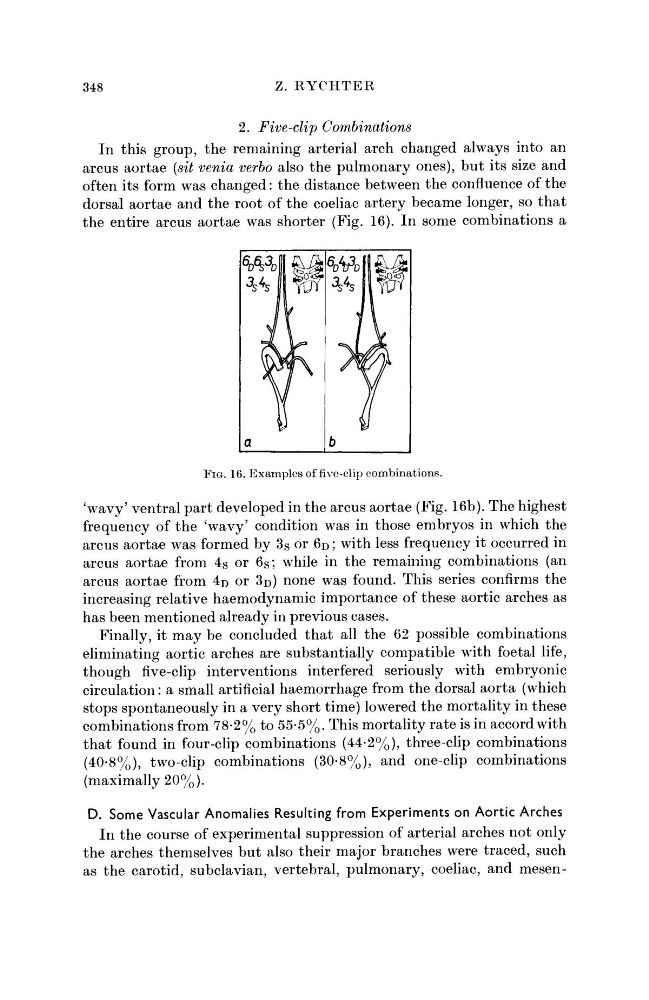
In this group, the remaining arterial arch changed always into an
arcus aortae (sit venia verbo also the pulmonary ones), but its size and
often its form was changed: the distance between the confluence of the
dorsal aortae and the root of the coeliac artery became longer, so that
the entire arcus aortae was shorter (Fig. 16). In some combinations a
FIG. 16. Examples of five-clip combinations.
'wavy' ventral part developed in the arcus aortae (Fig. 16b). The highest
frequency of the 'wavy' condition was in those embryos in which the
arcus aortae was formed by 3 S or 6 D ; with less frequency it occurred in
arcus aortae from 4 S or 6 S ; while in the remaining combinations (an
arcus aortae from 4 D or 3 D ) none was found. This series confirms the
increasing relative haemodynamic importance of these aortic arches as
has been mentioned already in previous cases.
Finally, it may be concluded that all the 62 possible combinations
eliminating aortic arches are substantially compatible with foetal life,
though five-clip interventions interfered seriously with embryonic
circulation: a small artificial haemorrhage from the dorsal aorta (which
stops spontaneously in a very short time) lowered the mortality in these
combinations from 78-2% to 55-5%. This mortality rate is in accord with
that found in four-clip combinations (44-2%), three-clip combinations
(40-8%), two-clip combinations (30-8%), and one-clip combinations
(maximally 20%).
D. Some Vascular Anomalies Resulting from Experiments on Aortic Arches
In the course of experimental suppression of arterial arches not only
the arches themselves but also their major branches were traced, such
as the carotid, subclavian, vertebral, pulmonary, coeliac, and mesen-
Z. RYCHTER
2. Five-clip Combinations
In this group, the remaining arterial arch changed always into an
arcus aortae (sit venia verbo also the pulmonary ones), but its size and
often its form was changed: the distance between the confluence of the
dorsal aortae and the root of the coeliac artery became longer, so that
the entire arcus aortae was shorter (Fig. 16). In some combinations a
FIG. 16. Examples of five-clip combinations.
'wavy' ventral part developed in the arcus aortae (Fig. 16b). The highest
frequency of the 'wavy' condition was in those embryos in which the
arcus aortae was formed by 3 S or 6 D ; with less frequency it occurred in
arcus aortae from 4 S or 6 S ; while in the remaining combinations (an
arcus aortae from 4 D or 3 D ) none was found. This series confirms the
increasing relative haemodynamic importance of these aortic arches as
has been mentioned already in previous cases.
Finally, it may be concluded that all the 62 possible combinations
eliminating aortic arches are substantially compatible with foetal life,
though five-clip interventions interfered seriously with embryonic
circulation: a small artificial haemorrhage from the dorsal aorta (which
stops spontaneously in a very short time) lowered the mortality in these
combinations from 78-2% to 55-5%. This mortality rate is in accord with
that found in four-clip combinations (44-2%), three-clip combinations
(40-8%), two-clip combinations (30-8%), and one-clip combinations
(maximally 20%).
D. Some Vascular Anomalies Resulting from Experiments on Aortic Arches
In the course of experimental suppression of arterial arches not only
the arches themselves but also their major branches were traced, such
as the carotid, subclavian, vertebral, pulmonary, coeliac, and mesen-