

MORPHOGENESIS OF FRESH-WATER PLANARIA
309
The irradiated animal survives for a time but is unable to regenerate the
damaged tissues. Neoblasts are actively dividing cells. They are more
sensitive to X-rays than the tissues of the planarian. At the moment of
division the irradiated neoblasts become necrotic and disappear.
Dubois (1949) used the technique of localized irradiation to demonstrate migration of the neoblasts. The planarian Euplanaria (Dugesia)
lugubris was irradiated locally in the anterior region (Fig. 3). After
decapitation, some time elapsed before a regeneration bud appeared
The further the zone of irradiation extended towards the back, the
longer was this interval. The irradiated neoblasts were destroyed and
the regeneration blastema was built up from healthy neoblasts which
had migrated across the irradiated zone and multiplied by mitosis. The
wounding of the planarian evidently evoked a stimulus which caused the
neoblasts to divide actively and to migrate.
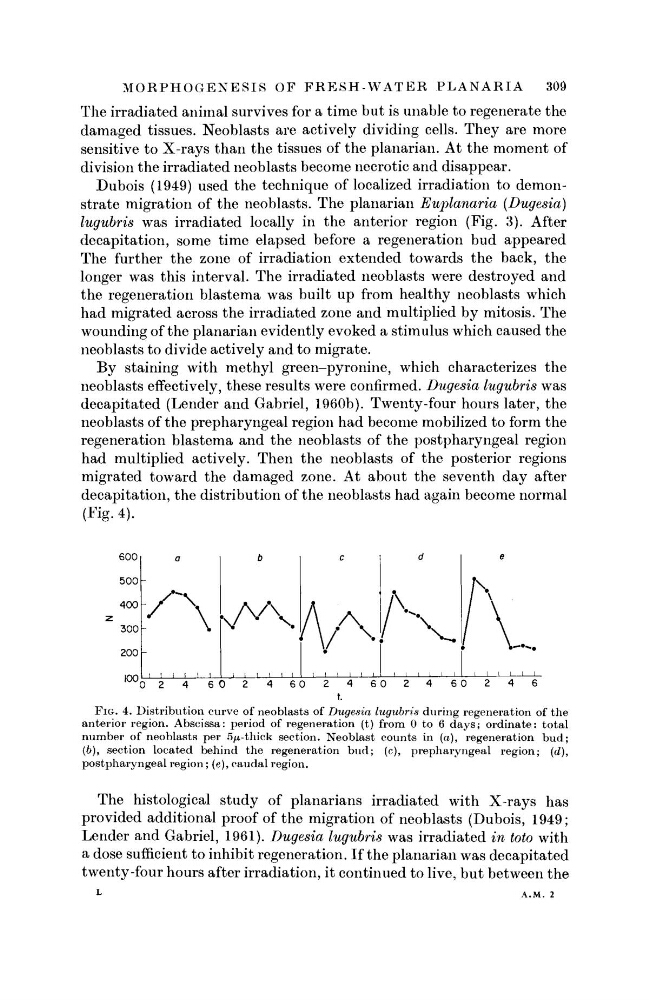
By staining with methyl green-pyronine, which characterizes the
neoblasts effectively, these results were confirmed. Dugesia lugubris was
decapitated (Lender and Gabriel, 1960b). Twenty-four hours later, the
neoblasts of the prepharyngeal region had become mobilized to form the
regeneration blastema and the neoblasts of the postpharyngeal region
had multiplied actively. Then the neoblasts of the posterior regions
migrated toward the damaged zone. At about the seventh day after
decapitation, the distribution of the neoblasts had again become normal
(Fig. 4).
6001
500
400
300
200
100,
λ^ Α !Λ·
0 2
6 0
6 0
6 0
6 0
2
4
t.
F I G . 4. D i s t r i b u t i o n c u r v e of n e o b l a s t s of Dugesia lugubris d u r i n g r e g e n e r a t i o n of t h e
a n t e r i o r region. A b s c i s s a : p e r i o d of r e g e n e r a t i o n (t) from 0 to 6 d a y s ; o r d i n a t e : t o t a l
n u m b e r of n e o b l a s t s p e r 5/x-thick section. N e o b l a s t c o u n t s in (a), r e g e n e r a t i o n b u d ;
(6), section l o c a t e d b e h i n d t h e r e g e n e r a t i o n b u d ; (c), p r e p h a r y n g e a l r e g i o n ;
(d),
p o s t p h a r y n g e a l r e g i o n ; (e), c a u d a l region.
The histological study of planarians irradiated with X-rays has
provided additional proof of the migration of neoblasts (Dubois, 1949;
Lender and Gabriel, 1961). Dugesia lugubris was irradiated in toto with
a dose sufficient to inhibit regeneration. If the planarian was decapitated
twenty-four hours after irradiation, it continued to live, but between the
309
The irradiated animal survives for a time but is unable to regenerate the
damaged tissues. Neoblasts are actively dividing cells. They are more
sensitive to X-rays than the tissues of the planarian. At the moment of
division the irradiated neoblasts become necrotic and disappear.
Dubois (1949) used the technique of localized irradiation to demonstrate migration of the neoblasts. The planarian Euplanaria (Dugesia)
lugubris was irradiated locally in the anterior region (Fig. 3). After
decapitation, some time elapsed before a regeneration bud appeared
The further the zone of irradiation extended towards the back, the
longer was this interval. The irradiated neoblasts were destroyed and
the regeneration blastema was built up from healthy neoblasts which
had migrated across the irradiated zone and multiplied by mitosis. The
wounding of the planarian evidently evoked a stimulus which caused the
neoblasts to divide actively and to migrate.
By staining with methyl green-pyronine, which characterizes the
neoblasts effectively, these results were confirmed. Dugesia lugubris was
decapitated (Lender and Gabriel, 1960b). Twenty-four hours later, the
neoblasts of the prepharyngeal region had become mobilized to form the
regeneration blastema and the neoblasts of the postpharyngeal region
had multiplied actively. Then the neoblasts of the posterior regions
migrated toward the damaged zone. At about the seventh day after
decapitation, the distribution of the neoblasts had again become normal
(Fig. 4).
6001
500
400
300
200
100,
λ^ Α !Λ·
0 2
6 0
6 0
6 0
6 0
2
4
t.
F I G . 4. D i s t r i b u t i o n c u r v e of n e o b l a s t s of Dugesia lugubris d u r i n g r e g e n e r a t i o n of t h e
a n t e r i o r region. A b s c i s s a : p e r i o d of r e g e n e r a t i o n (t) from 0 to 6 d a y s ; o r d i n a t e : t o t a l
n u m b e r of n e o b l a s t s p e r 5/x-thick section. N e o b l a s t c o u n t s in (a), r e g e n e r a t i o n b u d ;
(6), section l o c a t e d b e h i n d t h e r e g e n e r a t i o n b u d ; (c), p r e p h a r y n g e a l r e g i o n ;
(d),
p o s t p h a r y n g e a l r e g i o n ; (e), c a u d a l region.
The histological study of planarians irradiated with X-rays has
provided additional proof of the migration of neoblasts (Dubois, 1949;
Lender and Gabriel, 1961). Dugesia lugubris was irradiated in toto with
a dose sufficient to inhibit regeneration. If the planarian was decapitated
twenty-four hours after irradiation, it continued to live, but between the