

MORPHOGENESIS IN STENTOR
23
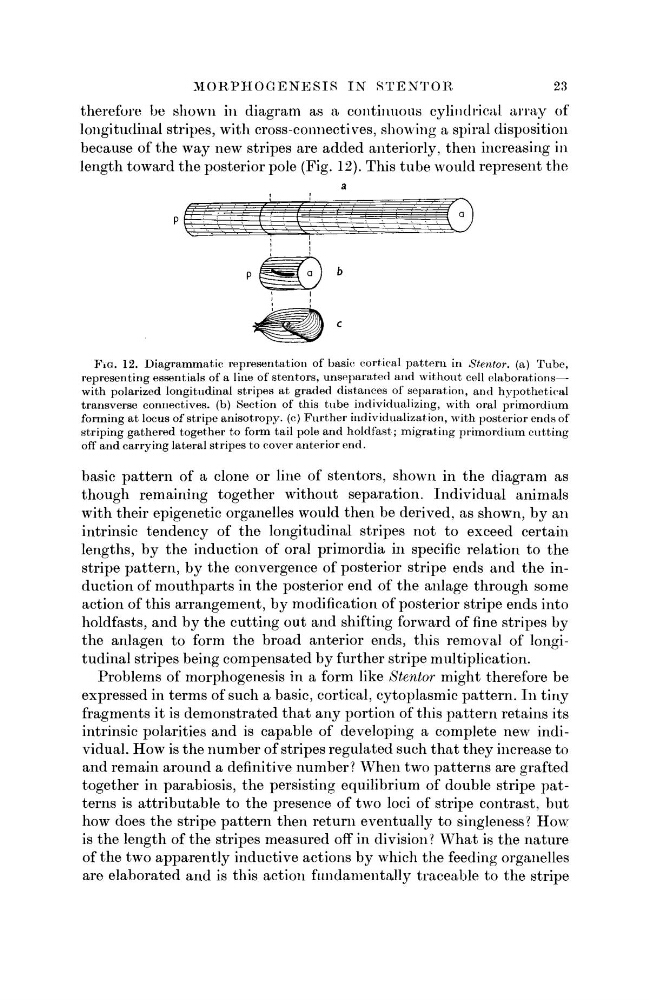
therefore be shown in diagram as a continuous cylindrical array of
longitudinal stripes, with cross-connectives, showing a spiral disposition
because of the way new stripes are added anteriorly, then increasing in
length toward the posterior pole (Fig. 12). This tube would represent the
FiG. 12. Diagrammatic representation of basic cortical pattern in Stentor. (a) Tube,
representing essentials of a line of stentors, unseparated and without cell elaborations—
with polarized longitudinal stripes at graded distances of separation, and hypothetical
transverse connectives, (b) Section of this tube individualizing, with oral primordium
forming at locus of stripe anisotropy. (c) Further individualization, with posterior ends of
striping gathered together to form tail pole and holdfast; migrating primordium cutting
off and carrying lateral stripes to cover anterior end.
basic pattern of a clone or line of stentors, shown in the diagram as
though remaining together without separation. Individual animals
with their epigenetic organelles would then be derived, as shown, by an
intrinsic tendency of the longitudinal stripes not to exceed certain
lengths, by the induction of oral primordia in specific relation to the
stripe pattern, by the convergence of posterior stripe ends and the induction of mouthparts in the posterior end of the anläge through some
action of this arrangement, by modification of posterior stripe ends into
holdfasts, and by the cutting out and shifting forward of fine stripes by
the anlagen to form the broad anterior ends, this removal of longitudinal stripes being compensated by further stripe multiplication.
Problems of morphogenesis in a form like Stentor might therefore be
expressed in terms of such a basic, cortical, cytoplasmic pattern. In tiny
fragments it is demonstrated that any portion of this pattern retains its
intrinsic polarities and is capable of developing a complete new individual. How is the number of stripes regulated such that they increase to
and remain around a definitive number? When two patterns are grafted
together in parabiosis, the persisting equilibrium of double stripe patterns is attributable to the presence of two loci of stripe contrast, but
how does the stripe pattern then return eventually to singleness? How
is the length of the stripes measured off in division ? What is the nature
of the two apparently inductive actions by which the feeding organelles
are elaborated and is this action fundamentally traceable to the stripe
23
therefore be shown in diagram as a continuous cylindrical array of
longitudinal stripes, with cross-connectives, showing a spiral disposition
because of the way new stripes are added anteriorly, then increasing in
length toward the posterior pole (Fig. 12). This tube would represent the
FiG. 12. Diagrammatic representation of basic cortical pattern in Stentor. (a) Tube,
representing essentials of a line of stentors, unseparated and without cell elaborations—
with polarized longitudinal stripes at graded distances of separation, and hypothetical
transverse connectives, (b) Section of this tube individualizing, with oral primordium
forming at locus of stripe anisotropy. (c) Further individualization, with posterior ends of
striping gathered together to form tail pole and holdfast; migrating primordium cutting
off and carrying lateral stripes to cover anterior end.
basic pattern of a clone or line of stentors, shown in the diagram as
though remaining together without separation. Individual animals
with their epigenetic organelles would then be derived, as shown, by an
intrinsic tendency of the longitudinal stripes not to exceed certain
lengths, by the induction of oral primordia in specific relation to the
stripe pattern, by the convergence of posterior stripe ends and the induction of mouthparts in the posterior end of the anläge through some
action of this arrangement, by modification of posterior stripe ends into
holdfasts, and by the cutting out and shifting forward of fine stripes by
the anlagen to form the broad anterior ends, this removal of longitudinal stripes being compensated by further stripe multiplication.
Problems of morphogenesis in a form like Stentor might therefore be
expressed in terms of such a basic, cortical, cytoplasmic pattern. In tiny
fragments it is demonstrated that any portion of this pattern retains its
intrinsic polarities and is capable of developing a complete new individual. How is the number of stripes regulated such that they increase to
and remain around a definitive number? When two patterns are grafted
together in parabiosis, the persisting equilibrium of double stripe patterns is attributable to the presence of two loci of stripe contrast, but
how does the stripe pattern then return eventually to singleness? How
is the length of the stripes measured off in division ? What is the nature
of the two apparently inductive actions by which the feeding organelles
are elaborated and is this action fundamentally traceable to the stripe