

P R O T E I N S I N D E V E L O P M E N T
251
Prom this data it seems that, in all the cases considered, the predisposition to breakdown is related to the formation of subunits.
We may interpret the observed phenomena taking into consideration
the view of Klotz (1958) that the stability of a protein molecule is due
to an aqueous coat bound to it. Li ion is highly hydrating in effect and its
binding to the protein molecules increases the amount of water bound to
it, while the SCN ion has a very powerful dehydrating effect and destroys
the aqueous coat all around the protein molecule.
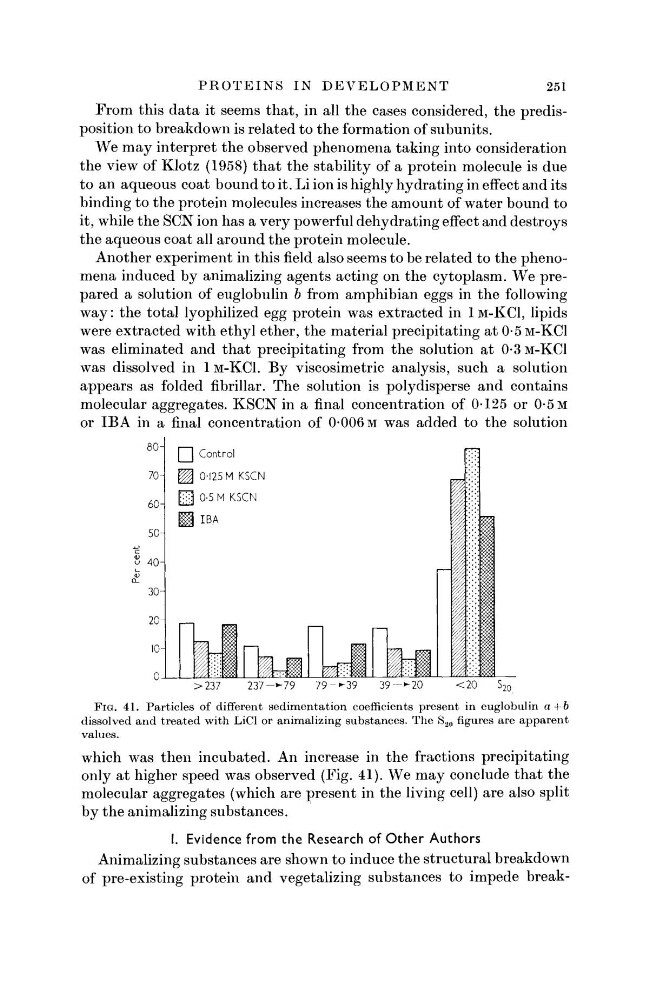
Another experiment in this field also seems to be related to the phenomena induced by animalizing agents acting on the cytoplasm. We prepared a solution of euglobulin b from amphibian eggs in the following
way: the total lyophilized egg protein was extracted in 1 M-KC1, lipids
were extracted with ethyl ether, the material precipitating at 0-5 M-KC1
was eliminated and that precipitating from the solution at 0-3M-KC1
was dissolved in 1 M-KC1. By viscosimetric analysis, such a solution
appears as folded fibrillar. The solution is poly disperse and contains
molecular aggregates. KSCN in a final concentration of 0-125 or 0*5 M
or IBA in a final concentration of 0-006 M was added to the solution
FIG. 41. Particles of different sedimentation coefficients present in euglobulin a+b
dissolved and treated with LiCl or animalizing substances. The S 20 figures are apparent
values.
which was then incubated. An increase in the fractions precipitating
only at higher speed was observed (Fig. 41). We may conclude that the
molecular aggregates (which are present in the living cell) are also split
by the animalizing substances.
I. Evidence from the Research of Other Authors
Animalizing substances are shown to induce the structural breakdown
of pre-existing protein and vegetalizing substances to impede break-
251
Prom this data it seems that, in all the cases considered, the predisposition to breakdown is related to the formation of subunits.
We may interpret the observed phenomena taking into consideration
the view of Klotz (1958) that the stability of a protein molecule is due
to an aqueous coat bound to it. Li ion is highly hydrating in effect and its
binding to the protein molecules increases the amount of water bound to
it, while the SCN ion has a very powerful dehydrating effect and destroys
the aqueous coat all around the protein molecule.
Another experiment in this field also seems to be related to the phenomena induced by animalizing agents acting on the cytoplasm. We prepared a solution of euglobulin b from amphibian eggs in the following
way: the total lyophilized egg protein was extracted in 1 M-KC1, lipids
were extracted with ethyl ether, the material precipitating at 0-5 M-KC1
was eliminated and that precipitating from the solution at 0-3M-KC1
was dissolved in 1 M-KC1. By viscosimetric analysis, such a solution
appears as folded fibrillar. The solution is poly disperse and contains
molecular aggregates. KSCN in a final concentration of 0-125 or 0*5 M
or IBA in a final concentration of 0-006 M was added to the solution
FIG. 41. Particles of different sedimentation coefficients present in euglobulin a+b
dissolved and treated with LiCl or animalizing substances. The S 20 figures are apparent
values.
which was then incubated. An increase in the fractions precipitating
only at higher speed was observed (Fig. 41). We may conclude that the
molecular aggregates (which are present in the living cell) are also split
by the animalizing substances.
I. Evidence from the Research of Other Authors
Animalizing substances are shown to induce the structural breakdown
of pre-existing protein and vegetalizing substances to impede break-