

250
SILVIO RANZI
0.30'tsp/c
0.200.15H
0.10\
\ „
0.5
1.0
—i
1 —
1.5
2.0
g per cenh
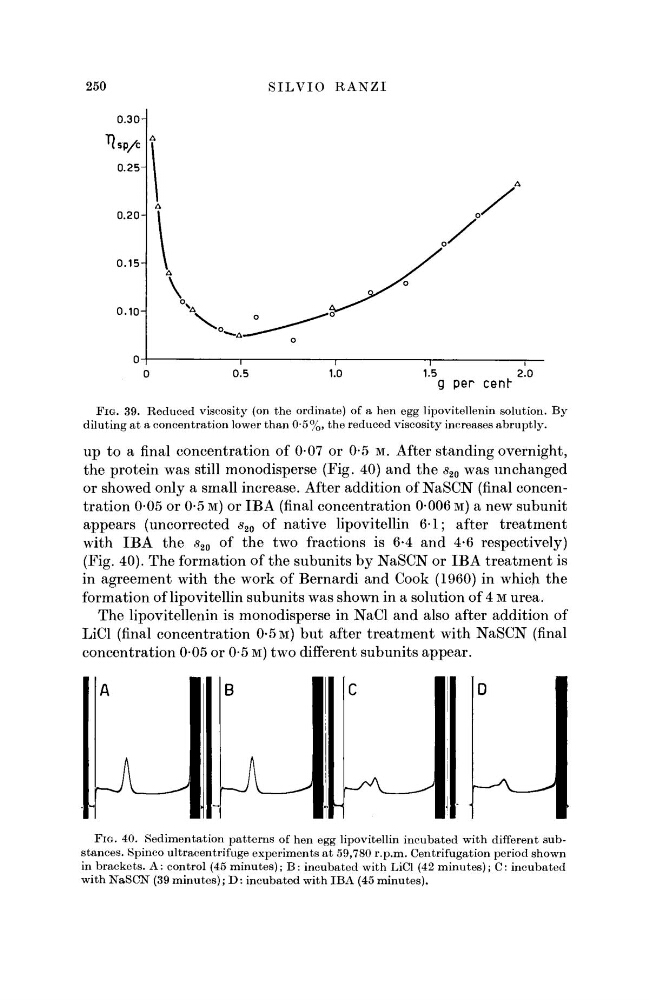
FIG. 39. Reduced viscosity (on the ordinate) of a hen egg lipovitellenin solution. By
diluting at a concentration lower than 0-5%, the reduced viscosity increases abruptly.
up to a final concentration of 0-07 or 0-5 M. After standing overnight,
the protein was still monodisperse (Fig. 40) and the s 20 was unchanged
or showed only a small increase. After addition of NaSCN (final concentration 0-05 or 0-5 M) or IBA (final concentration 0-006 M) a new subunit
appears (uncorrected s 2Q of native lipovitellin 6-1; after treatment
with IBA the s 20 of the two fractions is 6-4 and 4-6 respectively)
(Fig. 40). The formation of the subunits by NaSCN or IBA treatment is
in agreement with the work of Bernardi and Cook (1960) in which the
formation of lipovitellin subunits was shown in a solution of 4 M urea.
The lipovitellenin is monodisperse in NaCl and also after addition of
LiCl (final concentration 0-5 M) but after treatment with NaSCN (final
concentration 0-05 or 0-5 M) two different subunits appear.
FIG. 40. Sedimentation patterns of hen egg lipovitellin incubated with different substances. Spinco ultracentrifuge experiments at 59,780 r.p.m. Centrifugation period shown
in brackets. A: control (45 minutes); B : incubated with LiCl (42 minutes); C: incubated
with NaSCN (39 minutes); D : incubated with IBA (45 minutes).
SILVIO RANZI
0.30'tsp/c
0.200.15H
0.10\
\ „
0.5
1.0
—i
1 —
1.5
2.0
g per cenh
FIG. 39. Reduced viscosity (on the ordinate) of a hen egg lipovitellenin solution. By
diluting at a concentration lower than 0-5%, the reduced viscosity increases abruptly.
up to a final concentration of 0-07 or 0-5 M. After standing overnight,
the protein was still monodisperse (Fig. 40) and the s 20 was unchanged
or showed only a small increase. After addition of NaSCN (final concentration 0-05 or 0-5 M) or IBA (final concentration 0-006 M) a new subunit
appears (uncorrected s 2Q of native lipovitellin 6-1; after treatment
with IBA the s 20 of the two fractions is 6-4 and 4-6 respectively)
(Fig. 40). The formation of the subunits by NaSCN or IBA treatment is
in agreement with the work of Bernardi and Cook (1960) in which the
formation of lipovitellin subunits was shown in a solution of 4 M urea.
The lipovitellenin is monodisperse in NaCl and also after addition of
LiCl (final concentration 0-5 M) but after treatment with NaSCN (final
concentration 0-05 or 0-5 M) two different subunits appear.
FIG. 40. Sedimentation patterns of hen egg lipovitellin incubated with different substances. Spinco ultracentrifuge experiments at 59,780 r.p.m. Centrifugation period shown
in brackets. A: control (45 minutes); B : incubated with LiCl (42 minutes); C: incubated
with NaSCN (39 minutes); D : incubated with IBA (45 minutes).