

246
S I L V I O R A N Z I
a + b was dissolved in 1 M-KC1 and the three euglobulin solutions from
control, vegetalized, and animalized embryos were diluted in such a
way as to reach the same optical density at 275 m/x in the Beckman
spectrophotometer. With these solutions, samples were prepared in a
similar manner to that described earlier for sea urchin embryo proteins.
With frogs too, it can be seen that proteins from Li-treated embryos
are much more resistant to the action of urea (Table 3) and proteolytic
enzymes (such as trypsin and papain), than are proteins from control
embryos; proteins from embryos treated with NaSCN are less resistant
than the controls to urea and proteolytic enzymes.
The same test applied to euglobulin from toad crosses, showed that
euglobulin a + b from the non-viable cross Bufo viridis $ x Bufo bufo £
and from Li-treated B. bufo are much more resistant to breakdown by
urea and proteolytic enzymes than proteins of the embryos of Bufo
viridis, Bufo bufo, or of the cross Bufo bufo $ x Bufo viridis <$.
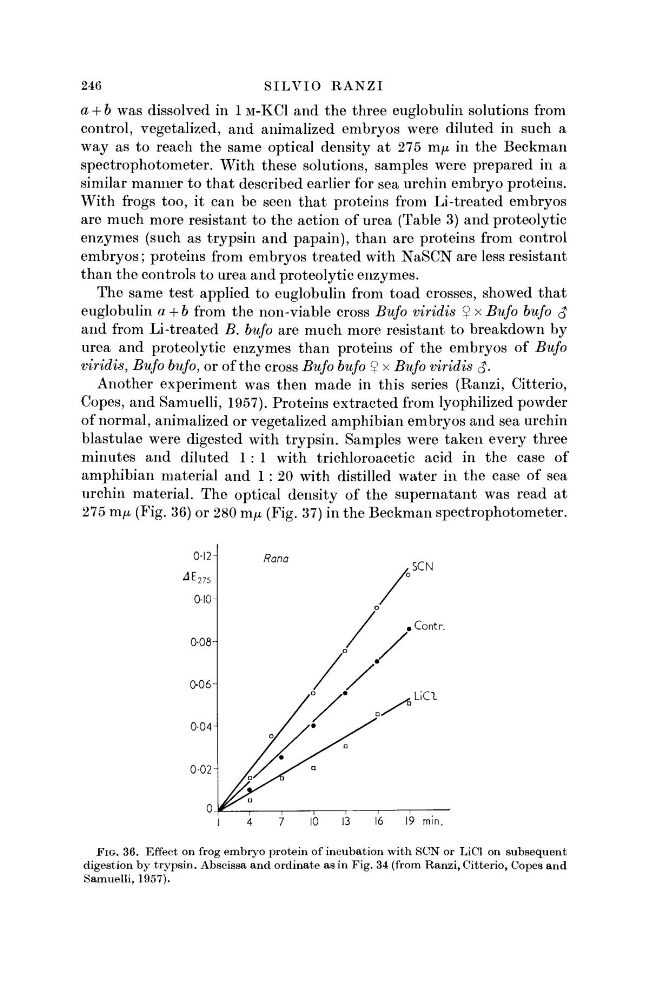
Another experiment was then made in this series (Ranzi, Citterio,
Copes, and Samuelli, 1957). Proteins extracted from lyophilized powder
of normal, animalized or vegetalized amphibian embryos and sea urchin
blastulae were digested with trypsin. Samples were taken every three
minutes and diluted 1 : 1 with trichloroacetic acid in the case of
amphibian material and 1 : 20 with distilled water in the case of sea
urchin material. The optical density of the supernatant was read at
275 m/x (Fig. 36) or 280 m/x (Fig. 37) in the Beckman spectrophotometer.
0-124E275
0I
4
7
10
13
16
19 min.
FIG. 36. Effect on frog embryo protein of incubation with SCN or LiCl on subsequent
digestion by trypsin. Abscissa and ordinate as in Fig. 34 (from Ranzi, Citterio, Copes and
Samuelli, 1957).
• Contr.
S I L V I O R A N Z I
a + b was dissolved in 1 M-KC1 and the three euglobulin solutions from
control, vegetalized, and animalized embryos were diluted in such a
way as to reach the same optical density at 275 m/x in the Beckman
spectrophotometer. With these solutions, samples were prepared in a
similar manner to that described earlier for sea urchin embryo proteins.
With frogs too, it can be seen that proteins from Li-treated embryos
are much more resistant to the action of urea (Table 3) and proteolytic
enzymes (such as trypsin and papain), than are proteins from control
embryos; proteins from embryos treated with NaSCN are less resistant
than the controls to urea and proteolytic enzymes.
The same test applied to euglobulin from toad crosses, showed that
euglobulin a + b from the non-viable cross Bufo viridis $ x Bufo bufo £
and from Li-treated B. bufo are much more resistant to breakdown by
urea and proteolytic enzymes than proteins of the embryos of Bufo
viridis, Bufo bufo, or of the cross Bufo bufo $ x Bufo viridis <$.
Another experiment was then made in this series (Ranzi, Citterio,
Copes, and Samuelli, 1957). Proteins extracted from lyophilized powder
of normal, animalized or vegetalized amphibian embryos and sea urchin
blastulae were digested with trypsin. Samples were taken every three
minutes and diluted 1 : 1 with trichloroacetic acid in the case of
amphibian material and 1 : 20 with distilled water in the case of sea
urchin material. The optical density of the supernatant was read at
275 m/x (Fig. 36) or 280 m/x (Fig. 37) in the Beckman spectrophotometer.
0-124E275
0I
4
7
10
13
16
19 min.
FIG. 36. Effect on frog embryo protein of incubation with SCN or LiCl on subsequent
digestion by trypsin. Abscissa and ordinate as in Fig. 34 (from Ranzi, Citterio, Copes and
Samuelli, 1957).
• Contr.