

P R O T E I N S I N D E V E L O P M E N T
245
cosimeter bath, the viscosity readings were taken; the viscosity of
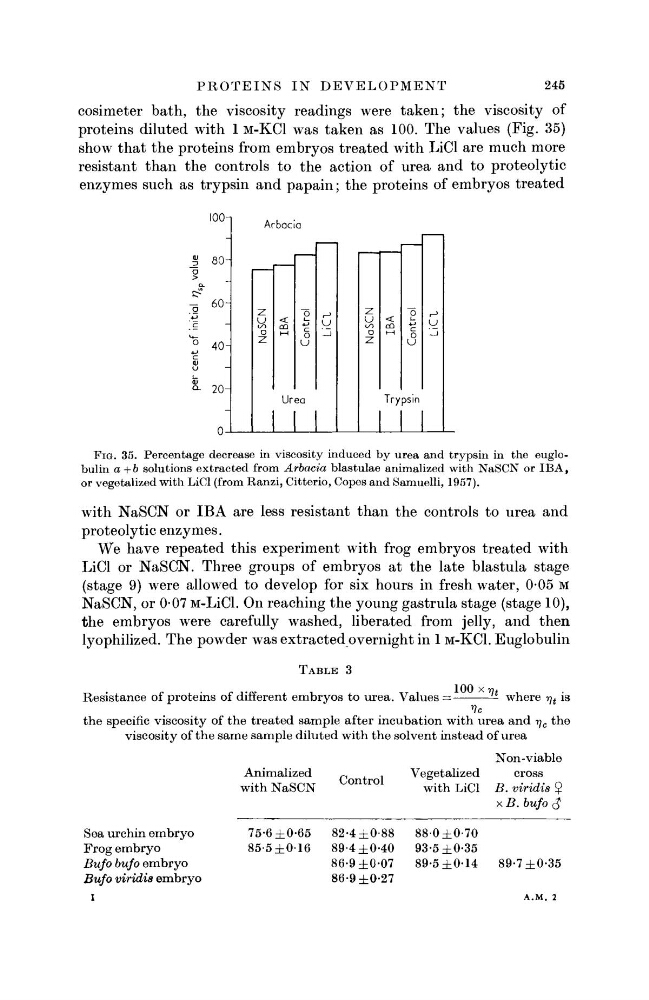
proteins diluted with 1 M-KCl was taken as 100. The values (Fig. 35)
show that the proteins from embryos treated with LiCl are much more
resistant than the controls to the action of urea and to proteolytic
enzymes such as trypsin and papain; the proteins of embryos treated
lOO-i
80H
60 H
0Arbac
Urea
Trypsin
FIG. 35. Percentage decrease in viscosity induced by urea and trypsin in the euglobulin a + b solutions extracted from Arbacia blastulae animalized with NaSCN or IBA,
or vegetalized with LiCl (from Ranzi, Citterio, Copes and Samuelli, 1957).
with NaSCN or IBA are less resistant than the controls to urea and
proteolytic enzymes.
We have repeated this experiment with frog embryos treated with
LiCl or NaSCN. Three groups of embryos at the late blastula stage
(stage 9) were allowed to develop for six hours in fresh water, 0-05 M
NaSCN, or 0-07 M-LiCl. On reaching the young gastrula stage (stage 10),
the embryos were carefully washed, liberated from jelly, and then
lyophilized. The powder was extracted overnight in 1 M-KCl. Euglobulin
TABLE 3
100 χ^
Resistance of proteins of different embryos to urea. Values =
where η t is
Vc
the specific viscosity of the treated sample after incubation with urea and η 0 the
viscosity of the same sample diluted with the solvent instead of urea
Non-viable
Animalized
~
,
Vegetalized
cross
with NaSCN
C o n t r o 1
w i t h L i C 1
Bt v i r idis ?
x B. bufo <$
Sea urchin embryo
Frog embryo
Bufo bufo embryo
Bufo viridis embryo
75-6 ±0-65
85-5 ±0-16
82-4 ±0-88
89-4 ±0-40
86·9±0·07
86-9 ±0-27
88·0±0·70
93-5 ±0-35
89·5±0·14
•7 ±0-35
245
cosimeter bath, the viscosity readings were taken; the viscosity of
proteins diluted with 1 M-KCl was taken as 100. The values (Fig. 35)
show that the proteins from embryos treated with LiCl are much more
resistant than the controls to the action of urea and to proteolytic
enzymes such as trypsin and papain; the proteins of embryos treated
lOO-i
80H
60 H
0Arbac
Urea
Trypsin
FIG. 35. Percentage decrease in viscosity induced by urea and trypsin in the euglobulin a + b solutions extracted from Arbacia blastulae animalized with NaSCN or IBA,
or vegetalized with LiCl (from Ranzi, Citterio, Copes and Samuelli, 1957).
with NaSCN or IBA are less resistant than the controls to urea and
proteolytic enzymes.
We have repeated this experiment with frog embryos treated with
LiCl or NaSCN. Three groups of embryos at the late blastula stage
(stage 9) were allowed to develop for six hours in fresh water, 0-05 M
NaSCN, or 0-07 M-LiCl. On reaching the young gastrula stage (stage 10),
the embryos were carefully washed, liberated from jelly, and then
lyophilized. The powder was extracted overnight in 1 M-KCl. Euglobulin
TABLE 3
100 χ^
Resistance of proteins of different embryos to urea. Values =
where η t is
Vc
the specific viscosity of the treated sample after incubation with urea and η 0 the
viscosity of the same sample diluted with the solvent instead of urea
Non-viable
Animalized
~
,
Vegetalized
cross
with NaSCN
C o n t r o 1
w i t h L i C 1
Bt v i r idis ?
x B. bufo <$
Sea urchin embryo
Frog embryo
Bufo bufo embryo
Bufo viridis embryo
75-6 ±0-65
85-5 ±0-16
82-4 ±0-88
89-4 ±0-40
86·9±0·07
86-9 ±0-27
88·0±0·70
93-5 ±0-35
89·5±0·14
•7 ±0-35