

230
SILVIO RANZI
are highly significant: the increases in the average number of notochord
nuclei are as high as 11*4% in Rana esculenta embryos and 11*8% in
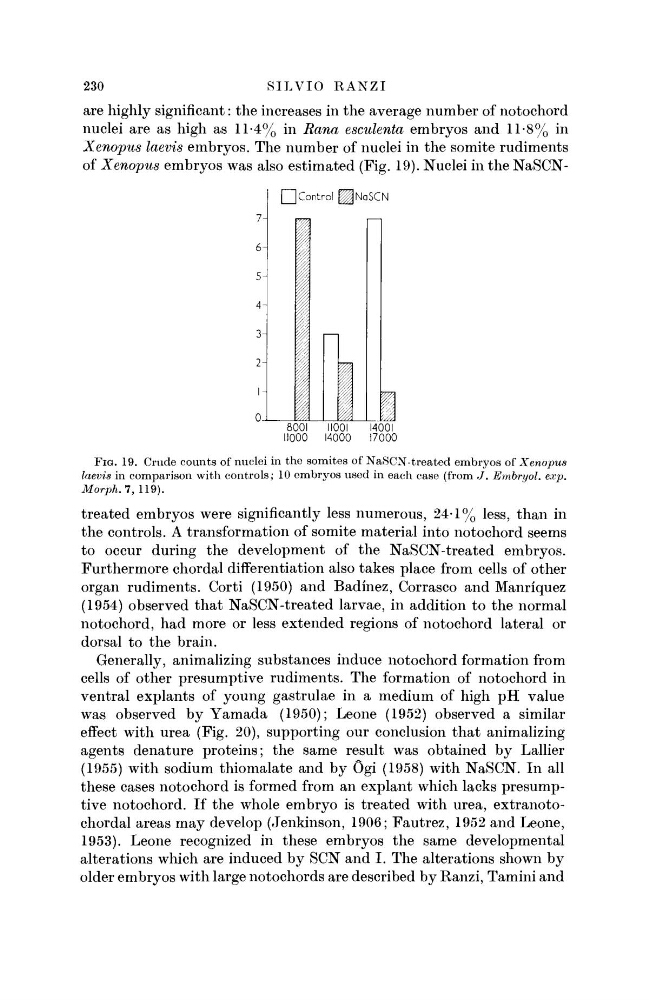
Xenopus laevis embryos. The number of nuclei in the somite rudiments
of Xenopus embryos was also estimated (Fig. 19). Nuclei in the NaSCN□ Control |§NaSCN
8001
i 1001
14001
11000
14000
17000
FIG. 19. Crude counts of nuclei in the somites of NaSCN-treated embryos of Xenopus
laevis in comparison with controls; 10 embryos used in each case (from J. Embryol. exp.
Morph.l, 119).
treated embryos were significantly less numerous, 24-1% less, than in
the controls. A transformation of somite material into notochord seems
to occur during the development of the NaSCN-treated embryos.
Furthermore chordal differentiation also takes place from cells of other
organ rudiments. Corti (1950) and Badinez, Corrasco and Manriquez
(1954) observed that NaSCN-treated larvae, in addition to the normal
notochord, had more or less extended regions of notochord lateral or
dorsal to the brain.
Generally, animalizing substances induce notochord formation from
cells of other presumptive rudiments. The formation of notochord in
ventral explants of young gastrulae in a medium of high pH value
was observed by Yamada (1950); Leone (1952) observed a similar
effect with urea (Fig. 20), supporting our conclusion that animalizing
agents denature proteins; the same result was obtained by Lallier
(1955) with sodium thiomalate and by Ögi (1958) with NaSCN. In all
these cases notochord is formed from an explant which lacks presumptive notochord. If the whole embryo is treated with urea, extranotochordal areas may develop (Jenkinson, 1906; Fautrez, 1952 and Leone,
1953). Leone recognized in these embryos the same developmental
alterations which are induced by SCN and I. The alterations shown by
older embryos with large notochords are described by Ranzi, Tamini and
SILVIO RANZI
are highly significant: the increases in the average number of notochord
nuclei are as high as 11*4% in Rana esculenta embryos and 11*8% in
Xenopus laevis embryos. The number of nuclei in the somite rudiments
of Xenopus embryos was also estimated (Fig. 19). Nuclei in the NaSCN□ Control |§NaSCN
8001
i 1001
14001
11000
14000
17000
FIG. 19. Crude counts of nuclei in the somites of NaSCN-treated embryos of Xenopus
laevis in comparison with controls; 10 embryos used in each case (from J. Embryol. exp.
Morph.l, 119).
treated embryos were significantly less numerous, 24-1% less, than in
the controls. A transformation of somite material into notochord seems
to occur during the development of the NaSCN-treated embryos.
Furthermore chordal differentiation also takes place from cells of other
organ rudiments. Corti (1950) and Badinez, Corrasco and Manriquez
(1954) observed that NaSCN-treated larvae, in addition to the normal
notochord, had more or less extended regions of notochord lateral or
dorsal to the brain.
Generally, animalizing substances induce notochord formation from
cells of other presumptive rudiments. The formation of notochord in
ventral explants of young gastrulae in a medium of high pH value
was observed by Yamada (1950); Leone (1952) observed a similar
effect with urea (Fig. 20), supporting our conclusion that animalizing
agents denature proteins; the same result was obtained by Lallier
(1955) with sodium thiomalate and by Ögi (1958) with NaSCN. In all
these cases notochord is formed from an explant which lacks presumptive notochord. If the whole embryo is treated with urea, extranotochordal areas may develop (Jenkinson, 1906; Fautrez, 1952 and Leone,
1953). Leone recognized in these embryos the same developmental
alterations which are induced by SCN and I. The alterations shown by
older embryos with large notochords are described by Ranzi, Tamini and