

P R O T E I N S I N D E V E L O P M E N T
229
in these embryos endoderm and mesenchyme are reduced. Shaver (1955)
showed an increase of mitochondria in the ciliated cells.
Vertebrate cyclopic embryos obtained by Stockard (1907) in Fundulus and by Cotronei (1922) in amphibians by the action of MgCl 2 and
LiCl may be considered as being caused by the same factors which induce vegetalized larvae in sea urchins. Adelmann (1934) and Lehmann
(1937) showed that LiCl induces an inhibition of prechordal plate and
notochord in amphibians (Fig. 16). The cyclopia therefore originates in
a disturbance of the induction process; the hypodevelopment of the
notochord and of the prechordal plate corresponds to the sea urchin
vegetalization. Bäckström (1953) observed a reduction in organ development induced by LiCl in the animal half of Xenopus embryos (and
therefore a small embryo). Disturbance of gastrulation and a smaller
neural tube and sense organs were observed in embryos developing in
LiCl or other salt solutions from the first cleavage (Jenkinson, 1906).
These embryos show the same monstrosities that appear in some nonviable hybrids, for instance the hybrid Bufo viridis ? x Bufo bufo $
(Montalenti, 1933).
An increase of notochord is induced in amphibians by NaSCN
(Ranzi, Tamini and Storari Offer, 1946). Statistical research by Corti
(1950) on the tail bud stage of Rana esculenta showed that the average
number of notochord cell nuclei was 1107 =t 24 in controls and 1233 ± 28
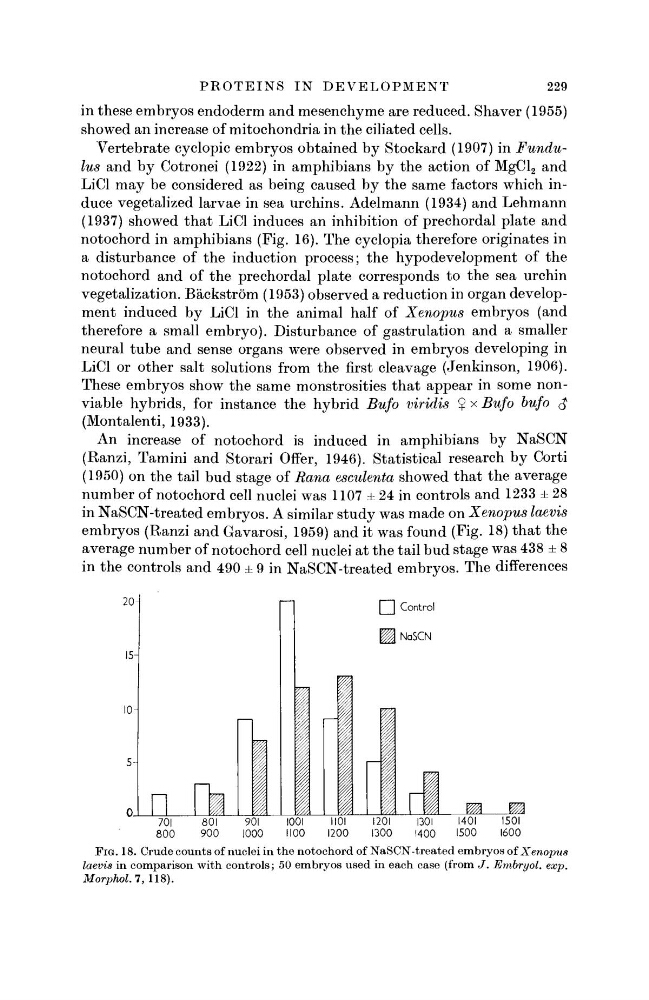
in NaSCN-treated embryos. A similar study was made on Xenopus laevis
embryos (Ranzi and Gavarosi, 1959) and it was found (Fig. 18) that the
average number of notochord cell nuclei at the tail bud stage was 438 ± 8
in the controls and 490 ± 9 in NaSCN-treated embryos. The differences
20
n
m
m m
n
Q Control
NaSCN
m
701
800
801
900
901
1000
1001
1100
1101
1200
1201
1300
1301
1400
1401
1500
1501
1600
FIG. 18. Crude counts of nuclei in the notochord of NaSCN-treated embryos of Xenopus
laevis in comparison with controls; 50 embryos used in each case (from J. Embryol. exp.
Morphol.l, 118).
229
in these embryos endoderm and mesenchyme are reduced. Shaver (1955)
showed an increase of mitochondria in the ciliated cells.
Vertebrate cyclopic embryos obtained by Stockard (1907) in Fundulus and by Cotronei (1922) in amphibians by the action of MgCl 2 and
LiCl may be considered as being caused by the same factors which induce vegetalized larvae in sea urchins. Adelmann (1934) and Lehmann
(1937) showed that LiCl induces an inhibition of prechordal plate and
notochord in amphibians (Fig. 16). The cyclopia therefore originates in
a disturbance of the induction process; the hypodevelopment of the
notochord and of the prechordal plate corresponds to the sea urchin
vegetalization. Bäckström (1953) observed a reduction in organ development induced by LiCl in the animal half of Xenopus embryos (and
therefore a small embryo). Disturbance of gastrulation and a smaller
neural tube and sense organs were observed in embryos developing in
LiCl or other salt solutions from the first cleavage (Jenkinson, 1906).
These embryos show the same monstrosities that appear in some nonviable hybrids, for instance the hybrid Bufo viridis ? x Bufo bufo $
(Montalenti, 1933).
An increase of notochord is induced in amphibians by NaSCN
(Ranzi, Tamini and Storari Offer, 1946). Statistical research by Corti
(1950) on the tail bud stage of Rana esculenta showed that the average
number of notochord cell nuclei was 1107 =t 24 in controls and 1233 ± 28
in NaSCN-treated embryos. A similar study was made on Xenopus laevis
embryos (Ranzi and Gavarosi, 1959) and it was found (Fig. 18) that the
average number of notochord cell nuclei at the tail bud stage was 438 ± 8
in the controls and 490 ± 9 in NaSCN-treated embryos. The differences
20
n
m
m m
n
Q Control
NaSCN
m
701
800
801
900
901
1000
1001
1100
1101
1200
1201
1300
1301
1400
1401
1500
1501
1600
FIG. 18. Crude counts of nuclei in the notochord of NaSCN-treated embryos of Xenopus
laevis in comparison with controls; 50 embryos used in each case (from J. Embryol. exp.
Morphol.l, 118).