

226
SILVIO RANZI
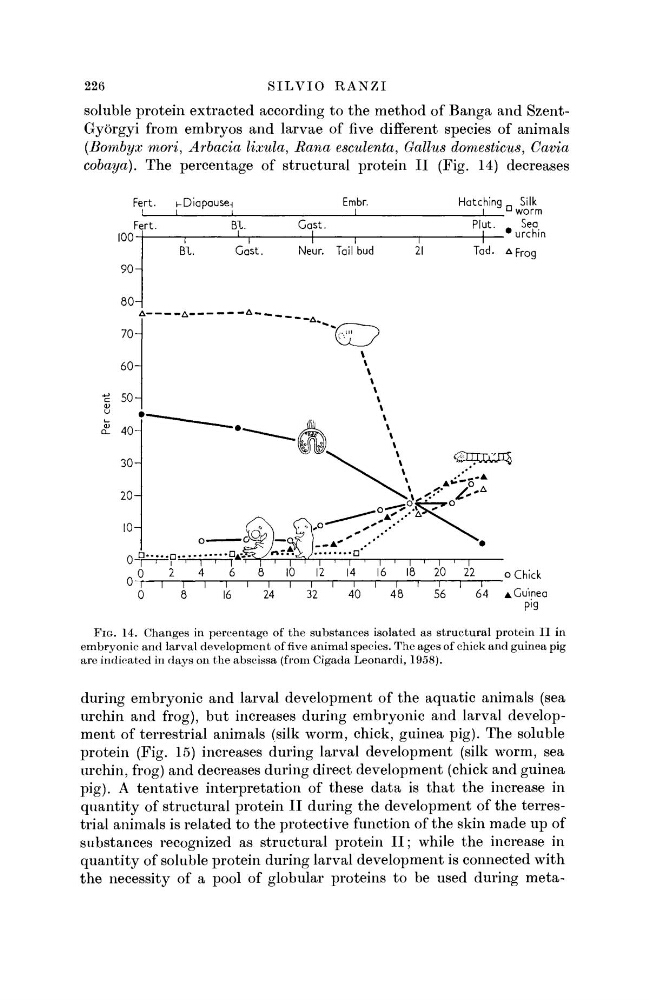
soluble protein extracted according to the method of Banga and SzentGyörgyi from embryos and larvae of five different species of animals
(Bombyx mori, Arbacia lixula, Bana esculenta, Gallus domesticus, Cavia
cobaya). The percentage of structural protein II (Fig. 14) decreases
Fe
Fe
ΙΛΛ—1
IUU
9 0 -
8 0 -
rt.
rt.
hDiapausen
1
I
Bl.
1
1
1
Bl.
Gast.
Gast.
I
1
Neun
Embr.
1
I
Tail bud
1
21
Hatching
1
°
Plut. _
1
·
1
Tad. Δ
Silk
worm
Sea
urchin
Frog
tgznj&SQ
21
o Chick
"1
64
AGumea
P'9
FIG. 14. Changes in percentage of the substances isolated as structural protein II in
embryonic and larval development of five animal species. The ages of chick and guinea pig
are indicated in days on the abscissa (from Cigada Leonardi, 1958).
during embryonic and larval development of the aquatic animals (sea
urchin and frog), but increases during embryonic and larval development of terrestrial animals (silk worm, chick, guinea pig). The soluble
protein (Fig. 15) increases during larval development (silk worm, sea
urchin, frog) and decreases during direct development (chick and guinea
pig). A tentative interpretation of these data is that the increase in
quantity of structural protein II during the development of the terrestrial animals is related to the protective function of the skin made up of
substances recognized as structural protein I I ; while the increase in
quantity of soluble protein during larval development is connected with
the necessity of a pool of globular proteins to be used during meta-
SILVIO RANZI
soluble protein extracted according to the method of Banga and SzentGyörgyi from embryos and larvae of five different species of animals
(Bombyx mori, Arbacia lixula, Bana esculenta, Gallus domesticus, Cavia
cobaya). The percentage of structural protein II (Fig. 14) decreases
Fe
Fe
ΙΛΛ—1
IUU
9 0 -
8 0 -
rt.
rt.
hDiapausen
1
I
Bl.
1
1
1
Bl.
Gast.
Gast.
I
1
Neun
Embr.
1
I
Tail bud
1
21
Hatching
1
°
Plut. _
1
·
1
Tad. Δ
Silk
worm
Sea
urchin
Frog
tgznj&SQ
21
o Chick
"1
64
AGumea
P'9
FIG. 14. Changes in percentage of the substances isolated as structural protein II in
embryonic and larval development of five animal species. The ages of chick and guinea pig
are indicated in days on the abscissa (from Cigada Leonardi, 1958).
during embryonic and larval development of the aquatic animals (sea
urchin and frog), but increases during embryonic and larval development of terrestrial animals (silk worm, chick, guinea pig). The soluble
protein (Fig. 15) increases during larval development (silk worm, sea
urchin, frog) and decreases during direct development (chick and guinea
pig). A tentative interpretation of these data is that the increase in
quantity of structural protein II during the development of the terrestrial animals is related to the protective function of the skin made up of
substances recognized as structural protein I I ; while the increase in
quantity of soluble protein during larval development is connected with
the necessity of a pool of globular proteins to be used during meta-