

224
S I L V I O R A N Z I
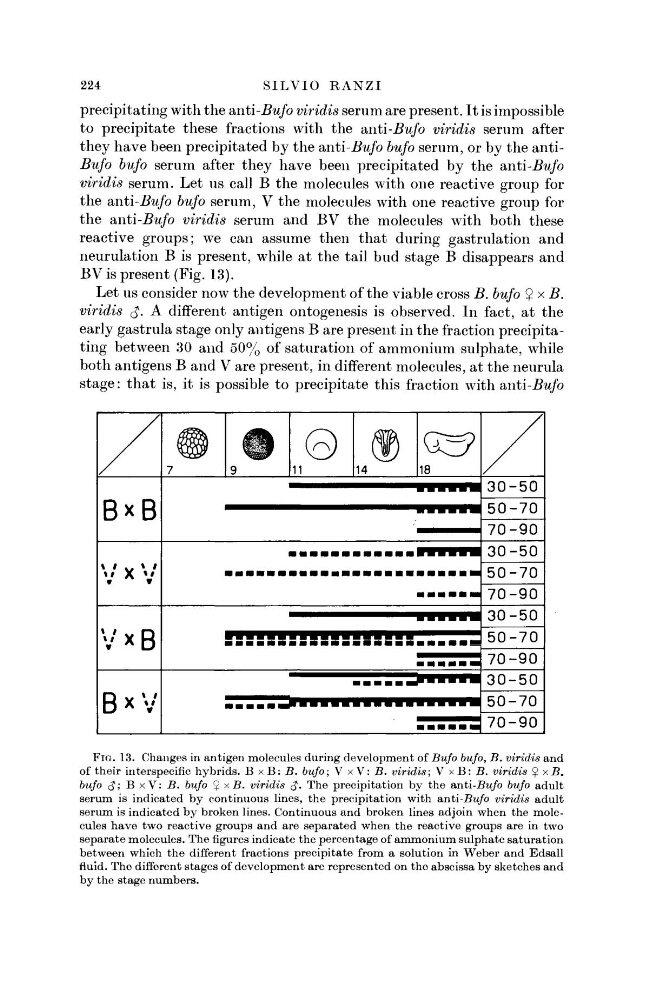
precipitating with the anti-Bufo viridis serum are present. It is impossible
to precipitate these fractions with the smti-Bufo viridis serum after
they have been precipitated by the a,nti-Bufo bufo serum, or by the antiBufo bufo serum after they have been precipitated by the smti-Bufo
viridis serum. Let us call B the molecules with one reactive group for
the smti-Bufo bufo serum, V the molecules with one reactive group for
the a>nti-Bufo viridis serum and BV the molecules with both these
reactive groups; we can assume then that during gastrulation and
neurulation B is present, while at the tail bud stage B disappears and
BV is present (Fig. 13).
Let us consider now the development of the viable cross B. bufo ? x 1?.
viridis <$. A different antigen ontogenesis is observed. In fact, at the
early gastrula stage only antigens B are present in the fraction precipitating between 30 and 50% of saturation of ammonium sulphate, while
both antigens B and V are present, in different molecules, at the neurula
stage: that is, it is possible to precipitate this fraction with smti-Bufo
FIG. 13. Changes in antigen molecules during development of Bufo bufo, B. viridis and
of their interspecific hybrids. B x B : B. bufo; V x V : B . viridis; V x B : B. viridis $ x B.
bufo <$; B x V : B. bufo $ x B. viridis $, The precipitation by the anti-Bufo bufo adult
serum is indicated by continuous lines, the precipitation with anti-Bufo viridis adult
serum is indicated by broken lines. Continuous and broken lines adjoin when the molecules have two reactive groups and are separated when the reactive groups are in two
separate molecules. The figures indicate the percentage of ammonium sulphate saturation
between which the different fractions precipitate from a solution in Weber and Edsall
fluid. The different stages of development are represented on the abscissa by sketches and
by the stage numbers.
S I L V I O R A N Z I
precipitating with the anti-Bufo viridis serum are present. It is impossible
to precipitate these fractions with the smti-Bufo viridis serum after
they have been precipitated by the a,nti-Bufo bufo serum, or by the antiBufo bufo serum after they have been precipitated by the smti-Bufo
viridis serum. Let us call B the molecules with one reactive group for
the smti-Bufo bufo serum, V the molecules with one reactive group for
the a>nti-Bufo viridis serum and BV the molecules with both these
reactive groups; we can assume then that during gastrulation and
neurulation B is present, while at the tail bud stage B disappears and
BV is present (Fig. 13).
Let us consider now the development of the viable cross B. bufo ? x 1?.
viridis <$. A different antigen ontogenesis is observed. In fact, at the
early gastrula stage only antigens B are present in the fraction precipitating between 30 and 50% of saturation of ammonium sulphate, while
both antigens B and V are present, in different molecules, at the neurula
stage: that is, it is possible to precipitate this fraction with smti-Bufo
FIG. 13. Changes in antigen molecules during development of Bufo bufo, B. viridis and
of their interspecific hybrids. B x B : B. bufo; V x V : B . viridis; V x B : B. viridis $ x B.
bufo <$; B x V : B. bufo $ x B. viridis $, The precipitation by the anti-Bufo bufo adult
serum is indicated by continuous lines, the precipitation with anti-Bufo viridis adult
serum is indicated by broken lines. Continuous and broken lines adjoin when the molecules have two reactive groups and are separated when the reactive groups are in two
separate molecules. The figures indicate the percentage of ammonium sulphate saturation
between which the different fractions precipitate from a solution in Weber and Edsall
fluid. The different stages of development are represented on the abscissa by sketches and
by the stage numbers.