

P R O T E I N S I N D E V E L O P M E N T
223
N J
\7ö\
Θ"
1
TO
®
M5 \
\ß
14
)
r
£ö>
fpV}
LY Y
r^V-V^^
rHuuTr
BxB
m Im
1 P
Γ
1 li
0|30|
iU
3050
aTbl
1
a
r
1 r
r
li 1 li
501701 o
m 2
70 90 S
cldle
« >
» 1
%
» # V * '
* <
v Λ v
v
1 l l
| 0 | 3 0
uu
3050
lalb
1
' Γ ■
\ ϊ|ϊ|θ|3(
1
■ "
50
I
70
IS
m 2 φ
7090 S 30 5(
c l d i e l a l t
'xB Β
l l l l l l l
ll
D|50|70
0 3C
o
° Ί
o
1 1 1 1 1 c/)l 1 1 1
D7090
305C
ilcldlelalb
xV
ll ll ll
|50|70
1111°
°> o
17090
Icldlel
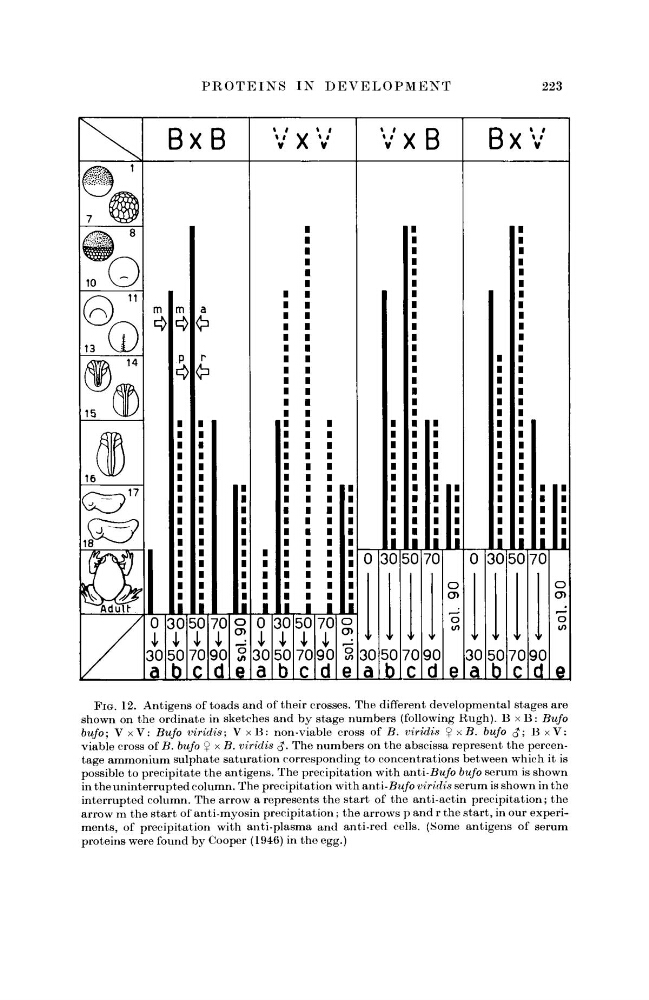
FIG. 12. Antigens of toads and of their crosses. The different developmental stages are
shown on the ordinate in sketches and by stage numbers (following Rugh). B x B : Bufo
bufo; V x V : Bufo viridis; V x B : non-viable cross of B. viridis $ x B. bufo <$; Β x V :
viable cross of B. bufo $ x f i . viridis <$. The numbers on the abscissa represent the percentage ammonium sulphate saturation corresponding to concentrations between which it is
possible to precipitate the antigens. The precipitation with anti-Bufo bufo serum is shown
in the uninterrupted column. The precipitation with anti-Bufo viridis serum is shown in the
interrupted column. The arrow a represents the start of the anti-actin precipitation; the
arrow m the start of anti-myosin precipitation; the arrows p and r the start, in our experiments, of precipitation with anti-plasma and anti-red cells. (Some antigens of serum
proteins were found by Cooper (1946) in the egg.)
223
N J
\7ö\
Θ"
1
TO
®
M5 \
\ß
14
)
r
£ö>
fpV}
LY Y
r^V-V^^
rHuuTr
BxB
m Im
1 P
Γ
1 li
0|30|
iU
3050
aTbl
1
a
r
1 r
r
li 1 li
501701 o
m 2
70 90 S
cldle
« >
» 1
%
» # V * '
* <
v Λ v
v
1 l l
| 0 | 3 0
uu
3050
lalb
1
' Γ ■
\ ϊ|ϊ|θ|3(
1
■ "
50
I
70
IS
m 2 φ
7090 S 30 5(
c l d i e l a l t
'xB Β
l l l l l l l
ll
D|50|70
0 3C
o
° Ί
o
1 1 1 1 1 c/)l 1 1 1
D7090
305C
ilcldlelalb
xV
ll ll ll
|50|70
1111°
°> o
17090
Icldlel
FIG. 12. Antigens of toads and of their crosses. The different developmental stages are
shown on the ordinate in sketches and by stage numbers (following Rugh). B x B : Bufo
bufo; V x V : Bufo viridis; V x B : non-viable cross of B. viridis $ x B. bufo <$; Β x V :
viable cross of B. bufo $ x f i . viridis <$. The numbers on the abscissa represent the percentage ammonium sulphate saturation corresponding to concentrations between which it is
possible to precipitate the antigens. The precipitation with anti-Bufo bufo serum is shown
in the uninterrupted column. The precipitation with anti-Bufo viridis serum is shown in the
interrupted column. The arrow a represents the start of the anti-actin precipitation; the
arrow m the start of anti-myosin precipitation; the arrows p and r the start, in our experiments, of precipitation with anti-plasma and anti-red cells. (Some antigens of serum
proteins were found by Cooper (1946) in the egg.)