

PROTEINS IN DEVELOPMENT
221
during cleavage, the extracted proteins precipitate at an increasingly
lower ammonium sulphate concentration. The maximum absorption
corresponds to the fractions which precipitate at 65% in the unfertilized
egg and 60% in the fertilized egg. During cleavage, precipitation occurs
at lower and lower concentrations, reaching 50% of saturation at the
end of the cleavage. During gastrulation, the salting-out pattern does
not change much. Neurulation, tadpole development, and metamorphosis are characterized by gradual increases in the proteins which
precipitate at low and high ammonium sulphate concentrations. The
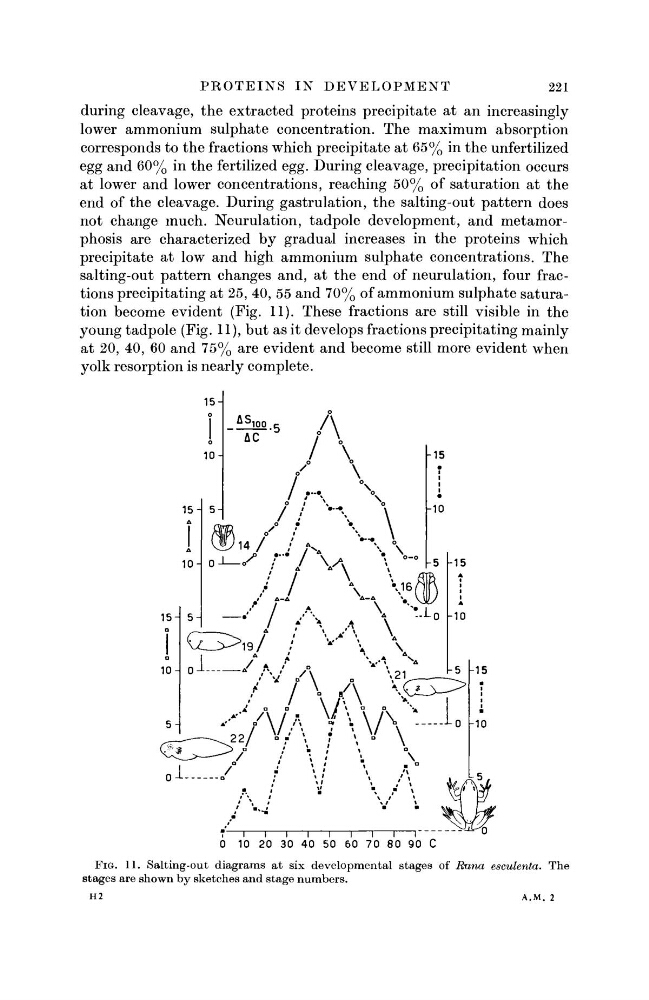
salting-out pattern changes and, at the end of neurulation, four fractions precipitating at 25, 40, 55 and 70% of ammonium sulphate saturation become evident (Fig. 11). These fractions are still visible in the
young tadpole (Fig. 11), but as it develops fractions precipitating mainly
at 20, 40, 60 and 75% are evident and become still more evident when
yolk resorption is nearly complete.
15
10
15 H 5-\
15
10
AS 100
AC
o
5
Λ
/
\
o $
\
/ /
\
v
15
h10
\
•J6
5 M5
-In L
\
\
/ /
\
/ r A \ *;
/
A
'
A
A
\
(
^ / / '· S\
\
/
A
/ \ A
H
22/ V / \ Γ \ V \
15
10
7
I
I
I
I
I
I
I
I
0 10 20 30 40 50 60 70 80 90 C
FIG. 11. Salting-out diagrams at six developmental stages of Rana esculenta. The
stages are shown by sketches and stage numbers.
A.M. 2
221
during cleavage, the extracted proteins precipitate at an increasingly
lower ammonium sulphate concentration. The maximum absorption
corresponds to the fractions which precipitate at 65% in the unfertilized
egg and 60% in the fertilized egg. During cleavage, precipitation occurs
at lower and lower concentrations, reaching 50% of saturation at the
end of the cleavage. During gastrulation, the salting-out pattern does
not change much. Neurulation, tadpole development, and metamorphosis are characterized by gradual increases in the proteins which
precipitate at low and high ammonium sulphate concentrations. The
salting-out pattern changes and, at the end of neurulation, four fractions precipitating at 25, 40, 55 and 70% of ammonium sulphate saturation become evident (Fig. 11). These fractions are still visible in the
young tadpole (Fig. 11), but as it develops fractions precipitating mainly
at 20, 40, 60 and 75% are evident and become still more evident when
yolk resorption is nearly complete.
15
10
15 H 5-\
15
10
AS 100
AC
o
5
Λ
/
\
o $
\
/ /
\
v
15
h10
\
•J6
5 M5
-In L
\
\
/ /
\
/ r A \ *;
/
A
'
A
A
\
(
^ / / '· S\
\
/
A
/ \ A
H
22/ V / \ Γ \ V \
15
10
7
I
I
I
I
I
I
I
I
0 10 20 30 40 50 60 70 80 90 C
FIG. 11. Salting-out diagrams at six developmental stages of Rana esculenta. The
stages are shown by sketches and stage numbers.
A.M. 2