

P R O T E I N S I N D E V E L O P M E N T
215
material before lipid extraction (Fig. 2). It was seen to diminish (Fig. 3)
after fertilization up to the pluteus stage. As a percentage of the total N
it was 77-4% in the unfertilized egg, 75-4% in the fertilized egg, 33-2%
in the pluteus, and 37-7% in the adult sea urchin.
The salting-out diagrams of the unfertilized egg show four peaks, at
15, 40, 50 and 70% of ammonium sulphate saturation (Fig. 4). After
fertilization the fraction precipitating at 40% of saturation diminishes,
and the fraction precipitating at 50% of saturation increases. The
salting-out diagrams of the cleavage stage are identical.
In the salting-out diagrams of the hatching blastula one fraction
precipitating between 45 and 60% of ammonium sulphate saturation
(P x ) and another fraction precipitating between 70 and 90% of saturation (P 2 ) can be recognized (Fig. 4). These fractions are synthesized
during development inside the egg envelope up to the stage of the hatching blastula. The material for this process is supplied by the fraction
having a peak at 40% of saturation, which decreases considerably in
amount. The later development is characterized by the appearance of
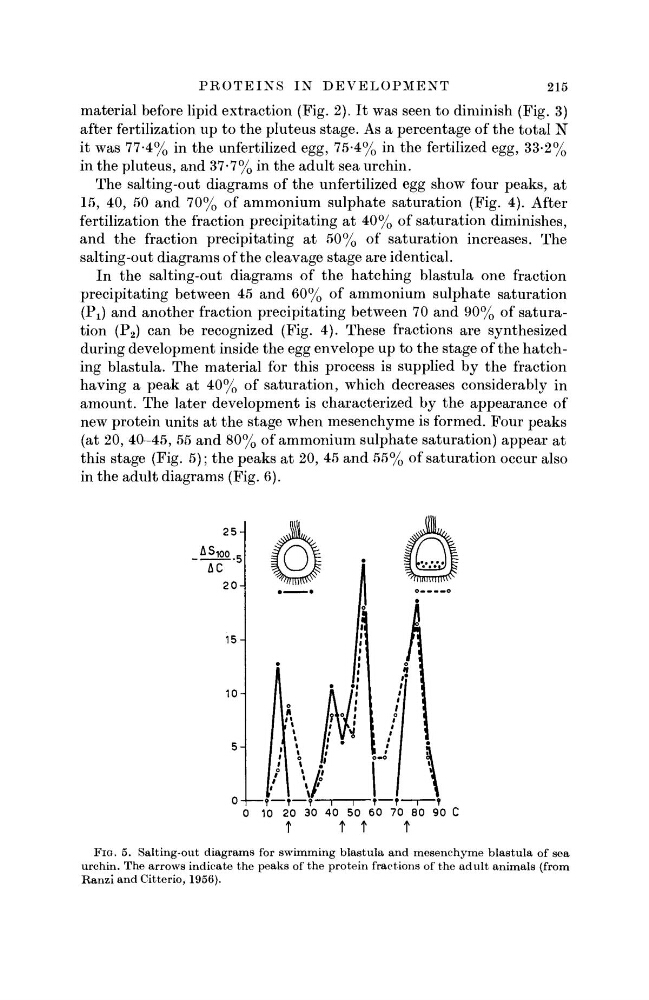
new protein units at the stage when mesenchyme is formed. Four peaks
(at 20, 40-45, 55 and 80% of ammonium sulphate saturation) appear at
this stage (Fig. 5); the peaks at 20, 45 and 55% of saturation occur also
in the adult diagrams (Fig. 6).
25
ASK)Q
AC
2 0 H
15H
10
- ? — T — ?
0 10 20 30 40 50 60 70 80
t
t t
t
FIG. 5. Salting-out diagrams for swimming blastula and mesenchyme blastula of sea
urchin. The arrows indicate the peaks of the protein fractions of the adult animals (from
Ranzi and Citterio, 1956).
215
material before lipid extraction (Fig. 2). It was seen to diminish (Fig. 3)
after fertilization up to the pluteus stage. As a percentage of the total N
it was 77-4% in the unfertilized egg, 75-4% in the fertilized egg, 33-2%
in the pluteus, and 37-7% in the adult sea urchin.
The salting-out diagrams of the unfertilized egg show four peaks, at
15, 40, 50 and 70% of ammonium sulphate saturation (Fig. 4). After
fertilization the fraction precipitating at 40% of saturation diminishes,
and the fraction precipitating at 50% of saturation increases. The
salting-out diagrams of the cleavage stage are identical.
In the salting-out diagrams of the hatching blastula one fraction
precipitating between 45 and 60% of ammonium sulphate saturation
(P x ) and another fraction precipitating between 70 and 90% of saturation (P 2 ) can be recognized (Fig. 4). These fractions are synthesized
during development inside the egg envelope up to the stage of the hatching blastula. The material for this process is supplied by the fraction
having a peak at 40% of saturation, which decreases considerably in
amount. The later development is characterized by the appearance of
new protein units at the stage when mesenchyme is formed. Four peaks
(at 20, 40-45, 55 and 80% of ammonium sulphate saturation) appear at
this stage (Fig. 5); the peaks at 20, 45 and 55% of saturation occur also
in the adult diagrams (Fig. 6).
25
ASK)Q
AC
2 0 H
15H
10
- ? — T — ?
0 10 20 30 40 50 60 70 80
t
t t
t
FIG. 5. Salting-out diagrams for swimming blastula and mesenchyme blastula of sea
urchin. The arrows indicate the peaks of the protein fractions of the adult animals (from
Ranzi and Citterio, 1956).