

THE ACRASINA
161
and advance just as they would do in a stream. Bonner (1959a), while
agreeing about the basic similarity of locomotion in these two bodies,
also suggests that the forward movement of cells in a grex, both lying
and standing, 'depends upon each cell pushing out slime sheath material
at its posterior end'. However attractive symbolically we may find the
idea of a population of jet-propelled amoebae, each discharging its
afflatus in the face of the one behind it, mechanically it is not quite
so satisfactory. A cell thrusting itself forward in this way would push
the one behind it backward, as well as tending to disorient it. Continued
secretion of slime would drive the cells apart, and they could no longer
be guided by contact following. Electron microscopy shows that the
cells in fact cling very closely together despite irregularities of the surfaces. And streams of all sizes manage to flow along without making
slime sheath.
As for the 'transverse' cells, it has been suggested that their orientation might be chemotactic. But if so, and the anterior part of the grex
axis in the Dictyosteliidae were a region of increased acrasin production,
one would expect the cells posterior to it to elongate towards it, particularly in a slug; this has not been described. Moreover, in Actyostelium,
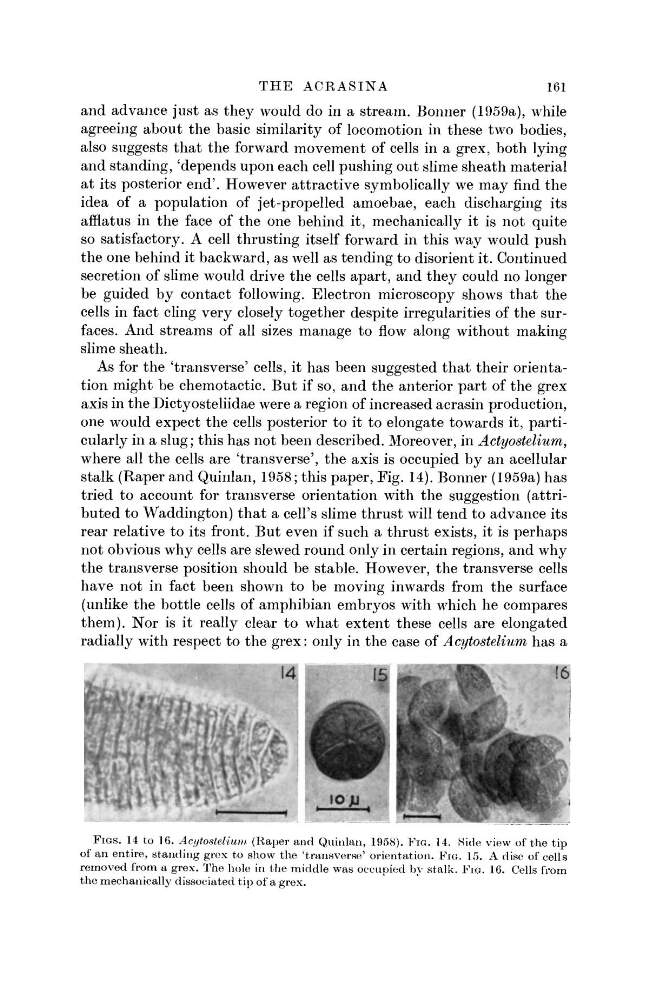
where all the cells are 'transverse', the axis is occupied by an acellular
stalk (Raper and Quinlan, 1958; this paper, Fig. 14). Bonner (1959a) has
tried to account for transverse orientation with the suggestion (attributed to Waddington) that a cell's slime thrust will tend to advance its
rear relative to its front. But even if such a thrust exists, it is perhaps
not obvious why cells are slewed round only in certain regions, and why
the transverse position should be stable. However, the transverse cells
have not in fact been shown to be moving inwards from the surface
(unlike the bottle cells of amphibian embryos with which he compares
them). Nor is it really clear to what extent these cells are elongated
radially with respect to the grex: only in the case of Acytostelium has a
FIGS. 14 to 16. Acytostelium (Raper and Quinlan, 1958). FIG. 14. Side view of the tip
of an entire, standing grex to show the 'transverse' orientation. FIG. 15. A disc of cells
removed from a grex. The hole in the middle was occupied by stalk. FIG. 16. Cells from
the mechanically dissociated tip of a grex.
161
and advance just as they would do in a stream. Bonner (1959a), while
agreeing about the basic similarity of locomotion in these two bodies,
also suggests that the forward movement of cells in a grex, both lying
and standing, 'depends upon each cell pushing out slime sheath material
at its posterior end'. However attractive symbolically we may find the
idea of a population of jet-propelled amoebae, each discharging its
afflatus in the face of the one behind it, mechanically it is not quite
so satisfactory. A cell thrusting itself forward in this way would push
the one behind it backward, as well as tending to disorient it. Continued
secretion of slime would drive the cells apart, and they could no longer
be guided by contact following. Electron microscopy shows that the
cells in fact cling very closely together despite irregularities of the surfaces. And streams of all sizes manage to flow along without making
slime sheath.
As for the 'transverse' cells, it has been suggested that their orientation might be chemotactic. But if so, and the anterior part of the grex
axis in the Dictyosteliidae were a region of increased acrasin production,
one would expect the cells posterior to it to elongate towards it, particularly in a slug; this has not been described. Moreover, in Actyostelium,
where all the cells are 'transverse', the axis is occupied by an acellular
stalk (Raper and Quinlan, 1958; this paper, Fig. 14). Bonner (1959a) has
tried to account for transverse orientation with the suggestion (attributed to Waddington) that a cell's slime thrust will tend to advance its
rear relative to its front. But even if such a thrust exists, it is perhaps
not obvious why cells are slewed round only in certain regions, and why
the transverse position should be stable. However, the transverse cells
have not in fact been shown to be moving inwards from the surface
(unlike the bottle cells of amphibian embryos with which he compares
them). Nor is it really clear to what extent these cells are elongated
radially with respect to the grex: only in the case of Acytostelium has a
FIGS. 14 to 16. Acytostelium (Raper and Quinlan, 1958). FIG. 14. Side view of the tip
of an entire, standing grex to show the 'transverse' orientation. FIG. 15. A disc of cells
removed from a grex. The hole in the middle was occupied by stalk. FIG. 16. Cells from
the mechanically dissociated tip of a grex.