

160
B. M. SHAFFER
agglutinate it with homologous antiserum after absorption with all these
mutants.
The clumps formed in roller tubes by various mutant and wild strains
differ characteristically in size and shape (Gerisch, 1960); presumably
this is a manifestation of some aspect of adhesion. Similar, though more
elaborate, differences arise with cells derived from vertebrate embryonic
organs (Moscona, 1961).
V. The Grex
A. The Cells
1. Orientation
Whether travelling over the ground or through the air, a grex,
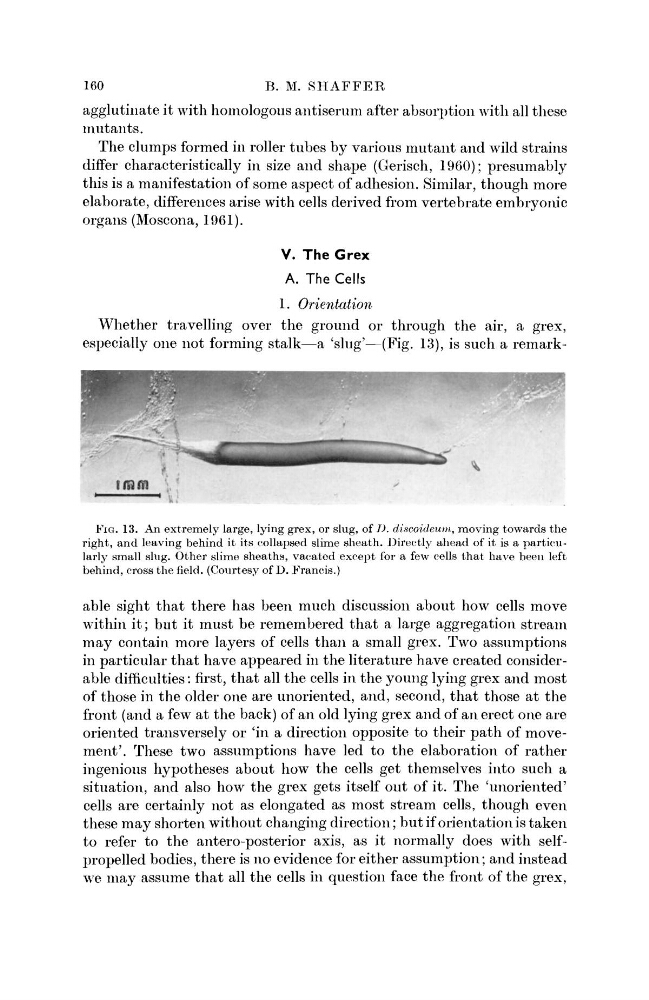
especially one not forming stalk—a 'slug'—(Fig. 13), is such a remark -
FIG. 13. An extremely large, lying grex, or slug, of D. discoideum, moving towards the
right, and leaving behind it its collapsed slime sheath. Directly ahead of it is a particularly small slug. Other slime sheaths, vacated except for a few cells that have been left
behind, cross the field. (Courtesy of D. Francis.)
able sight that there has been much discussion about how cells move
within it; but it must be remembered that a large aggregation stream
may contain more layers of cells than a small grex. Two assumptions
in particular that have appeared in the literature have created considerable difficulties: first, that all the cells in the young lying grex and most
of those in the older one are unoriented, and, second, that those at the
front (and a few at the back) of an old lying grex and of an erect one are
oriented transversely or 'in a direction opposite to their path of movement'. These two assumptions have led to the elaboration of rather
ingenious hypotheses about how the cells get themselves into such a
situation, and also how the grex gets itself out of it. The 'unoriented'
cells are certainly not as elongated as most stream cells, though even
these may shorten without changing direction; but if orientation is taken
to refer to the antero-posterior axis, as it normally does with selfpropelled bodies, there is no evidence for either assumption; and instead
we may assume that all the cells in question face the front of the grex,
B. M. SHAFFER
agglutinate it with homologous antiserum after absorption with all these
mutants.
The clumps formed in roller tubes by various mutant and wild strains
differ characteristically in size and shape (Gerisch, 1960); presumably
this is a manifestation of some aspect of adhesion. Similar, though more
elaborate, differences arise with cells derived from vertebrate embryonic
organs (Moscona, 1961).
V. The Grex
A. The Cells
1. Orientation
Whether travelling over the ground or through the air, a grex,
especially one not forming stalk—a 'slug'—(Fig. 13), is such a remark -
FIG. 13. An extremely large, lying grex, or slug, of D. discoideum, moving towards the
right, and leaving behind it its collapsed slime sheath. Directly ahead of it is a particularly small slug. Other slime sheaths, vacated except for a few cells that have been left
behind, cross the field. (Courtesy of D. Francis.)
able sight that there has been much discussion about how cells move
within it; but it must be remembered that a large aggregation stream
may contain more layers of cells than a small grex. Two assumptions
in particular that have appeared in the literature have created considerable difficulties: first, that all the cells in the young lying grex and most
of those in the older one are unoriented, and, second, that those at the
front (and a few at the back) of an old lying grex and of an erect one are
oriented transversely or 'in a direction opposite to their path of movement'. These two assumptions have led to the elaboration of rather
ingenious hypotheses about how the cells get themselves into such a
situation, and also how the grex gets itself out of it. The 'unoriented'
cells are certainly not as elongated as most stream cells, though even
these may shorten without changing direction; but if orientation is taken
to refer to the antero-posterior axis, as it normally does with selfpropelled bodies, there is no evidence for either assumption; and instead
we may assume that all the cells in question face the front of the grex,