

140
B. M. SHAFFER
What pattern of secretion would account for aggregation? If activity
were inversely related to distance from the centre measured along an
arc of orientation, and if the cells were uniformly distributed along it,
there would be a continuous gradient to guide them. But such a necessarily small differential would easily be upset by local differences in
spacing and by physiological variation in the responses of cells of the
same genotype; and there may in fact be several genotypes present
(Filosa, 1958), and gross changes in density along such an arc. Moreover,
as Bonner (1950) pointed out, a continuous gradient cannot explain
how an area of cells can be circularly polarized, and attempts to demonstrate such a gradient have been unsuccessful.
If instead of extending over the entire field, the gradient is compressed
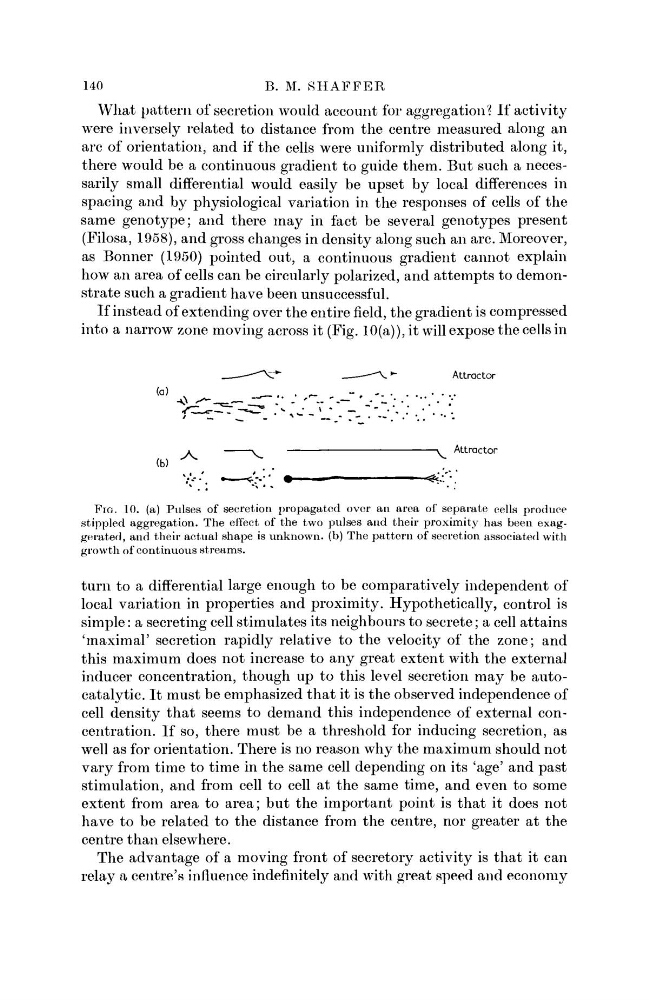
into a narrow zone moving across it (Fig. 10(a)), it will expose the cells in
FIG. 10. (a) Pulses of secretion propagated over an area of separate cells produce
stippled aggregation. The effect of the two pulses and their proximity has been exaggerated, and their actual shape is unknown, (b) The pattern of secretion associated with
growth of continuous streams.
turn to a differential large enough to be comparatively independent of
local variation in properties and proximity. Hypothetically, control is
simple: a secreting cell stimulates its neighbours to secrete; a cell attains
'maximal' secretion rapidly relative to the velocity of the zone; and
this maximum does not increase to any great extent with the external
inducer concentration, though up to this level secretion may be autocatalytic. I t must be emphasized that it is the observed independence of
cell density that seems to demand this independence of external concentration. If so, there must be a threshold for inducing secretion, as
well as for orientation. There is no reason why the maximum should not
vary from time to time in the same cell depending on its 'age' and past
stimulation, and from cell to cell at the same time, and even to some
extent from area to area; but the important point is that it does not
have to be related to the distance from the centre, nor greater at the
centre than elsewhere.
The advantage of a moving front of secretory activity is that it can
relay a centre's influence indefinitely and with great speed and economy
B. M. SHAFFER
What pattern of secretion would account for aggregation? If activity
were inversely related to distance from the centre measured along an
arc of orientation, and if the cells were uniformly distributed along it,
there would be a continuous gradient to guide them. But such a necessarily small differential would easily be upset by local differences in
spacing and by physiological variation in the responses of cells of the
same genotype; and there may in fact be several genotypes present
(Filosa, 1958), and gross changes in density along such an arc. Moreover,
as Bonner (1950) pointed out, a continuous gradient cannot explain
how an area of cells can be circularly polarized, and attempts to demonstrate such a gradient have been unsuccessful.
If instead of extending over the entire field, the gradient is compressed
into a narrow zone moving across it (Fig. 10(a)), it will expose the cells in
FIG. 10. (a) Pulses of secretion propagated over an area of separate cells produce
stippled aggregation. The effect of the two pulses and their proximity has been exaggerated, and their actual shape is unknown, (b) The pattern of secretion associated with
growth of continuous streams.
turn to a differential large enough to be comparatively independent of
local variation in properties and proximity. Hypothetically, control is
simple: a secreting cell stimulates its neighbours to secrete; a cell attains
'maximal' secretion rapidly relative to the velocity of the zone; and
this maximum does not increase to any great extent with the external
inducer concentration, though up to this level secretion may be autocatalytic. I t must be emphasized that it is the observed independence of
cell density that seems to demand this independence of external concentration. If so, there must be a threshold for inducing secretion, as
well as for orientation. There is no reason why the maximum should not
vary from time to time in the same cell depending on its 'age' and past
stimulation, and from cell to cell at the same time, and even to some
extent from area to area; but the important point is that it does not
have to be related to the distance from the centre, nor greater at the
centre than elsewhere.
The advantage of a moving front of secretory activity is that it can
relay a centre's influence indefinitely and with great speed and economy