

T H E A C R A S I N A
139
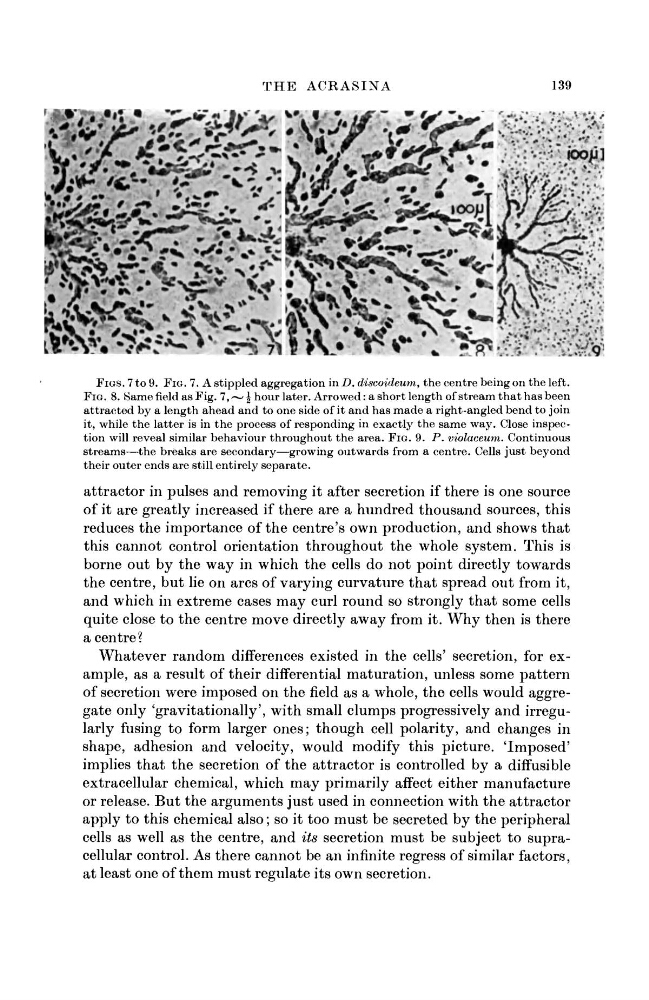
FIGS. 7 to 9. FIG. 7. A stippled aggregation in D. discoideum, the centre being on the left.
FIG. 8. Same field as Fig. 7, ~ J hour later. Arrowed: a short length of stream that has been
attracted by a length ahead and to one side of it and has made a right-angled bend to join
it, while the latter is in the process of responding in exactly the same way. Close inspection will reveal similar behaviour throughout the area. FIG. 9. P. violaceum. Continuous
streams—the breaks are secondary—growing outwards from a centre. Cells just beyond
their outer ends are still entirely separate.
attractor in pulses and removing it after secretion if there is one source
of it are greatly increased if there are a hundred thousand sources, this
reduces the importance of the centre's own production, and shows that
this cannot control orientation throughout the whole system. This is
borne out by the way in which the cells do not point directly towards
the centre, but lie on arcs of varying curvature that spread out from it,
and which in extreme cases may curl round so strongly that some cells
quite close to the centre move directly away from it. Why then is there
a centre?
Whatever random differences existed in the cells' secretion, for example, as a result of their differential maturation, unless some pattern
of secretion were imposed on the field as a whole, the cells would aggregate only 'gravitationally', with small clumps progressively and irregularly fusing to form larger ones; though cell polarity, and changes in
shape, adhesion and velocity, would modify this picture. 'Imposed'
implies that the secretion of the attractor is controlled by a diffusible
extracellular chemical, which may primarily affect either manufacture
or release. But the arguments just used in connection with the attractor
apply to this chemical also; so it too must be secreted by the peripheral
cells as well as the centre, and its secretion must be subject to supracellular control. As there cannot be an infinite regress of similar factors,
at least one of them must regulate its own secretion.
139
FIGS. 7 to 9. FIG. 7. A stippled aggregation in D. discoideum, the centre being on the left.
FIG. 8. Same field as Fig. 7, ~ J hour later. Arrowed: a short length of stream that has been
attracted by a length ahead and to one side of it and has made a right-angled bend to join
it, while the latter is in the process of responding in exactly the same way. Close inspection will reveal similar behaviour throughout the area. FIG. 9. P. violaceum. Continuous
streams—the breaks are secondary—growing outwards from a centre. Cells just beyond
their outer ends are still entirely separate.
attractor in pulses and removing it after secretion if there is one source
of it are greatly increased if there are a hundred thousand sources, this
reduces the importance of the centre's own production, and shows that
this cannot control orientation throughout the whole system. This is
borne out by the way in which the cells do not point directly towards
the centre, but lie on arcs of varying curvature that spread out from it,
and which in extreme cases may curl round so strongly that some cells
quite close to the centre move directly away from it. Why then is there
a centre?
Whatever random differences existed in the cells' secretion, for example, as a result of their differential maturation, unless some pattern
of secretion were imposed on the field as a whole, the cells would aggregate only 'gravitationally', with small clumps progressively and irregularly fusing to form larger ones; though cell polarity, and changes in
shape, adhesion and velocity, would modify this picture. 'Imposed'
implies that the secretion of the attractor is controlled by a diffusible
extracellular chemical, which may primarily affect either manufacture
or release. But the arguments just used in connection with the attractor
apply to this chemical also; so it too must be secreted by the peripheral
cells as well as the centre, and its secretion must be subject to supracellular control. As there cannot be an infinite regress of similar factors,
at least one of them must regulate its own secretion.