

EGG CORTEX IN MORPHOGENESIS
367
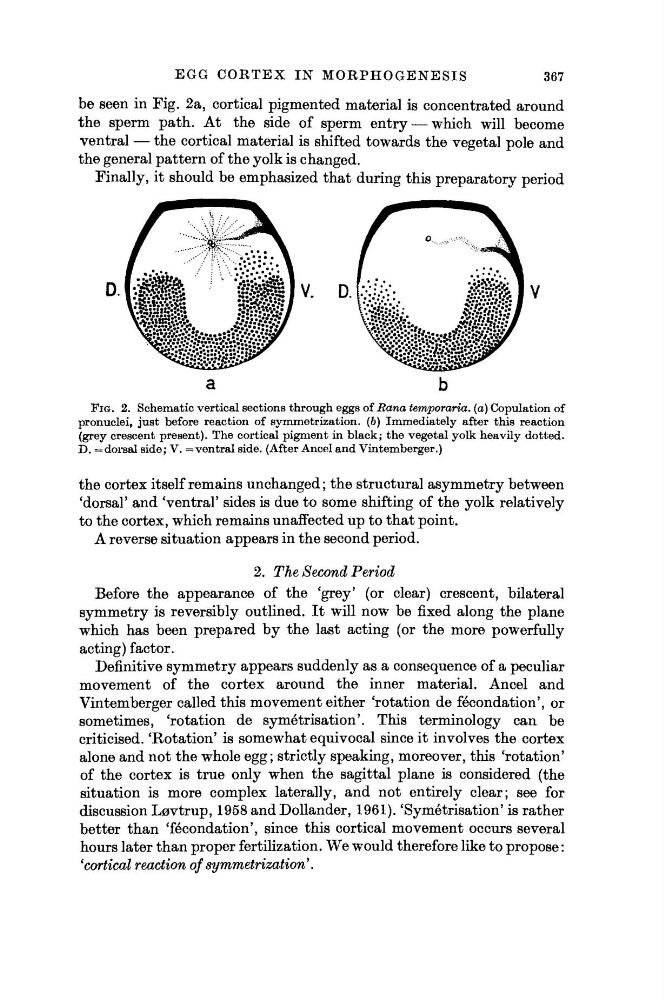
be seen in Fig. 2a, cortical pigmented material is concentrated around
the sperm path. At the side of sperm entry — which will become
ventral — the cortical material is shifted towards the vegetal pole and
the general pattern of the yolk is changed.
Finally, it should be emphasized that during this preparatory period
FIG. 2. Schematic vertical sections through eggs of Rana temporaria. (a) Copulation of
pronuclei, just before reaction of symmetrization. (b) Immediately after this reaction
(grey crescent present). The cortical pigment in black; the vegetal yolk heavily dotted.
D. = dorsal side ; V. = ventral side. (After Ancel and Vintemberger.)
the cortex itself remains unchanged; the structural asymmetry between
'dorsal' and Ventral' sides is due to some shifting of the yolk relatively
to the cortex, which remains unaffected up to that point.
A reverse situation appears in the second period.
Before the appearance of the 'grey' (or clear) crescent, bilateral
symmetry is reversibly outlined. It will now be fixed along the plane
which has been prepared by the last acting (or the more powerfully
acting) factor.
Definitive symmetry appears suddenly as a consequence of a peculiar
movement of the cortex around the inner material. Ancel and
Vintemberger called this movement either 'rotation de fécondation', or
sometimes, 'rotation de symétrisation'. This terminology can be
criticised. 'Rotation' is somewhat equivocal since it involves the cortex
alone and not the whole egg ; strictly speaking, moreover, this 'rotation'
of the cortex is true only when the sagittal plane is considered (the
situation is more complex laterally, and not entirely clear; see for
discussion Lovtrup, 1958 and Dollander, 1961). 'Symétrisation' is rather
better than 'fécondation', since this cortical movement occurs several
hours later than proper fertilization. We would therefore like to propose :
'cortical reaction of
symmetrization\
2. The Second Period
367
be seen in Fig. 2a, cortical pigmented material is concentrated around
the sperm path. At the side of sperm entry — which will become
ventral — the cortical material is shifted towards the vegetal pole and
the general pattern of the yolk is changed.
Finally, it should be emphasized that during this preparatory period
FIG. 2. Schematic vertical sections through eggs of Rana temporaria. (a) Copulation of
pronuclei, just before reaction of symmetrization. (b) Immediately after this reaction
(grey crescent present). The cortical pigment in black; the vegetal yolk heavily dotted.
D. = dorsal side ; V. = ventral side. (After Ancel and Vintemberger.)
the cortex itself remains unchanged; the structural asymmetry between
'dorsal' and Ventral' sides is due to some shifting of the yolk relatively
to the cortex, which remains unaffected up to that point.
A reverse situation appears in the second period.
Before the appearance of the 'grey' (or clear) crescent, bilateral
symmetry is reversibly outlined. It will now be fixed along the plane
which has been prepared by the last acting (or the more powerfully
acting) factor.
Definitive symmetry appears suddenly as a consequence of a peculiar
movement of the cortex around the inner material. Ancel and
Vintemberger called this movement either 'rotation de fécondation', or
sometimes, 'rotation de symétrisation'. This terminology can be
criticised. 'Rotation' is somewhat equivocal since it involves the cortex
alone and not the whole egg ; strictly speaking, moreover, this 'rotation'
of the cortex is true only when the sagittal plane is considered (the
situation is more complex laterally, and not entirely clear; see for
discussion Lovtrup, 1958 and Dollander, 1961). 'Symétrisation' is rather
better than 'fécondation', since this cortical movement occurs several
hours later than proper fertilization. We would therefore like to propose :
'cortical reaction of
symmetrization\
2. The Second Period