

366
JEAN J. PASTEELS
Rana esculenta, where it may, if not altered by other factors, correspond
to the definitive symmetry of the embryo (Pasteels 1937, 1938a, b).
Such a type of organization also clearly appeared in the study of
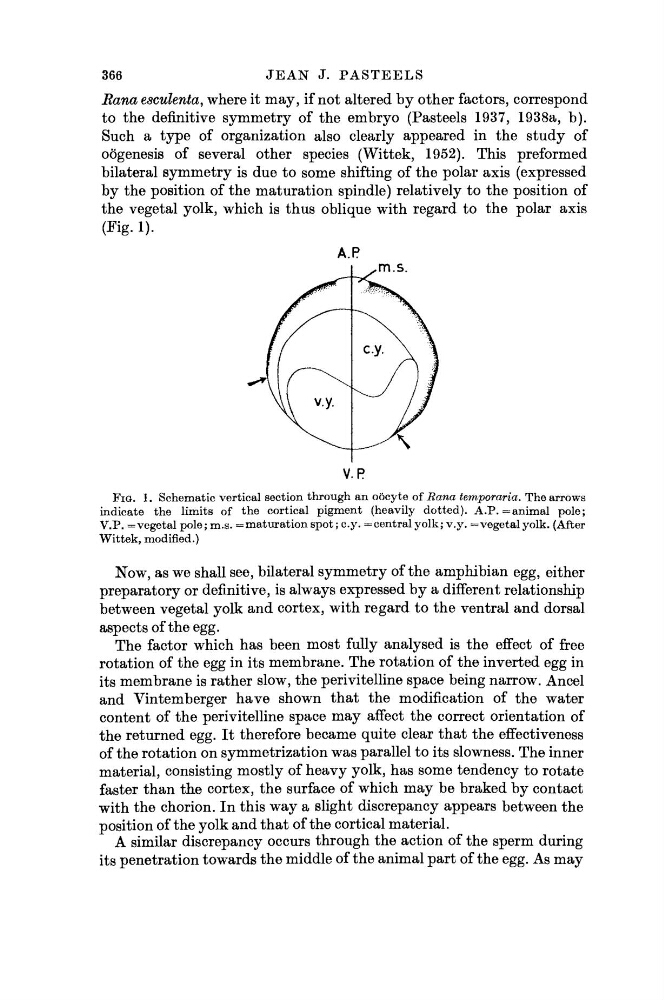
oogenesis of several other species (Wittek, 1952). This preformed
bilateral symmetry is due to some shifting of the polar axis (expressed
by the position of the maturation spindle) relatively to the position of
the vegetal yolk, which is thus oblique with regard to the polar axis
(Fig. 1).
A.P
V.P
FIG. 1. Schematic vertical section through an oocyte of Rana temporaria. The arrows
indicate the limits of the cortical pigment (heavily dotted). A.P. = animal pole;
V.P. =vegetal pole; m.s. =maturation spot; c.y. =central yolk; v.y. = vegetal yolk. (After
Wittek, modified.)
Now, as we shall see, bilateral symmetry of the amphibian egg, either
preparatory or definitive, is always expressed by a different relationship
between vegetal yolk and cortex, with regard to the ventral and dorsal
aspects of the egg.
The factor which has been most fully analysed is the effect of free
rotation of the egg in its membrane. The rotation of the inverted egg in
its membrane is rather slow, the perivitelline space being narrow. Ancel
and Vintemberger have shown that the modification of the water
content of the perivitelline space may affect the correct orientation of
the returned egg. It therefore became quite clear that the effectiveness
of the rotation on symmetrization was parallel to its slowness. The inner
material, consisting mostly of heavy yolk, has some tendency to rotate
faster than the cortex, the surface of which may be braked by contact
with the chorion. In this way a slight discrepancy appears between the
position of the yolk and that of the cortical material.
A similar discrepancy occurs through the action of the sperm during
its penetration towards the middle of the animal part of the egg. As may
JEAN J. PASTEELS
Rana esculenta, where it may, if not altered by other factors, correspond
to the definitive symmetry of the embryo (Pasteels 1937, 1938a, b).
Such a type of organization also clearly appeared in the study of
oogenesis of several other species (Wittek, 1952). This preformed
bilateral symmetry is due to some shifting of the polar axis (expressed
by the position of the maturation spindle) relatively to the position of
the vegetal yolk, which is thus oblique with regard to the polar axis
(Fig. 1).
A.P
V.P
FIG. 1. Schematic vertical section through an oocyte of Rana temporaria. The arrows
indicate the limits of the cortical pigment (heavily dotted). A.P. = animal pole;
V.P. =vegetal pole; m.s. =maturation spot; c.y. =central yolk; v.y. = vegetal yolk. (After
Wittek, modified.)
Now, as we shall see, bilateral symmetry of the amphibian egg, either
preparatory or definitive, is always expressed by a different relationship
between vegetal yolk and cortex, with regard to the ventral and dorsal
aspects of the egg.
The factor which has been most fully analysed is the effect of free
rotation of the egg in its membrane. The rotation of the inverted egg in
its membrane is rather slow, the perivitelline space being narrow. Ancel
and Vintemberger have shown that the modification of the water
content of the perivitelline space may affect the correct orientation of
the returned egg. It therefore became quite clear that the effectiveness
of the rotation on symmetrization was parallel to its slowness. The inner
material, consisting mostly of heavy yolk, has some tendency to rotate
faster than the cortex, the surface of which may be braked by contact
with the chorion. In this way a slight discrepancy appears between the
position of the yolk and that of the cortical material.
A similar discrepancy occurs through the action of the sperm during
its penetration towards the middle of the animal part of the egg. As may