

T H E
A C R A S I N A
303
strong school of t h o u g h t t h a t in Amoeba t h e cell surface slides over t h e
s t a t i o n a r y t u b e a n d travels forwards w i t h t h e cell (e.g., Griffin a n d Allen,
1960; b u t see Goldacre, 1961). This a r r a n g e m e n t would be incompatible
w i t h t h e simple model of t h e aggregate j u s t proposed. I t has, however,
n o w been shown (Shaffer, 1962) t h a t t h e slime-mould a m o e b a is quite
differently organized : t h e g r a n u l a r c y t o p l a s m does not circulate, b u t t h e
cell surface is s t a t i o n a r y along t h e sides, being m a d e anew each t i m e t h e
cell travels its own length. T h u s one cell lying on t o p of a n o t h e r would be
able t o a d v a n c e i n d e p e n d e n t l y of it mechanically, except for 'contact
following' (Vol. 2, p . 136) a n d t h e restrictions discussed below.
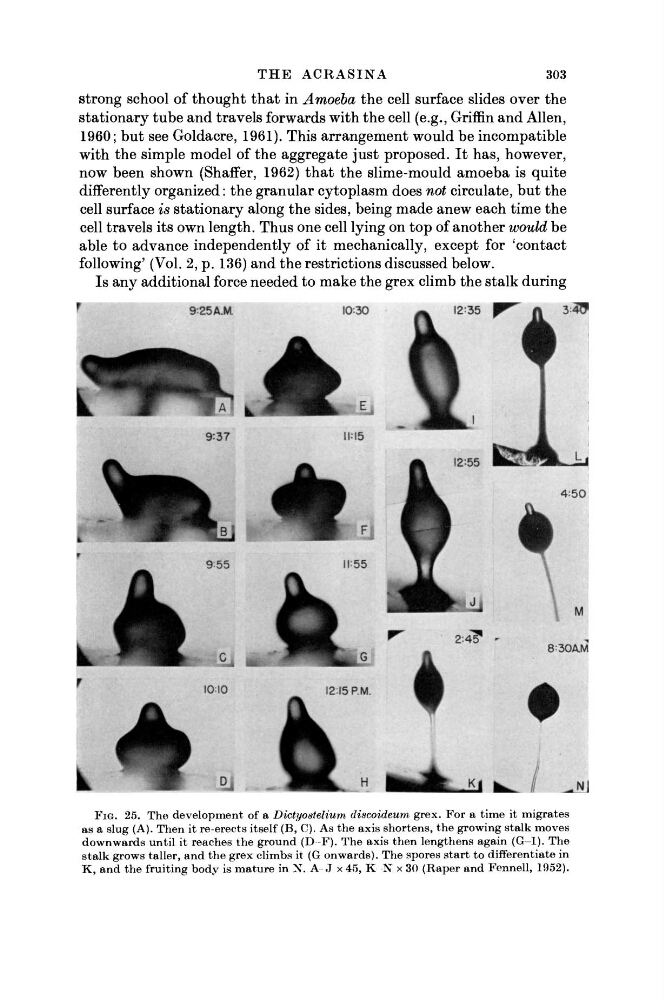
I s a n y additional force needed t o m a k e t h e grex climb t h e stalk during
FIG. 25. The development of a Dictyostelium discoideum grex. For a time it migrates
as a slug (A). Then it re-erects itself (B, C). As the axis shortens, the growing stalk moves
downwards until it reaches the ground (D-F). The axis then lengthens again (G-I). The
stalk grows taller, and the grex climbs it (G onwards). The spores start to differentiate in
K, and the fruiting body is mature in N . A-J χ 45, K - N χ 30 (Raper and Fennell, 1952).
A C R A S I N A
303
strong school of t h o u g h t t h a t in Amoeba t h e cell surface slides over t h e
s t a t i o n a r y t u b e a n d travels forwards w i t h t h e cell (e.g., Griffin a n d Allen,
1960; b u t see Goldacre, 1961). This a r r a n g e m e n t would be incompatible
w i t h t h e simple model of t h e aggregate j u s t proposed. I t has, however,
n o w been shown (Shaffer, 1962) t h a t t h e slime-mould a m o e b a is quite
differently organized : t h e g r a n u l a r c y t o p l a s m does not circulate, b u t t h e
cell surface is s t a t i o n a r y along t h e sides, being m a d e anew each t i m e t h e
cell travels its own length. T h u s one cell lying on t o p of a n o t h e r would be
able t o a d v a n c e i n d e p e n d e n t l y of it mechanically, except for 'contact
following' (Vol. 2, p . 136) a n d t h e restrictions discussed below.
I s a n y additional force needed t o m a k e t h e grex climb t h e stalk during
FIG. 25. The development of a Dictyostelium discoideum grex. For a time it migrates
as a slug (A). Then it re-erects itself (B, C). As the axis shortens, the growing stalk moves
downwards until it reaches the ground (D-F). The axis then lengthens again (G-I). The
stalk grows taller, and the grex climbs it (G onwards). The spores start to differentiate in
K, and the fruiting body is mature in N . A-J χ 45, K - N χ 30 (Raper and Fennell, 1952).