

N U C L E I C A C I D S A N D S U L P H Y D R Y L G R O U P S
257
g r o w t h of t h e zygote, which soon differentiates into rhizoid a n d stalk.
I t should be a d d e d t h a t , according t o P u i s e u x - D a o (1963), certain
details of this classical description of t h e life-cycle of Acetabularia
are
open t o question.
As d e m o n s t r a t e d b y H ä m m e r l i n g (1934), non-nucleated stalks can
survive for several m o n t h s . T h e apical (but n o t t h e m e d i a n or basal)
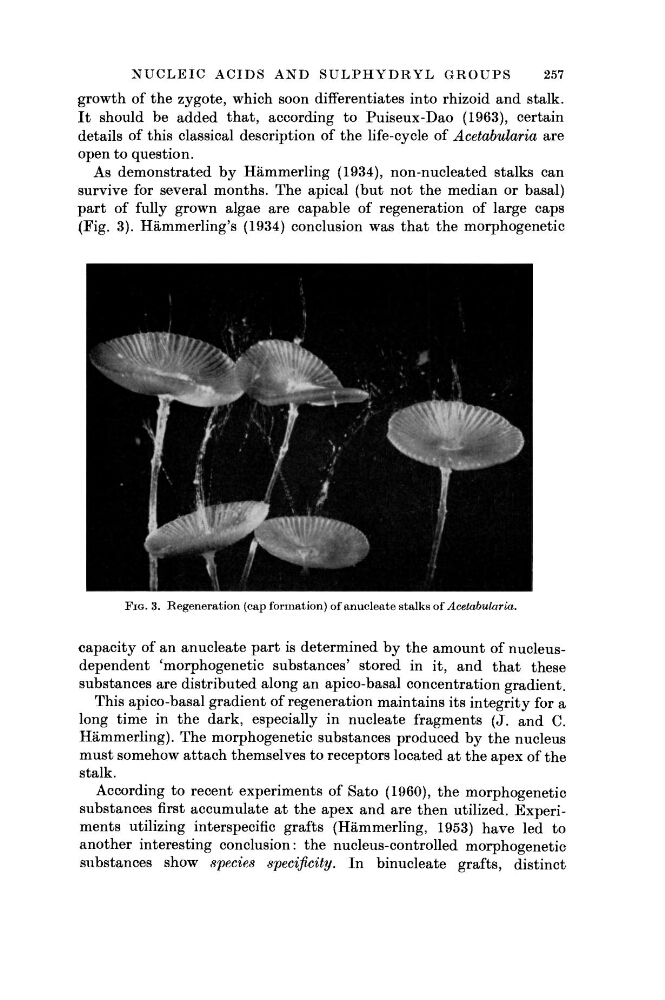
p a r t of fully grown algae are capable of regeneration of large caps
(Fig. 3). H ä m m e r l i n g ' s (1934) conclusion was t h a t t h e morphogenetic
FIG. 3. Regeneration (cap formation) of anucleate stalks of Acetabularia.
c a p a c i t y of a n anucleate p a r t is d e t e r m i n e d b y t h e a m o u n t of nucleusd e p e n d e n t 'morphogenetic substances' stored in it, a n d t h a t these
substances are d i s t r i b u t e d along a n apico-basal concentration gradient.
This apico-basal g r a d i e n t of regeneration m a i n t a i n s its i n t e g r i t y for a
long t i m e in t h e d a r k , especially in nucleate fragments (J. a n d C.
H ä m m e r l i n g ) . T h e morphogenetic substances p r o d u c e d b y t h e nucleus
m u s t somehow a t t a c h themselves t o receptors located a t t h e a p e x of t h e
stalk.
According t o recent e x p e r i m e n t s of S a t o (1960), t h e morphogenetic
substances first a c c u m u l a t e a t t h e a p e x a n d are t h e n utilized. E x p e r i -
m e n t s utilizing interspecific grafts (Hämmerling, 1953) h a v e led t o
a n o t h e r interesting conclusion: t h e nucleus-controlled morphogenetic
substances show species specificity.
I n binucleate grafts, distinct
257
g r o w t h of t h e zygote, which soon differentiates into rhizoid a n d stalk.
I t should be a d d e d t h a t , according t o P u i s e u x - D a o (1963), certain
details of this classical description of t h e life-cycle of Acetabularia
are
open t o question.
As d e m o n s t r a t e d b y H ä m m e r l i n g (1934), non-nucleated stalks can
survive for several m o n t h s . T h e apical (but n o t t h e m e d i a n or basal)
p a r t of fully grown algae are capable of regeneration of large caps
(Fig. 3). H ä m m e r l i n g ' s (1934) conclusion was t h a t t h e morphogenetic
FIG. 3. Regeneration (cap formation) of anucleate stalks of Acetabularia.
c a p a c i t y of a n anucleate p a r t is d e t e r m i n e d b y t h e a m o u n t of nucleusd e p e n d e n t 'morphogenetic substances' stored in it, a n d t h a t these
substances are d i s t r i b u t e d along a n apico-basal concentration gradient.
This apico-basal g r a d i e n t of regeneration m a i n t a i n s its i n t e g r i t y for a
long t i m e in t h e d a r k , especially in nucleate fragments (J. a n d C.
H ä m m e r l i n g ) . T h e morphogenetic substances p r o d u c e d b y t h e nucleus
m u s t somehow a t t a c h themselves t o receptors located a t t h e a p e x of t h e
stalk.
According t o recent e x p e r i m e n t s of S a t o (1960), t h e morphogenetic
substances first a c c u m u l a t e a t t h e a p e x a n d are t h e n utilized. E x p e r i -
m e n t s utilizing interspecific grafts (Hämmerling, 1953) h a v e led t o
a n o t h e r interesting conclusion: t h e nucleus-controlled morphogenetic
substances show species specificity.
I n binucleate grafts, distinct