

256
J E A N B R Ä C H E T
B. Acetabularia
1. Outline of Life-cycle, Cytology,
Regeneration
The biological aspects of the problems raised by studies of Acetabularia
have been very well described by Hämmerling (1953), who was the first
to demonstrate, as early as 1934, the many potentialities of this interesting material. The alga, which is about 2 inches long, is made of a
chloroplast-containing stalk and of rhizoids during most of its life. A
single nucleus, with an extraordinarily developed and basophilic
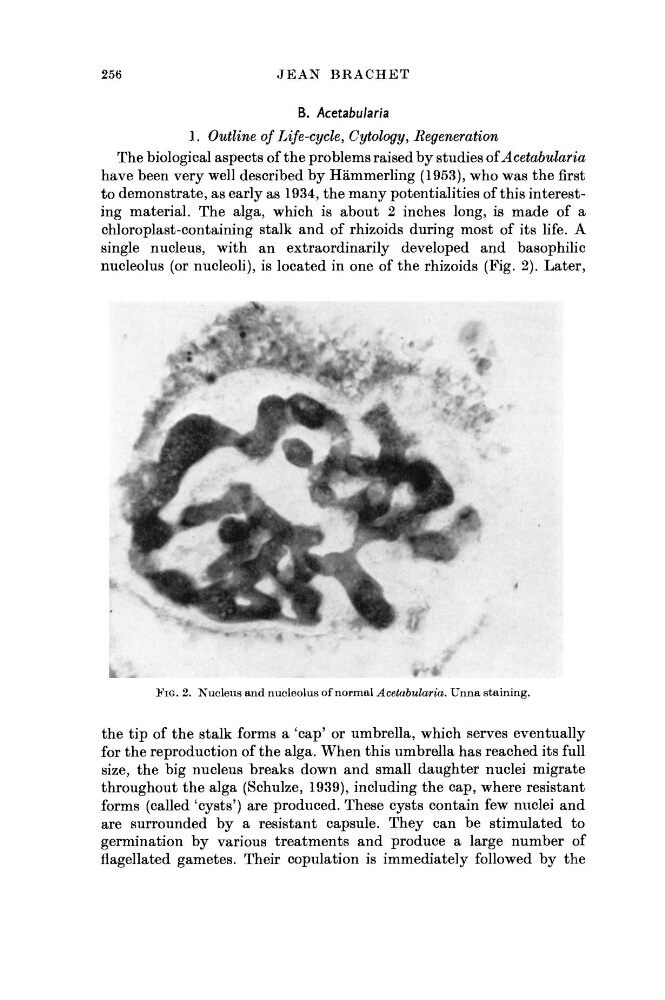
nucleolus (or nucleoli), is located in one of the rhizoids (Fig. 2). Later,
FIG. 2. Nucleus and nucleolus of normal Acetabularia. Unna staining.
the tip of the stalk forms a 'cap' or umbrella, which serves eventually
for the reproduction of the alga. When this umbrella has reached its full
size, the big nucleus breaks down and small daughter nuclei migrate
throughout the alga (Schulze, 1939), including the cap, where resistant
forms (called 'cysts') are produced. These cysts contain few nuclei and
are surrounded by a resistant capsule. They can be stimulated to
germination by various treatments and produce a large number of
flagellated gametes. Their copulation is immediately followed b y the
J E A N B R Ä C H E T
B. Acetabularia
1. Outline of Life-cycle, Cytology,
Regeneration
The biological aspects of the problems raised by studies of Acetabularia
have been very well described by Hämmerling (1953), who was the first
to demonstrate, as early as 1934, the many potentialities of this interesting material. The alga, which is about 2 inches long, is made of a
chloroplast-containing stalk and of rhizoids during most of its life. A
single nucleus, with an extraordinarily developed and basophilic
nucleolus (or nucleoli), is located in one of the rhizoids (Fig. 2). Later,
FIG. 2. Nucleus and nucleolus of normal Acetabularia. Unna staining.
the tip of the stalk forms a 'cap' or umbrella, which serves eventually
for the reproduction of the alga. When this umbrella has reached its full
size, the big nucleus breaks down and small daughter nuclei migrate
throughout the alga (Schulze, 1939), including the cap, where resistant
forms (called 'cysts') are produced. These cysts contain few nuclei and
are surrounded by a resistant capsule. They can be stimulated to
germination by various treatments and produce a large number of
flagellated gametes. Their copulation is immediately followed b y the