

ANIMALIZATION AND VEGETALIZATION
159
B. Vegetalization
Lindahl (1936, 1939), studying the action of lithium on respiration,
undertook the first research on the biochemistry of vegetalization. We
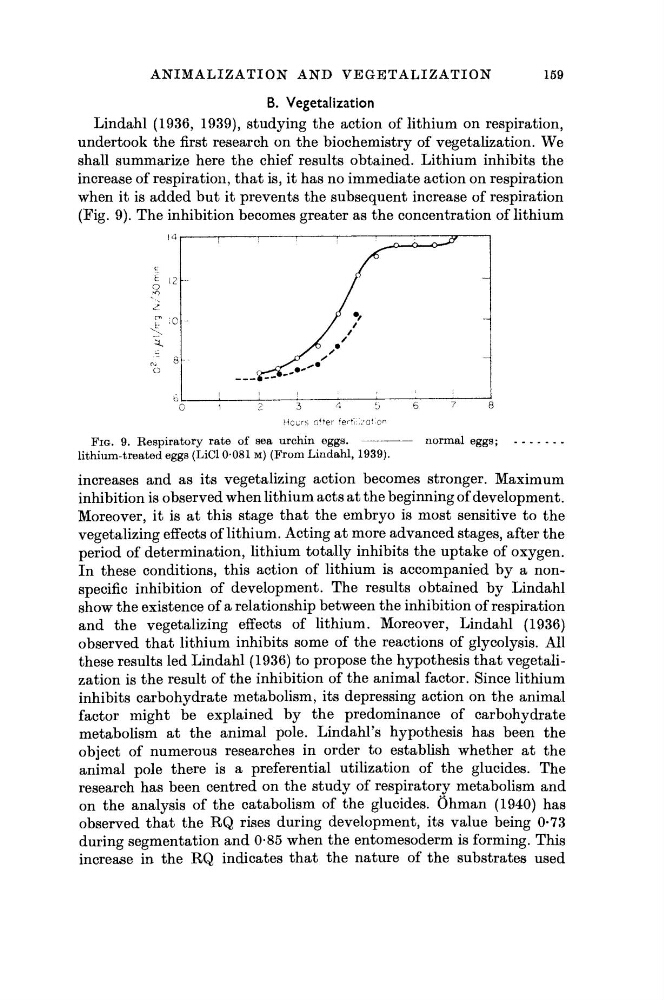
shall summarize here the chief results obtained. Lithium inhibits the
increase of respiration, that is, it has no immediate action on respiration
when it is added but it prevents the subsequent increase of respiration
(Fig. 9). The inhibition becomes greater as the concentration of lithium
0
1
2
3
4
5
6
7
8
Hours after fertilization
FIG. 9. Respiratory rate of sea urchin eggs.
normal eggs;
lithium-treated eggs (LiCl 0-081 M) (From Lindahl, 1939).
increases and as its vegetalizing action becomes stronger. Maximum
inhibition is observed when lithium acts at the beginning of development.
Moreover, it is at this stage that the embryo is most sensitive to the
vegetalizing effects of lithium. Acting at more advanced stages, after the
period of determination, lithium totally inhibits the uptake of oxygen.
In these conditions, this action of lithium is accompanied by a nonspecific inhibition of development. The results obtained by Lindahl
show the existence of a relationship between the inhibition of respiration
and the vegetalizing effects of lithium. Moreover, Lindahl (1936)
observed that lithium inhibits some of the reactions of glycolysis. All
these results led Lindahl (1936) to propose the hypothesis that vegetalization is the result of the inhibition of the animal factor. Since lithium
inhibits carbohydrate metabolism, its depressing action on the animal
factor might be explained by the predominance of carbohydrate
metabolism at the animal pole. Lindahrs hypothesis has been the
object of numerous researches in order to establish whether at the
animal pole there is a preferential utilization of the glucides. The
research has been centred on the study of respiratory metabolism and
on the analysis of the catabolism of the glucides. Öhman (1940) has
observed that the RQ rises during development, its value being 0-73
during segmentation and 0-85 when the entomesoderm is forming. This
increase in the RQ indicates that the nature of the substrates used
159
B. Vegetalization
Lindahl (1936, 1939), studying the action of lithium on respiration,
undertook the first research on the biochemistry of vegetalization. We
shall summarize here the chief results obtained. Lithium inhibits the
increase of respiration, that is, it has no immediate action on respiration
when it is added but it prevents the subsequent increase of respiration
(Fig. 9). The inhibition becomes greater as the concentration of lithium
0
1
2
3
4
5
6
7
8
Hours after fertilization
FIG. 9. Respiratory rate of sea urchin eggs.
normal eggs;
lithium-treated eggs (LiCl 0-081 M) (From Lindahl, 1939).
increases and as its vegetalizing action becomes stronger. Maximum
inhibition is observed when lithium acts at the beginning of development.
Moreover, it is at this stage that the embryo is most sensitive to the
vegetalizing effects of lithium. Acting at more advanced stages, after the
period of determination, lithium totally inhibits the uptake of oxygen.
In these conditions, this action of lithium is accompanied by a nonspecific inhibition of development. The results obtained by Lindahl
show the existence of a relationship between the inhibition of respiration
and the vegetalizing effects of lithium. Moreover, Lindahl (1936)
observed that lithium inhibits some of the reactions of glycolysis. All
these results led Lindahl (1936) to propose the hypothesis that vegetalization is the result of the inhibition of the animal factor. Since lithium
inhibits carbohydrate metabolism, its depressing action on the animal
factor might be explained by the predominance of carbohydrate
metabolism at the animal pole. Lindahrs hypothesis has been the
object of numerous researches in order to establish whether at the
animal pole there is a preferential utilization of the glucides. The
research has been centred on the study of respiratory metabolism and
on the analysis of the catabolism of the glucides. Öhman (1940) has
observed that the RQ rises during development, its value being 0-73
during segmentation and 0-85 when the entomesoderm is forming. This
increase in the RQ indicates that the nature of the substrates used