

158
R. LALLIER
vegetalization. Reciprocally the restoration of the normal type of
gradient allows the development of typical larvae. These observations
thus indicate the existence of close relations between the gradients of
reduction and embryonic development.
V. Respiration and Carbohydrate Catabolism
A. Normal Development
Respiration greatly increases during the development of the sea
urchin egg (Gray, 1927; Lindahl and Öhman, 1938; Borei, 1948).
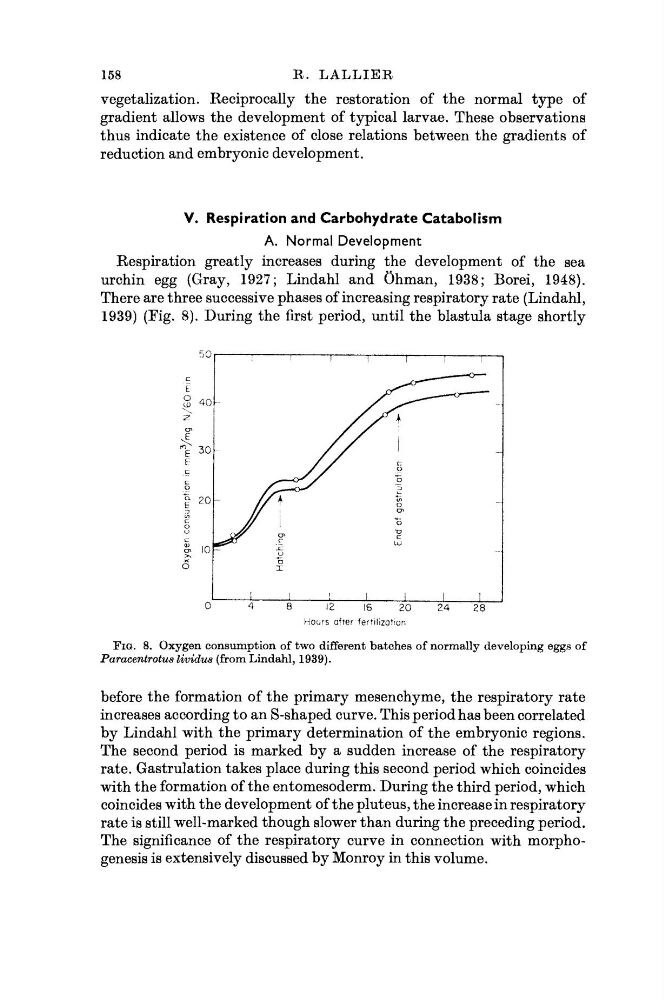
There are three successive phases of increasing respiratory rate (Lindahl,
1939) (Fig. 8). During the first period, until the blastula stage shortly
δ
0
4
8
12
16
20
24
28
Hours after fertilization
FIG. 8. Oxygen consumption of two different batches of normally developing eggs of
Paracentrotus lividus (from Lindahl, 1939).
before the formation of the primary mesenchyme, the respiratory rate
increases according to an S-shaped curve. This period has been correlated
by Lindahl with the primary determination of the embryonic regions.
The second period is marked by a sudden increase of the respiratory
rate. Gastrulation takes place during this second period which coincides
with the formation of the entomesoderm. During the third period, which
coincides with the development of the pluteus, the increase in respiratory
rate is still well-marked though slower than during the preceding period.
The significance of the respiratory curve in connection with morphogenesis is extensively discussed by Monroy in this volume.
R. LALLIER
vegetalization. Reciprocally the restoration of the normal type of
gradient allows the development of typical larvae. These observations
thus indicate the existence of close relations between the gradients of
reduction and embryonic development.
V. Respiration and Carbohydrate Catabolism
A. Normal Development
Respiration greatly increases during the development of the sea
urchin egg (Gray, 1927; Lindahl and Öhman, 1938; Borei, 1948).
There are three successive phases of increasing respiratory rate (Lindahl,
1939) (Fig. 8). During the first period, until the blastula stage shortly
δ
0
4
8
12
16
20
24
28
Hours after fertilization
FIG. 8. Oxygen consumption of two different batches of normally developing eggs of
Paracentrotus lividus (from Lindahl, 1939).
before the formation of the primary mesenchyme, the respiratory rate
increases according to an S-shaped curve. This period has been correlated
by Lindahl with the primary determination of the embryonic regions.
The second period is marked by a sudden increase of the respiratory
rate. Gastrulation takes place during this second period which coincides
with the formation of the entomesoderm. During the third period, which
coincides with the development of the pluteus, the increase in respiratory
rate is still well-marked though slower than during the preceding period.
The significance of the respiratory curve in connection with morphogenesis is extensively discussed by Monroy in this volume.