

EARLY DEVELOPMENT OF THE SEA URCHIN
105
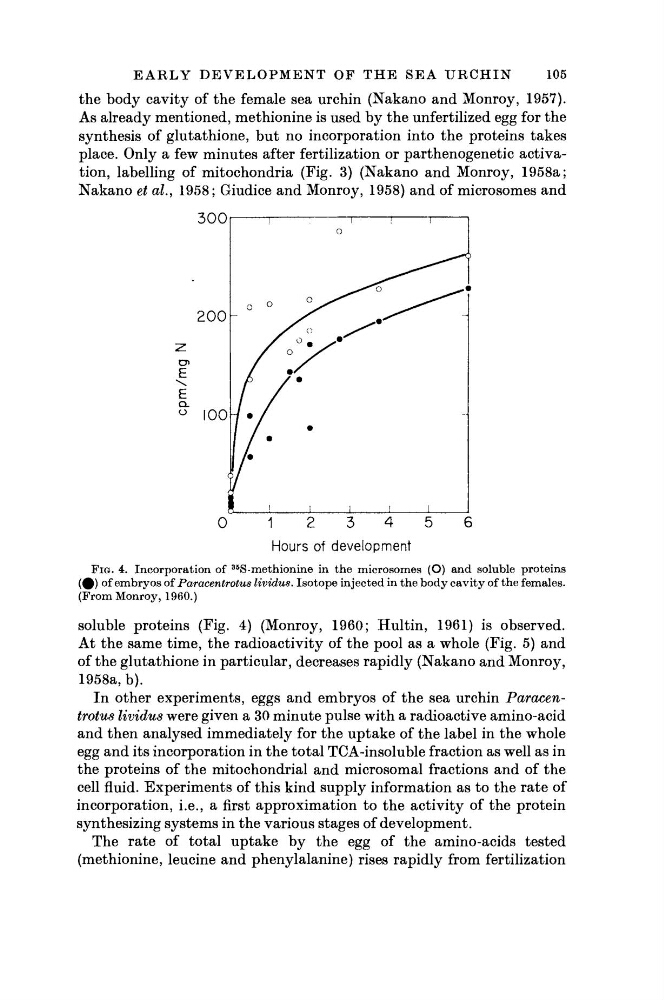
FIG. 4. Incorporation of
35
S-methionine in the microsomes (O) and soluble proteins
(0) of embryos of Paracentrotus lividus. Isotope injected in the body cavity of the females.
(From Monroy, 1960.)
soluble proteins (Fig. 4) (Monroy, 1960; Hultin, 1961) is observed.
At the same time, the radioactivity of the pool as a whole (Fig. 5) and
of the glutathione in particular, decreases rapidly (Nakano and Monroy,
1958a, b).
In other experiments, eggs and embryos of the sea urchin Paracentrotus lividus were given a 30 minute pulse with a radioactive amino-acid
and then analysed immediately for the uptake of the label in the whole
egg and its incorporation in the total TCA-insoluble fraction as well as in
the proteins of the mitochondrial and microsomal fractions and of the
cell fluid. Experiments of this kind supply information as to the rate of
incorporation, i.e., a first approximation to the activity of the protein
synthesizing systems in the various stages of development.
The rate of total uptake by the egg of the amino-acids tested
(methionine, leucine and phenylalanine) rises rapidly from fertilization
300
ο
Hours of development
the body cavity of the female sea urchin (Nakano and Monroy, 1957).
As already mentioned, methionine is used by the unfertilized egg for the
synthesis of glutathione, but no incorporation into the proteins takes
place. Only a few minutes after fertilization or parthenogenetic activation, labelling of mitochondria (Fig. 3) (Nakano and Monroy, 1958a;
Nakano et al., 1958; Giudice and Monroy, 1958) and of microsomes and
105
FIG. 4. Incorporation of
35
S-methionine in the microsomes (O) and soluble proteins
(0) of embryos of Paracentrotus lividus. Isotope injected in the body cavity of the females.
(From Monroy, 1960.)
soluble proteins (Fig. 4) (Monroy, 1960; Hultin, 1961) is observed.
At the same time, the radioactivity of the pool as a whole (Fig. 5) and
of the glutathione in particular, decreases rapidly (Nakano and Monroy,
1958a, b).
In other experiments, eggs and embryos of the sea urchin Paracentrotus lividus were given a 30 minute pulse with a radioactive amino-acid
and then analysed immediately for the uptake of the label in the whole
egg and its incorporation in the total TCA-insoluble fraction as well as in
the proteins of the mitochondrial and microsomal fractions and of the
cell fluid. Experiments of this kind supply information as to the rate of
incorporation, i.e., a first approximation to the activity of the protein
synthesizing systems in the various stages of development.
The rate of total uptake by the egg of the amino-acids tested
(methionine, leucine and phenylalanine) rises rapidly from fertilization
300
ο
Hours of development
the body cavity of the female sea urchin (Nakano and Monroy, 1957).
As already mentioned, methionine is used by the unfertilized egg for the
synthesis of glutathione, but no incorporation into the proteins takes
place. Only a few minutes after fertilization or parthenogenetic activation, labelling of mitochondria (Fig. 3) (Nakano and Monroy, 1958a;
Nakano et al., 1958; Giudice and Monroy, 1958) and of microsomes and