

104
ALBERTO MONROY AND RACHELE
MAGGIO
glycine, proline, glutamic and aspartic acid (Monroy and Vittorelli,
1962). Nevertheless, as long as the egg remains unfertilized these
compounds accumulate in the low molecular pool and no incorporation
at all occurs in the proteins.
A discussion as to the nature of the block is beyond the scope of this
article (see Monroy, 1957b, 1961): it may just suffice to mention that
700
I
I
I
I
I
L
0
2
4
6
10
18
Hours after fertilization
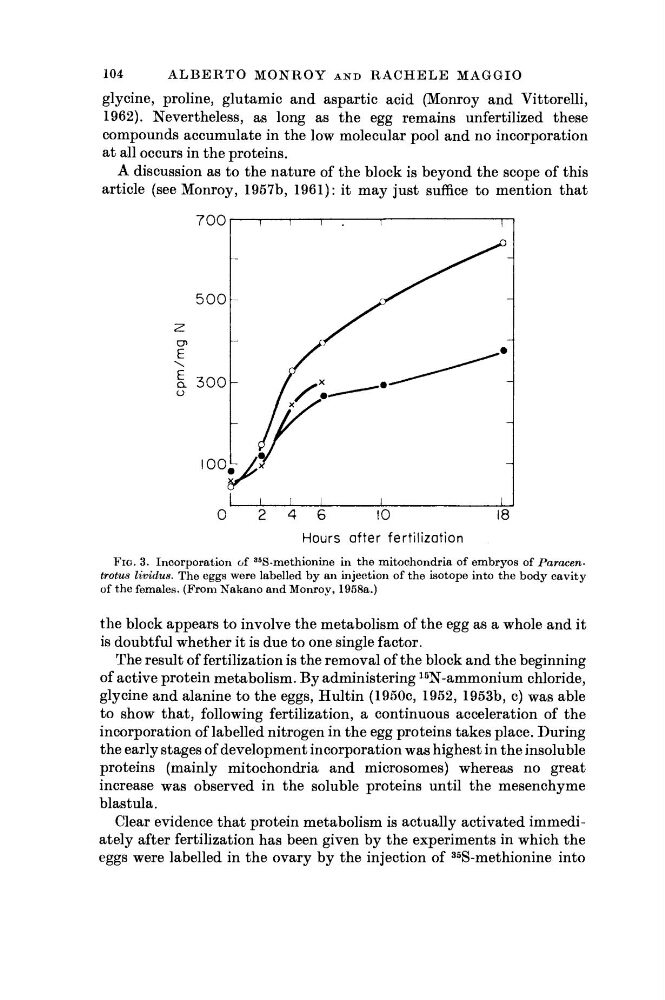
FIG. 3. Incorporation of
35
S-methionine in the mitochondria of embryos of Paracentrotus lividus. The eggs were labelled by an injection of the isotope into the body cavity
of the females. (From Nakano and Monroy, 1958a.)
the block appears to involve the metabolism of the egg as a whole and it
is doubtful whether it is due to one single factor.
The result of fertilization is the removal of the block and the beginning
of active protein metabolism. By administering
15
N-ammonium chloride,
glycine and alanine to the eggs, Hultin (1950c, 1952, 1953b, c) was able
to show that, following fertilization, a continuous acceleration of the
incorporation of labelled nitrogen in the egg proteins takes place. During
the early stages of development incorporation was highest in the insoluble
proteins (mainly mitochondria and microsomes) whereas no great
increase was observed in the soluble proteins until the mesenchyme
blastula.
Clear evidence that protein metabolism is actually activated immediately after fertilization has been given by the experiments in which the
eggs were labelled in the ovary by the injection of
35
S-methionine into
ALBERTO MONROY AND RACHELE
MAGGIO
glycine, proline, glutamic and aspartic acid (Monroy and Vittorelli,
1962). Nevertheless, as long as the egg remains unfertilized these
compounds accumulate in the low molecular pool and no incorporation
at all occurs in the proteins.
A discussion as to the nature of the block is beyond the scope of this
article (see Monroy, 1957b, 1961): it may just suffice to mention that
700
I
I
I
I
I
L
0
2
4
6
10
18
Hours after fertilization
FIG. 3. Incorporation of
35
S-methionine in the mitochondria of embryos of Paracentrotus lividus. The eggs were labelled by an injection of the isotope into the body cavity
of the females. (From Nakano and Monroy, 1958a.)
the block appears to involve the metabolism of the egg as a whole and it
is doubtful whether it is due to one single factor.
The result of fertilization is the removal of the block and the beginning
of active protein metabolism. By administering
15
N-ammonium chloride,
glycine and alanine to the eggs, Hultin (1950c, 1952, 1953b, c) was able
to show that, following fertilization, a continuous acceleration of the
incorporation of labelled nitrogen in the egg proteins takes place. During
the early stages of development incorporation was highest in the insoluble
proteins (mainly mitochondria and microsomes) whereas no great
increase was observed in the soluble proteins until the mesenchyme
blastula.
Clear evidence that protein metabolism is actually activated immediately after fertilization has been given by the experiments in which the
eggs were labelled in the ovary by the injection of
35
S-methionine into