

220
GEORGE G. LATIES
is made available again. Alternatively, endergonic chemical reactions
which would not take place for thermodynamic reasons may be caused
to take place by first phosphorylating one or more of the reactants. In
such cases, too, inorganic phosphate is usually returned to the environment ultimately. Thus in a variety of ways the performance of physiological work and the execution of numerous cellular chemical reactions
regenerate the phosphate acceptors and thereby influence the rate of
respiration.
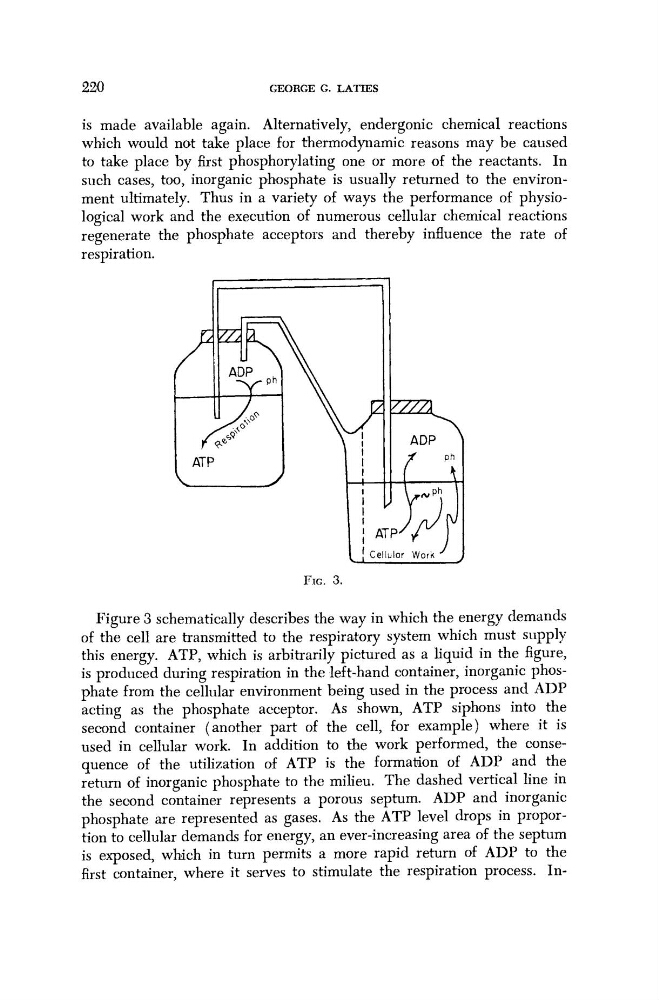
FIG. 3.
Figure 3 schematically describes the way in which the energy demands
of the cell are transmitted to the respiratory system which must supply
this energy. ATP, which is arbitrarily pictured as a liquid in the figure,
is produced during respiration in the left-hand container, inorganic phosphate from the cellular environment being used in the process and ADP
acting as the phosphate acceptor. As shown, ATP siphons into the
second container (another part of the cell, for example) where it is
used in cellular work. In addition to the work performed, the consequence of the utilization of ATP is the formation of ADP and the
return of inorganic phosphate to the milieu. The dashed vertical line in
the second container represents a porous septum. ADP and inorganic
phosphate are represented as gases. As the ATP level drops in proportion to cellular demands for energy, an ever-increasing area of the septum
is exposed, which in turn permits a more rapid return of ADP to the
first container, where it serves to stimulate the respiration process. In-
GEORGE G. LATIES
is made available again. Alternatively, endergonic chemical reactions
which would not take place for thermodynamic reasons may be caused
to take place by first phosphorylating one or more of the reactants. In
such cases, too, inorganic phosphate is usually returned to the environment ultimately. Thus in a variety of ways the performance of physiological work and the execution of numerous cellular chemical reactions
regenerate the phosphate acceptors and thereby influence the rate of
respiration.
FIG. 3.
Figure 3 schematically describes the way in which the energy demands
of the cell are transmitted to the respiratory system which must supply
this energy. ATP, which is arbitrarily pictured as a liquid in the figure,
is produced during respiration in the left-hand container, inorganic phosphate from the cellular environment being used in the process and ADP
acting as the phosphate acceptor. As shown, ATP siphons into the
second container (another part of the cell, for example) where it is
used in cellular work. In addition to the work performed, the consequence of the utilization of ATP is the formation of ADP and the
return of inorganic phosphate to the milieu. The dashed vertical line in
the second container represents a porous septum. ADP and inorganic
phosphate are represented as gases. As the ATP level drops in proportion to cellular demands for energy, an ever-increasing area of the septum
is exposed, which in turn permits a more rapid return of ADP to the
first container, where it serves to stimulate the respiration process. In-