

RESPIRATION RATE IN PLANTS
219
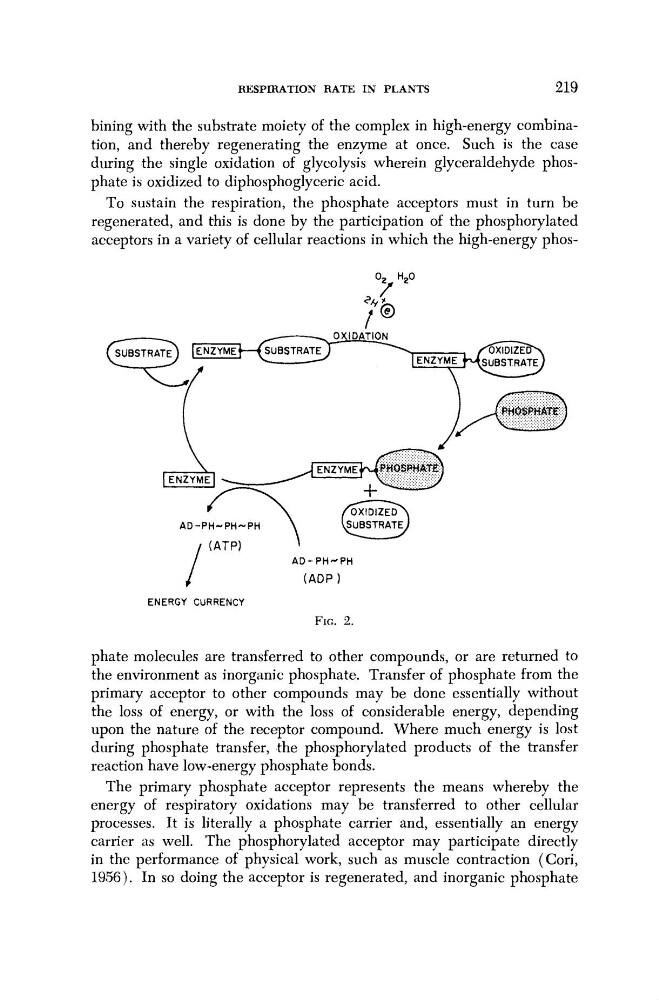
bining with the substrate moiety of the complex in high-energy combination, and thereby regenerating the enzyme at once. Such is the case
during the single oxidation of glycolysis wherein glyceraldehyde phosphate is oxidized to diphosphoglyceric acid.
To sustain the respiration, the phosphate acceptors must in turn be
regenerated, and this is done by the participation of the phosphorylated
acceptors in a variety of cellular reactions in which the high-energy phosENERGY CURRENCY
FIG. 2.
phate molecules are transferred to other compounds, or are returned to
the environment as inorganic phosphate. Transfer of phosphate from the
primary acceptor to other compounds may be done essentially without
the loss of energy, or with the loss of considerable energy, depending
upon the nature of the receptor compound. Where much energy is lost
during phosphate transfer, the phosphorylated products of the transfer
reaction have low-energy phosphate bonds.
The primary phosphate acceptor represents the means whereby the
energy of respiratory oxidations may be transferred to other cellular
processes. It is literally a phosphate carrier and, essentially an energy
carrier as well. The phosphorylated acceptor may participate directly
in the performance of physical work, such as muscle contraction (Cori,
1956). In so doing the acceptor is regenerated, and inorganic phosphate
219
bining with the substrate moiety of the complex in high-energy combination, and thereby regenerating the enzyme at once. Such is the case
during the single oxidation of glycolysis wherein glyceraldehyde phosphate is oxidized to diphosphoglyceric acid.
To sustain the respiration, the phosphate acceptors must in turn be
regenerated, and this is done by the participation of the phosphorylated
acceptors in a variety of cellular reactions in which the high-energy phosENERGY CURRENCY
FIG. 2.
phate molecules are transferred to other compounds, or are returned to
the environment as inorganic phosphate. Transfer of phosphate from the
primary acceptor to other compounds may be done essentially without
the loss of energy, or with the loss of considerable energy, depending
upon the nature of the receptor compound. Where much energy is lost
during phosphate transfer, the phosphorylated products of the transfer
reaction have low-energy phosphate bonds.
The primary phosphate acceptor represents the means whereby the
energy of respiratory oxidations may be transferred to other cellular
processes. It is literally a phosphate carrier and, essentially an energy
carrier as well. The phosphorylated acceptor may participate directly
in the performance of physical work, such as muscle contraction (Cori,
1956). In so doing the acceptor is regenerated, and inorganic phosphate