

MECHANISMS OF HORMONE ACTIONS
201
work, which has effects similar to insulin. It would be of great interest
to search at what point in evolution the muscle factor emerged in relation to the point of appearance of insulin.
Those organs and tissues which work on "one gear," i.e., which do
not greatly increase or decrease their energy expenditure, have an "open"
glucose transfer system; while the working and storage cells, which
work on several "gears," seem to have developed devices which open
the gates for entry of the important blood-borne metabolite, glucose,
when it is needed for work or when it is present in excess in
the circulation.
350 Η
* 300-1
ob
Ε
"Δ 250-1
I
2 0 0
1 ··:
150 J
100.
• WORK
QREST
"NON-RESPONSIVE" SUGARS
BLOOD LEVELS 2-3 HOURS AFTER
INJECTING 1 G./KG., I.V.
i i
D-GALACTOSE
L-ARABINOSE
D-XYLOSE
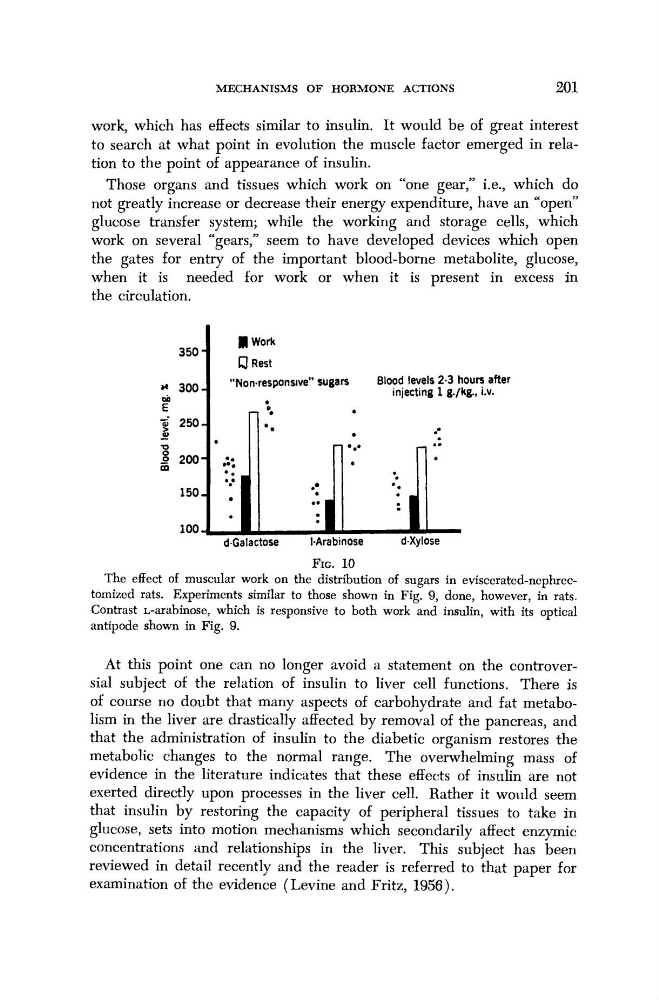
FIG. 10
The effect of muscular work on the distribution of sugars in eviscerated-nephrectomized rats. Experiments similar to those shown in Fig. 9, done, however, in rats.
Contrast L-arabinose, which is responsive to both work and insulin, with its optical
antipode shown in Fig. 9.
At this point one can no longer avoid a statement on the controversial subject of the relation of insulin to liver cell functions. There is
of course no doubt that many aspects of carbohydrate and fat metabolism in the liver are drastically affected by removal of the pancreas, and
that the administration of insulin to the diabetic organism restores the
metabolic changes to the normal range. The overwhelming mass of
evidence in the literature indicates that these effects of insulin are not
exerted directly upon processes in the liver cell. Rather it would seem
that insulin by restoring the capacity of peripheral tissues to take in
glucose, sets into motion mechanisms which secondarily affect enzymic
concentrations and relationships in the liver. This subject has been
reviewed in detail recently and the reader is referred to that paper for
examination of the evidence (Levine and Fritz, 1956).
201
work, which has effects similar to insulin. It would be of great interest
to search at what point in evolution the muscle factor emerged in relation to the point of appearance of insulin.
Those organs and tissues which work on "one gear," i.e., which do
not greatly increase or decrease their energy expenditure, have an "open"
glucose transfer system; while the working and storage cells, which
work on several "gears," seem to have developed devices which open
the gates for entry of the important blood-borne metabolite, glucose,
when it is needed for work or when it is present in excess in
the circulation.
350 Η
* 300-1
ob
Ε
"Δ 250-1
I
2 0 0
1 ··:
150 J
100.
• WORK
QREST
"NON-RESPONSIVE" SUGARS
BLOOD LEVELS 2-3 HOURS AFTER
INJECTING 1 G./KG., I.V.
i i
D-GALACTOSE
L-ARABINOSE
D-XYLOSE
FIG. 10
The effect of muscular work on the distribution of sugars in eviscerated-nephrectomized rats. Experiments similar to those shown in Fig. 9, done, however, in rats.
Contrast L-arabinose, which is responsive to both work and insulin, with its optical
antipode shown in Fig. 9.
At this point one can no longer avoid a statement on the controversial subject of the relation of insulin to liver cell functions. There is
of course no doubt that many aspects of carbohydrate and fat metabolism in the liver are drastically affected by removal of the pancreas, and
that the administration of insulin to the diabetic organism restores the
metabolic changes to the normal range. The overwhelming mass of
evidence in the literature indicates that these effects of insulin are not
exerted directly upon processes in the liver cell. Rather it would seem
that insulin by restoring the capacity of peripheral tissues to take in
glucose, sets into motion mechanisms which secondarily affect enzymic
concentrations and relationships in the liver. This subject has been
reviewed in detail recently and the reader is referred to that paper for
examination of the evidence (Levine and Fritz, 1956).