

200
RACHMIEL LEVINE
this influence is "humoral," because stimulation of one muscle group of
a hind limb leads to the distribution of galactose in the total volume of
body water, and because denervation of the exercising limb has no
influence on this distributive action (Goldstein et al, 1953b).
The findings which indicate that in certain tissues (muscle, connective
tissues) the transfer system for glucose is ordinarily fairly inactive, and
that its rate of action is increased both by insulin and by muscular work,
makes good biological sense from the standpoint of the needs of the
organism as a whole. During the time when no carbohydrate is being
I
I
I
0
1
2
3
Hours
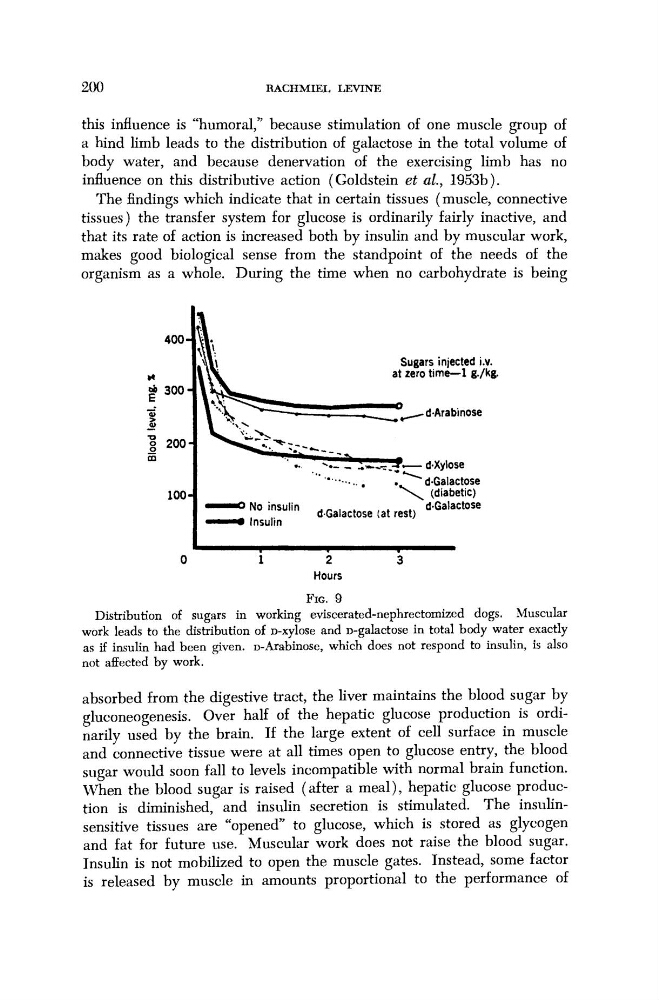
FIG. 9
Distribution of sugars in working eviscerated-nephrectomized dogs. Muscular
work leads to the distribution of D-xylose and D-galactose in total body water exactly
as if insulin had been given. D-Arabinose, which does not respond to insulin, is also
not affected by work.
absorbed from the digestive tract, the liver maintains the blood sugar by
gluconeogenesis. Over half of the hepatic glucose production is ordinarily used by the brain. If the large extent of cell surface in muscle
and connective tissue were at all times open to glucose entry, the blood
sugar would soon fall to levels incompatible with normal brain function.
When the blood sugar is raised (after a meal), hepatic glucose production is diminished, and insulin secretion is stimulated. The insulinsensitive tissues are "opened" to glucose, which is stored as glycogen
and fat for future use. Muscular work does not raise the blood sugar.
Insulin is not mobilized to open the muscle gates. Instead, some factor
is released by muscle in amounts proportional to the performance of
RACHMIEL LEVINE
this influence is "humoral," because stimulation of one muscle group of
a hind limb leads to the distribution of galactose in the total volume of
body water, and because denervation of the exercising limb has no
influence on this distributive action (Goldstein et al, 1953b).
The findings which indicate that in certain tissues (muscle, connective
tissues) the transfer system for glucose is ordinarily fairly inactive, and
that its rate of action is increased both by insulin and by muscular work,
makes good biological sense from the standpoint of the needs of the
organism as a whole. During the time when no carbohydrate is being
I
I
I
0
1
2
3
Hours
FIG. 9
Distribution of sugars in working eviscerated-nephrectomized dogs. Muscular
work leads to the distribution of D-xylose and D-galactose in total body water exactly
as if insulin had been given. D-Arabinose, which does not respond to insulin, is also
not affected by work.
absorbed from the digestive tract, the liver maintains the blood sugar by
gluconeogenesis. Over half of the hepatic glucose production is ordinarily used by the brain. If the large extent of cell surface in muscle
and connective tissue were at all times open to glucose entry, the blood
sugar would soon fall to levels incompatible with normal brain function.
When the blood sugar is raised (after a meal), hepatic glucose production is diminished, and insulin secretion is stimulated. The insulinsensitive tissues are "opened" to glucose, which is stored as glycogen
and fat for future use. Muscular work does not raise the blood sugar.
Insulin is not mobilized to open the muscle gates. Instead, some factor
is released by muscle in amounts proportional to the performance of