

17. A C T I O N S OF V I T A M I N S A A N D C
663
C. H Y P E R V I T A M I N O S I S A IN O R G A N C U L T U R E
T o study the action of excess of vitamin A is comparatively simple
since the vitamin, dissolved in ethanol, can be added to a natural
medium in any concentration desired. In excess, the vitamin affects
the morphology and metabolism of a wide range of tissues, including
epithelia (epidermis, cornea, vagina, oesophageal and respiratory
epithelia), teeth, cartilage and bone.
1. Skin, Palate and Tongue
(a) Histological changes. That excess of vitamin A has a profound
effect on embryonic chick skin in culture, was discovered by Fell and
Mellanby (1953). Since vitamin A-deficiency in vivo causes keratinization of mucous epithelia, experiments were undertaken to see whether
the reverse effect could be produced in organ culture, and keratinization be inhibited in embryonic skin by adding excess of vitamin to the
culture medium. Fortunately, as it proved, chick skin rather than mammalian skin was chosen for these early experiments.
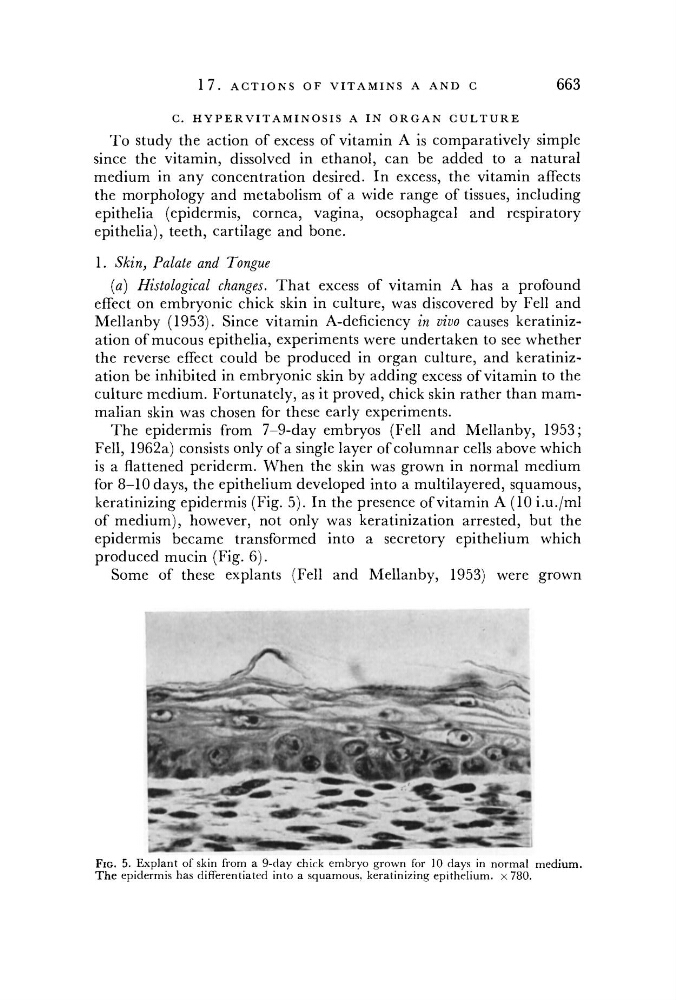
The epidermis from 7-9-day embryos (Fell and Mellanby, 1953;
Fell, 1962a) consists only of a single layer of columnar cells above which
is a flattened periderm. When the skin was grown in normal medium
for 8-10 days, the epithelium developed into a multilayered, squamous,
keratinizing epidermis (Fig. 5). In the presence of vitamin A (10 i.u./ml
of medium), however, not only was keratinization arrested, but the
epidermis became transformed into a secretory epithelium which
produced mucin (Fig. 6).
Some of these explants (Fell and Mellanby, 1953) were grown
FIG. 5. Explant of skin from a 9-day chick embryo grown for 10 days in normal medium.
The epidermis has differentiated into a squamous, keratinizing epithelium. X 780.