

17.
A C T I O N S
O F
V I T A M I N S
A
A N D
C
661
respects also, so that even the addition of the vitamin did not make it
suitable for the healthy growth and survival of the explants.
Recently, however, Lasnitzki (1962) has succeeded in producing
typical vitamin A-deficient changes in the prostate glands of young
mice, by using a chemically defined medium in which this tissue
thrives quite well.
It is well known that in a vitamin-A deficient animal, certain glandular epithelia lose their secretory structure and become transformed
into squamous, keratinizing epithelium; this is true of the prostate
gland. When the prostate gland is grown in natural medium consisting
of horse serum and chick-embryo extract, its glandular structure is
preserved. If, however, it is cultivated on chemically denned medium
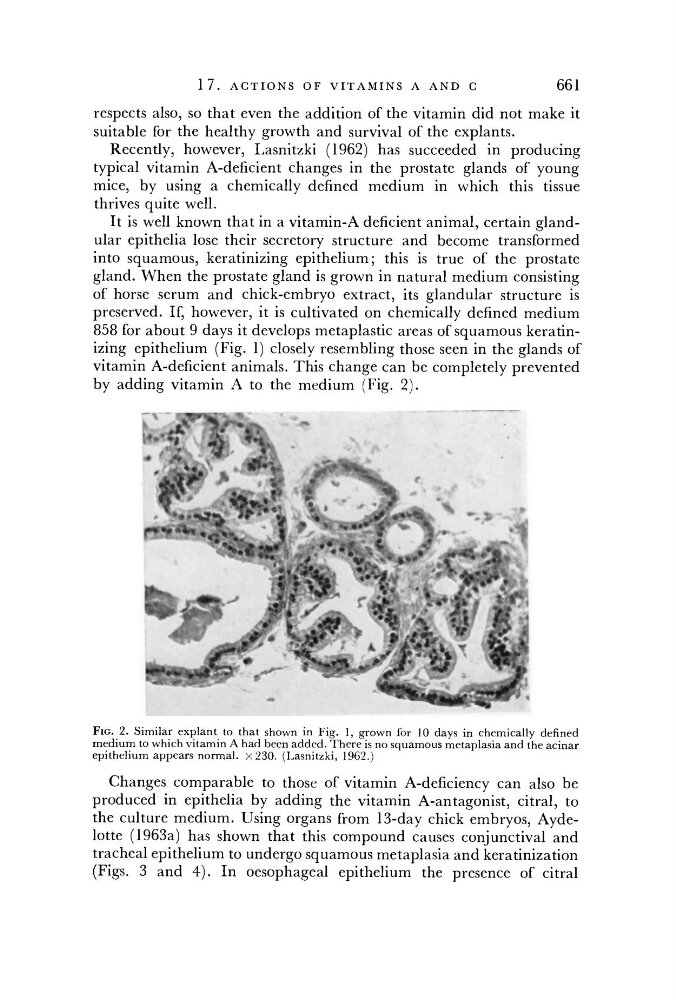
858 for about 9 days it develops metaplastic areas of squamous keratinizing epithelium (Fig. 1) closely resembling those seen in the glands of
vitamin A-deficient animals. This change can be completely prevented
by adding vitamin A to the medium (Fig. 2).
FIG. 2. Similar explant to that shown in Fig. 1, grown for 10 days in chemically defined
medium to which vitamin A had been added. There is no squamous metaplasia and the acinar
epithelium appears normal. x230. (Lasnitzki, 196.2.)
Changes comparable to those of vitamin A-deficiency can also be
produced in epithelia by adding the vitamin A-antagonist, citral, to
the culture medium. Using organs from 13-day chick embryos, Aydelotte (1963a) has shown that this compound causes conjunctival and
tracheal epithelium to undergo squamous metaplasia and keratinization
(Figs. 3 and 4). In oesophageal epithelium the presence of citral