

15. E M B R Y O G E N E S I S in vitro
561
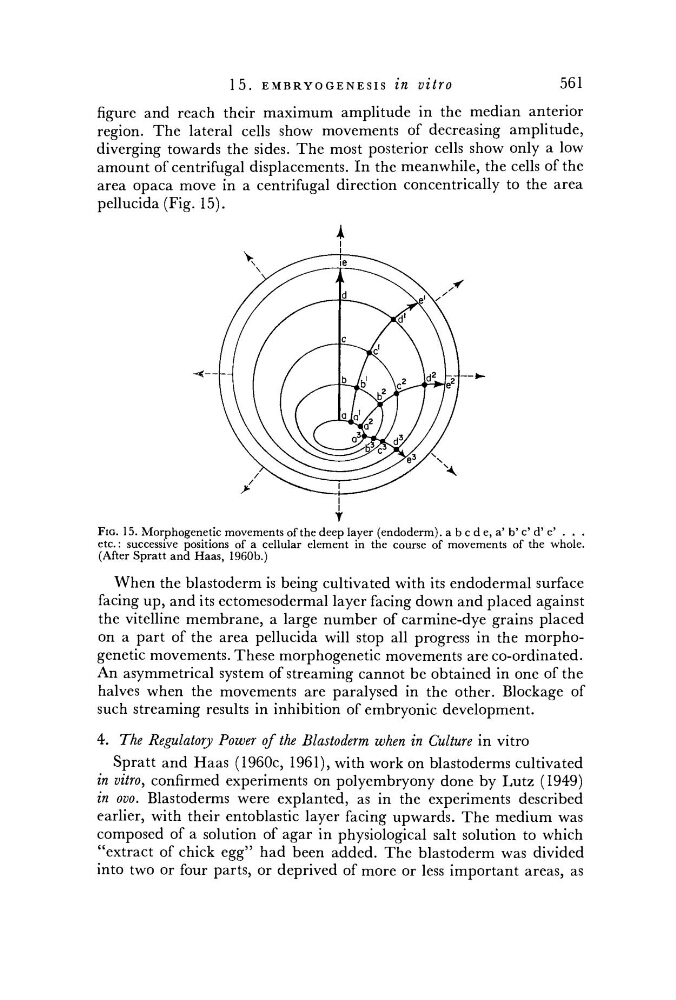
figure and reach their maximum amplitude in the median anterior
region. The lateral cells show movements of decreasing amplitude,
diverging towards the sides. The most posterior cells show only a low
amount of centrifugal displacements. In the meanwhile, the cells ofthe
area opaca move in a centrifugal direction concentrically to the area
pellucida (Fig. 15).
i
i
Y
FIG. 15. Morphogenetic movements ofthe deep layer (endoderm). a b c d e, a' b ' c ' d ' e' . . .
etc.: successive positions of a cellular element in the course of movements of the whole.
(After Spratt and Haas, 1960b.)
When the blastoderm is being cultivated with its endodermal surface
facing up, and its ectomesodermal layer facing down and placed against
the vitelline membrane, a large number of carmine-dye grains placed
on a part of the area pellucida will stop all progress in the morphogenetic movements. These morphogenetic movements are co-ordinated.
An asymmetrical system of streaming cannot be obtained in one of the
halves when the movements are paralysed in the other. Blockage of
such streaming results in inhibition of embryonic development.
4. The Regulatory Power of the Blastoderm when in Culture in vitro
Spratt and Haas (1960c, 1961), with work on blastoderms cultivated
in vitro, confirmed experiments on polyembryony done by Lutz (1949)
in ovo. Blastoderms were explanted, as in the experiments described
earlier, with their entoblastic layer facing upwards. The medium was
composed of a solution of agar in physiological salt solution to which
"extract of chick egg" had been added. The blastoderm was divided
into two or four parts, or deprived of more or less important areas, as
561
figure and reach their maximum amplitude in the median anterior
region. The lateral cells show movements of decreasing amplitude,
diverging towards the sides. The most posterior cells show only a low
amount of centrifugal displacements. In the meanwhile, the cells ofthe
area opaca move in a centrifugal direction concentrically to the area
pellucida (Fig. 15).
i
i
Y
FIG. 15. Morphogenetic movements ofthe deep layer (endoderm). a b c d e, a' b ' c ' d ' e' . . .
etc.: successive positions of a cellular element in the course of movements of the whole.
(After Spratt and Haas, 1960b.)
When the blastoderm is being cultivated with its endodermal surface
facing up, and its ectomesodermal layer facing down and placed against
the vitelline membrane, a large number of carmine-dye grains placed
on a part of the area pellucida will stop all progress in the morphogenetic movements. These morphogenetic movements are co-ordinated.
An asymmetrical system of streaming cannot be obtained in one of the
halves when the movements are paralysed in the other. Blockage of
such streaming results in inhibition of embryonic development.
4. The Regulatory Power of the Blastoderm when in Culture in vitro
Spratt and Haas (1960c, 1961), with work on blastoderms cultivated
in vitro, confirmed experiments on polyembryony done by Lutz (1949)
in ovo. Blastoderms were explanted, as in the experiments described
earlier, with their entoblastic layer facing upwards. The medium was
composed of a solution of agar in physiological salt solution to which
"extract of chick egg" had been added. The blastoderm was divided
into two or four parts, or deprived of more or less important areas, as