

560
ETIENNE WOLFF
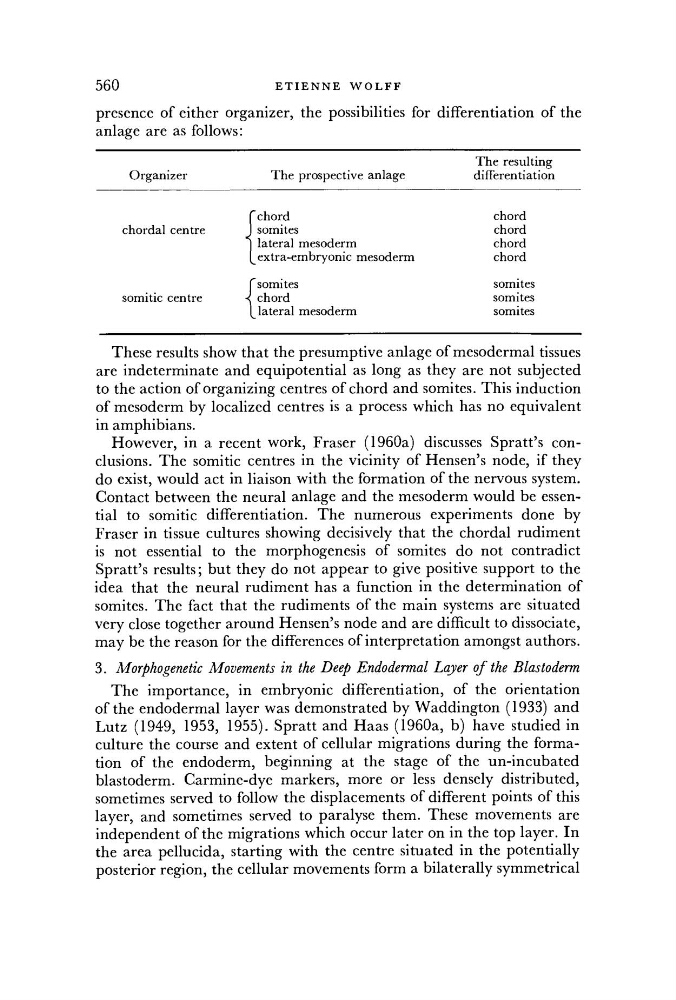
presence of either organizer, the possibilities for differentiation of the
anlage are as follows:
Organizer
T h e prospective anlage
T h e resulting
differentiation
f c h o r d
chord
chordal centre
J somites
chord
] lateral mesoderm
chord
[_ extra-embryonic mesoderm
chord
f somites
somites
somitic centre
< chord
somites
(^lateral mesoderm
somites
These results show that the presumptive anlage of mesodermal tissues
are indeterminate and equipotential as long as they are not subjected
to the action of organizing centres of chord and somites. This induction
of mesoderm by localized centres is a process which has no equivalent
in amphibians.
However, in a recent work, Fraser (1960a) discusses Spratt's conclusions. The somitic centres in the vicinity of Hensen's node, if they
do exist, would act in liaison with the formation of the nervous system.
Contact between the neural anlage and the mesoderm would be essential to somitic differentiation. The numerous experiments done by
Fraser in tissue cultures showing decisively that the chordal rudiment
is not essential to the morphogenesis of somites do not contradict
Spratt's results; but they do not appear to give positive support to the
idea that the neural rudiment has a function in the determination of
somites. The fact that the rudiments of the main systems are situated
very close together around Hensen's node and are difficult to dissociate,
may be the reason for the differences of interpretation amongst authors.
3. Morphogenetic Movements in the Deep Endodermal Layer of the Blastoderm
The importance, in embryonic differentiation, of the orientation
of the endodermal layer was demonstrated by Waddington (1933) and
Lutz (1949, 1953, 1955). Spratt and Haas (1960a, b) have studied in
culture the course and extent of cellular migrations during the formation of the endoderm, beginning at the stage of the un-incubated
blastoderm. Carmine-dye markers, more or less densely distributed,
sometimes served to follow the displacements of different points of this
layer, and sometimes served to paralyse them. These movements are
independent of the migrations which occur later on in the top layer. In
the area pellucida, starting with the centre situated in the potentially
posterior region, the cellular movements form a bilaterally symmetrical
ETIENNE WOLFF
presence of either organizer, the possibilities for differentiation of the
anlage are as follows:
Organizer
T h e prospective anlage
T h e resulting
differentiation
f c h o r d
chord
chordal centre
J somites
chord
] lateral mesoderm
chord
[_ extra-embryonic mesoderm
chord
f somites
somites
somitic centre
< chord
somites
(^lateral mesoderm
somites
These results show that the presumptive anlage of mesodermal tissues
are indeterminate and equipotential as long as they are not subjected
to the action of organizing centres of chord and somites. This induction
of mesoderm by localized centres is a process which has no equivalent
in amphibians.
However, in a recent work, Fraser (1960a) discusses Spratt's conclusions. The somitic centres in the vicinity of Hensen's node, if they
do exist, would act in liaison with the formation of the nervous system.
Contact between the neural anlage and the mesoderm would be essential to somitic differentiation. The numerous experiments done by
Fraser in tissue cultures showing decisively that the chordal rudiment
is not essential to the morphogenesis of somites do not contradict
Spratt's results; but they do not appear to give positive support to the
idea that the neural rudiment has a function in the determination of
somites. The fact that the rudiments of the main systems are situated
very close together around Hensen's node and are difficult to dissociate,
may be the reason for the differences of interpretation amongst authors.
3. Morphogenetic Movements in the Deep Endodermal Layer of the Blastoderm
The importance, in embryonic differentiation, of the orientation
of the endodermal layer was demonstrated by Waddington (1933) and
Lutz (1949, 1953, 1955). Spratt and Haas (1960a, b) have studied in
culture the course and extent of cellular migrations during the formation of the endoderm, beginning at the stage of the un-incubated
blastoderm. Carmine-dye markers, more or less densely distributed,
sometimes served to follow the displacements of different points of this
layer, and sometimes served to paralyse them. These movements are
independent of the migrations which occur later on in the top layer. In
the area pellucida, starting with the centre situated in the potentially
posterior region, the cellular movements form a bilaterally symmetrical