

15. E M B R Y O G E N E S I S in vitro
555
a way as to form a convex surface, so that the blastoderm might be
strongly stretched over this surface. This stretching tends to supplement
the natural tension imposed by the vitelline membrane. Thus, the area
vasculosa can progress for a fairly long time, and circulation becomes
established. When growth of the blastoderm stops, one can continue
the development of the area vasculosa by grafting pieces of an extraembryonic membrane from another embryo along the edges of the
blastoderm. These pieces become welded to the original blastoderm
whose limits are soon exceeded by the vascular area. Supplementary
pieces of blastoderm can be grafted on several times. However, the
growth ofthe vascular area is limited by two things: first, the dimensions
of the container, secondly, the fact that the area vasculosa is not subject
to the same tensions as it undergoes normally whilst progressing over
the surface of a sphere. Neither of these conditions has yet been realized
experimentally.
Nevertheless, this technique does permit development for 2-4 days,
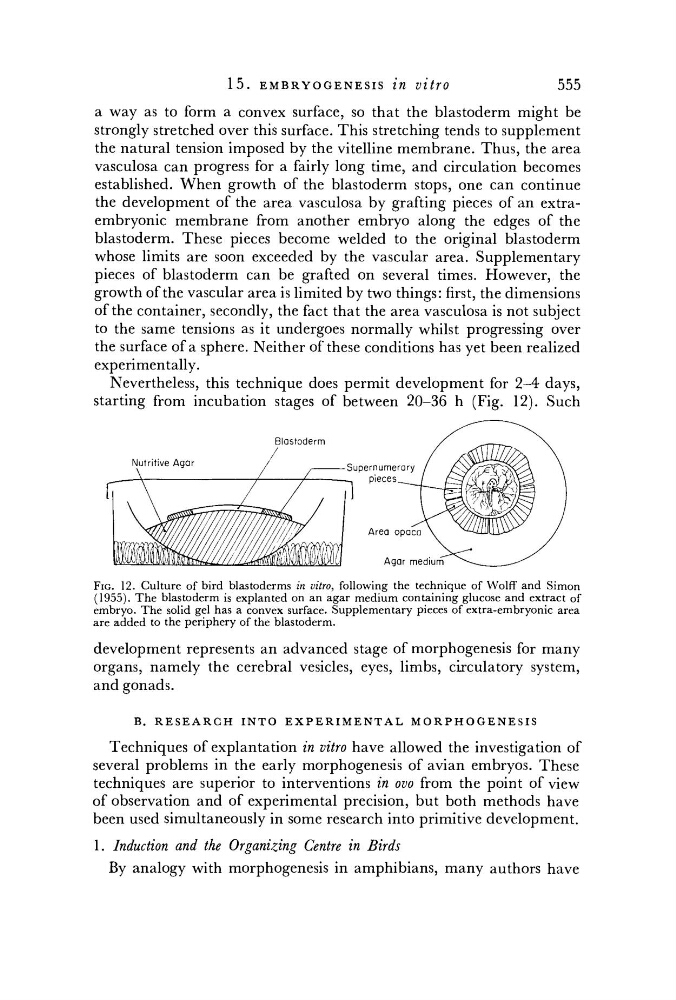
starting from incubation stages of between 20-36 h (Fig. 12). Such
FIG. 12. Culture of bird blastoderms in vitro, following the technique of Wolff and Simon
( 1 9 5 5 ) . The blastoderm is explanted on an agar medium containing glucose and extract of
embryo. The solid gel has a convex surface. Supplementary pieces of extra-embryonic area
are added to the periphery of the blastoderm.
development represents an advanced stage of morphogenesis for many
organs, namely the cerebral vesicles, eyes, limbs, circulatory system,
and gonads.
B. R E S E A R C H I N T O E X P E R I M E N T A L M O R P H O G E N E S I S
Techniques of explantation in vitro have allowed the investigation of
several problems in the early morphogenesis of avian embryos. These
techniques are superior to interventions in ovo from the point of view
of observation and of experimental precision, but both methods have
been used simultaneously in some research into primitive development.
1. Induction and the Organizing Centre in Birds
By analogy with morphogenesis in amphibians, many authors have
IT
HI
555
a way as to form a convex surface, so that the blastoderm might be
strongly stretched over this surface. This stretching tends to supplement
the natural tension imposed by the vitelline membrane. Thus, the area
vasculosa can progress for a fairly long time, and circulation becomes
established. When growth of the blastoderm stops, one can continue
the development of the area vasculosa by grafting pieces of an extraembryonic membrane from another embryo along the edges of the
blastoderm. These pieces become welded to the original blastoderm
whose limits are soon exceeded by the vascular area. Supplementary
pieces of blastoderm can be grafted on several times. However, the
growth ofthe vascular area is limited by two things: first, the dimensions
of the container, secondly, the fact that the area vasculosa is not subject
to the same tensions as it undergoes normally whilst progressing over
the surface of a sphere. Neither of these conditions has yet been realized
experimentally.
Nevertheless, this technique does permit development for 2-4 days,
starting from incubation stages of between 20-36 h (Fig. 12). Such
FIG. 12. Culture of bird blastoderms in vitro, following the technique of Wolff and Simon
( 1 9 5 5 ) . The blastoderm is explanted on an agar medium containing glucose and extract of
embryo. The solid gel has a convex surface. Supplementary pieces of extra-embryonic area
are added to the periphery of the blastoderm.
development represents an advanced stage of morphogenesis for many
organs, namely the cerebral vesicles, eyes, limbs, circulatory system,
and gonads.
B. R E S E A R C H I N T O E X P E R I M E N T A L M O R P H O G E N E S I S
Techniques of explantation in vitro have allowed the investigation of
several problems in the early morphogenesis of avian embryos. These
techniques are superior to interventions in ovo from the point of view
of observation and of experimental precision, but both methods have
been used simultaneously in some research into primitive development.
1. Induction and the Organizing Centre in Birds
By analogy with morphogenesis in amphibians, many authors have
IT
HI