

554
ETIENNE WOLFF
approximating White's medium (1946). In experiments in which he
studied the minimum nutritive needs of blastoderms, the media were
very much simplified and reduced to a small number of ingredients.
These techniques, used by Waddington and Spratt, gave important
results relating to the first stages of morphogenesis, but did not allow
normal development for more than 15-20 h after the primitive streak
stage or cephalic elongation.
New (1955, 1959) noted that in these techniques the edge of the
blastoderm cannot spread itself out on the substrate. This is related
to the fact that, in normal conditions, the peripheral cells of this edge
have peculiar properties. They adhere to the vitelline membrane, upon
which they stretch out and migrate, pulling along with them the rest
of the blastoderm. Thus, the area vasculosa can extend concentrically
outwards and the whole circulatory system develop normally. The
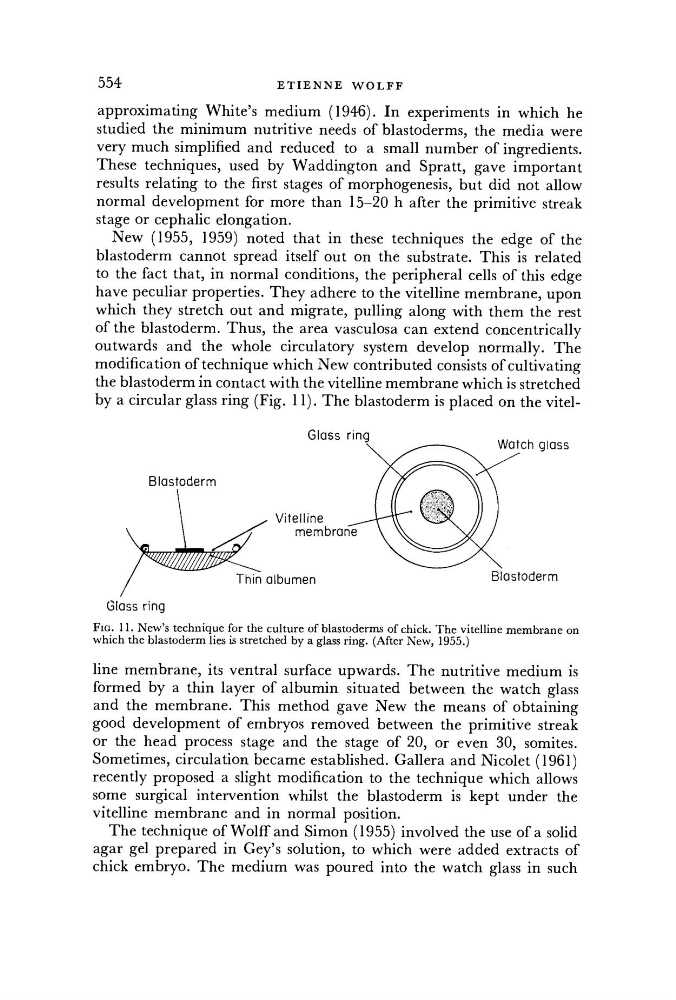
modification of technique which New contributed consists of cultivating
the blastoderm in contact with the vitelline membrane which is stretched
by a circular glass ring (Fig. 11). The blastoderm is placed on the vitelGlass ring
... . , .
\
^ - — ^
Watch glass
Blastoderm
Vitelline
membrane
Thin albumen
Blastoderm
Glass ring
FIG. 11. New's technique for the culture of blastoderms of chick. The vitelline membrane on
which the blastoderm lies is stretched by a glass ring. (After New, 1955.)
line membrane, its ventral surface upwards. The nutritive medium is
formed by a thin layer of albumin situated between the watch glass
and the membrane. This method gave New the means of obtaining
good development of embryos removed between the primitive streak
or the head process stage and the stage of 20, or even 30, somites.
Sometimes, circulation became established. Gallera and Nicolet (1961)
recently proposed a slight modification to the technique which allows
some surgical intervention whilst the blastoderm is kept under the
vitelline membrane and in normal position.
The technique of Wolff and Simon (1955) involved the use of a solid
agar gel prepared in Gey's solution, to which were added extracts of
chick embryo. The medium was poured into the watch glass in such
ETIENNE WOLFF
approximating White's medium (1946). In experiments in which he
studied the minimum nutritive needs of blastoderms, the media were
very much simplified and reduced to a small number of ingredients.
These techniques, used by Waddington and Spratt, gave important
results relating to the first stages of morphogenesis, but did not allow
normal development for more than 15-20 h after the primitive streak
stage or cephalic elongation.
New (1955, 1959) noted that in these techniques the edge of the
blastoderm cannot spread itself out on the substrate. This is related
to the fact that, in normal conditions, the peripheral cells of this edge
have peculiar properties. They adhere to the vitelline membrane, upon
which they stretch out and migrate, pulling along with them the rest
of the blastoderm. Thus, the area vasculosa can extend concentrically
outwards and the whole circulatory system develop normally. The
modification of technique which New contributed consists of cultivating
the blastoderm in contact with the vitelline membrane which is stretched
by a circular glass ring (Fig. 11). The blastoderm is placed on the vitelGlass ring
... . , .
\
^ - — ^
Watch glass
Blastoderm
Vitelline
membrane
Thin albumen
Blastoderm
Glass ring
FIG. 11. New's technique for the culture of blastoderms of chick. The vitelline membrane on
which the blastoderm lies is stretched by a glass ring. (After New, 1955.)
line membrane, its ventral surface upwards. The nutritive medium is
formed by a thin layer of albumin situated between the watch glass
and the membrane. This method gave New the means of obtaining
good development of embryos removed between the primitive streak
or the head process stage and the stage of 20, or even 30, somites.
Sometimes, circulation became established. Gallera and Nicolet (1961)
recently proposed a slight modification to the technique which allows
some surgical intervention whilst the blastoderm is kept under the
vitelline membrane and in normal position.
The technique of Wolff and Simon (1955) involved the use of a solid
agar gel prepared in Gey's solution, to which were added extracts of
chick embryo. The medium was poured into the watch glass in such