

8. P R O T E I N M E T A B O L I S M I N C E L L L I N E S
289
between these two amino acids and alanine. When cells are grown in
a medium containing ribose and pyruvate in lieu of glucose, the
serine and glycine then derive their carbon almost wholly from ribose,
while alanine derives primarily from pyruvate.
In the glutamine family of amino acids, the amide nitrogen of asparagine derives from glutamine amide nitrogen. Although proline is synthesized largely from glutamic acid, presumably by the same pathway
operative in bacteria and involving glutamic-y-semialdehyde as a
precursor, significant quantities also derive from arginine, with
ornithine as the apparently necessary intermediate. It is not yet known
whether significant amounts of ornithine derive from glutamic acid,
or whether glutamic-y-semialdehyde is an intermediate in the conversion of ornithine to proline, as described for certain fungi (Vogel,
1955).
With all the nutritionally non-essential amino acids, the a-amino
group derives almost entirely from glutamic acid, this despite the fact
that cultured cells contain a wide spectrum of transaminases, involving
many different amino acids as both amino donors and acceptors.
Free ammonia is utilized to only a minor degree; and even that limited
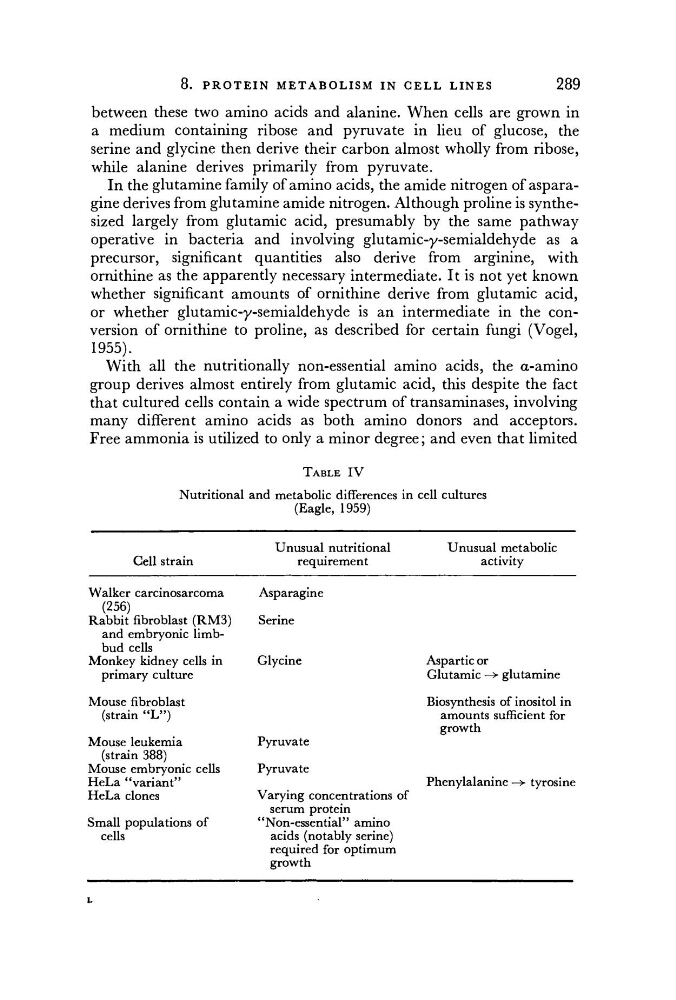
T A B L E
I V
Nutritional and metabolic differences in cell cultures
(Eagle, 1959)
Cell strain
Unusual nutritional
requirement
Unusual metabolic
activity
Walker carcinosarcoma
(256)
R a b b i t fibroblast ( R M 3 )
and embryonic limbb u d cells
M o n k e y kidney cells in
primary culture
M o u s e fibroblast
(strain " L " )
M o u s e leukemia
(strain 388)
M o u s e embryonic cells
H e L a "variant"
H e L a clones
Small populations o f
cells
Asparagine
Serine
Glycine
Pyruvate
Pyruvate
Varying concentrations o f
serum protein
"Non-essential" amino
acids (notably serine)
required for o p t i m u m
growth
Aspartic or
Glutamic —> glutamine
Biosynthesis o f inositol in
amounts sufficient for
growth
Phenylalanine —> tyrosine
L
289
between these two amino acids and alanine. When cells are grown in
a medium containing ribose and pyruvate in lieu of glucose, the
serine and glycine then derive their carbon almost wholly from ribose,
while alanine derives primarily from pyruvate.
In the glutamine family of amino acids, the amide nitrogen of asparagine derives from glutamine amide nitrogen. Although proline is synthesized largely from glutamic acid, presumably by the same pathway
operative in bacteria and involving glutamic-y-semialdehyde as a
precursor, significant quantities also derive from arginine, with
ornithine as the apparently necessary intermediate. It is not yet known
whether significant amounts of ornithine derive from glutamic acid,
or whether glutamic-y-semialdehyde is an intermediate in the conversion of ornithine to proline, as described for certain fungi (Vogel,
1955).
With all the nutritionally non-essential amino acids, the a-amino
group derives almost entirely from glutamic acid, this despite the fact
that cultured cells contain a wide spectrum of transaminases, involving
many different amino acids as both amino donors and acceptors.
Free ammonia is utilized to only a minor degree; and even that limited
T A B L E
I V
Nutritional and metabolic differences in cell cultures
(Eagle, 1959)
Cell strain
Unusual nutritional
requirement
Unusual metabolic
activity
Walker carcinosarcoma
(256)
R a b b i t fibroblast ( R M 3 )
and embryonic limbb u d cells
M o n k e y kidney cells in
primary culture
M o u s e fibroblast
(strain " L " )
M o u s e leukemia
(strain 388)
M o u s e embryonic cells
H e L a "variant"
H e L a clones
Small populations o f
cells
Asparagine
Serine
Glycine
Pyruvate
Pyruvate
Varying concentrations o f
serum protein
"Non-essential" amino
acids (notably serine)
required for o p t i m u m
growth
Aspartic or
Glutamic —> glutamine
Biosynthesis o f inositol in
amounts sufficient for
growth
Phenylalanine —> tyrosine
L