

7 . C A R B O H Y D R A T E A N D E N E R G Y M E T A B O L I S M
2 5 9
2. Effect of Glucose Concentration in the Medium
When the glucose concentration in the medium is increased, glycolysis
is also increased (Abdel-Tawab et al., 1959) and respiration is inhibited
(Danes and Paul, 1961b). The Crabtree or "inverse Pasteur" effect, as
this phenomenon is called, is particularly exhibited by some kinds of
animal cells. All cell strains examined by us have been found to
exhibit a Crabtree effect although this is quite radically modified in
some cases (Danes et al., 1963; Danes and Paul, 1961a). Certain
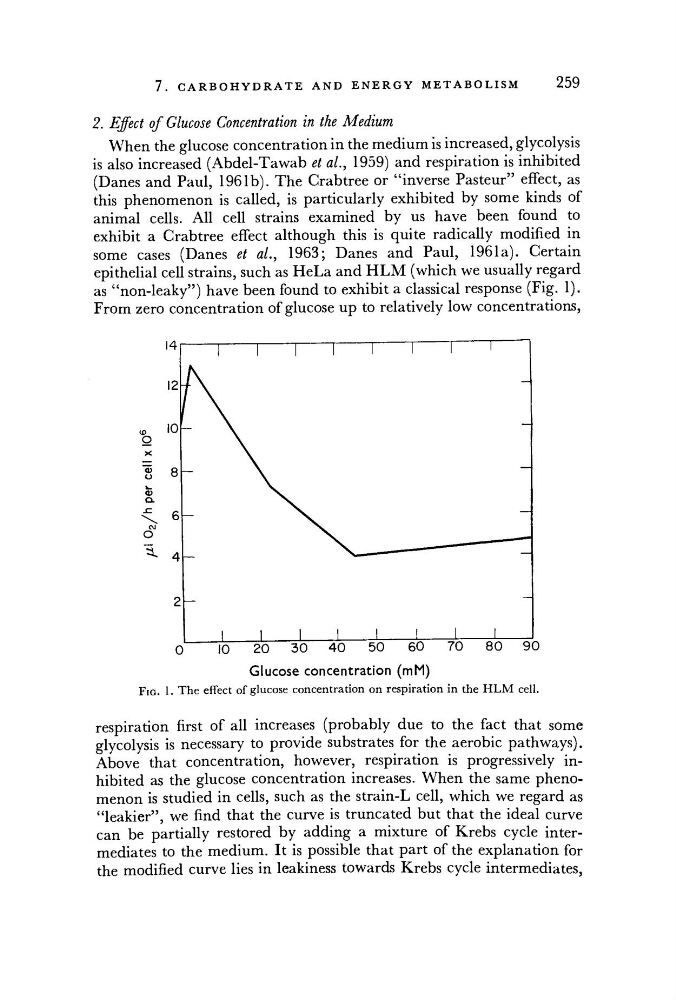
epithelial cell strains, such as HeLa and H L M (which we usually regard
as "non-leaky") have been found to exhibit a classical response (Fig. 1).
From zero concentration of glucose up to relatively low concentrations,
2fI
I
I
I
I
I
I
I
0
10
20
30
40
50
60
70
80
90
Glucose concentration (mM)
FIG. 1. The effect of glucose concentration on respiration in the H L M cell.
respiration first of all increases (probably due to the fact that some
glycolysis is necessary to provide substrates for the aerobic pathways).
Above that concentration, however, respiration is progressively inhibited as the glucose concentration increases. When the same phenomenon is studied in cells, such as the strain-L cell, which we regard as
"leakier", we find that the curve is truncated but that the ideal curve
can be partially restored by adding a mixture of Krebs cycle intermediates to the medium. It is possible that part of the explanation for
the modified curve lies in leakiness towards Krebs cycle intermediates.
a\ Oo/h per cell x IO
6
2 5 9
2. Effect of Glucose Concentration in the Medium
When the glucose concentration in the medium is increased, glycolysis
is also increased (Abdel-Tawab et al., 1959) and respiration is inhibited
(Danes and Paul, 1961b). The Crabtree or "inverse Pasteur" effect, as
this phenomenon is called, is particularly exhibited by some kinds of
animal cells. All cell strains examined by us have been found to
exhibit a Crabtree effect although this is quite radically modified in
some cases (Danes et al., 1963; Danes and Paul, 1961a). Certain
epithelial cell strains, such as HeLa and H L M (which we usually regard
as "non-leaky") have been found to exhibit a classical response (Fig. 1).
From zero concentration of glucose up to relatively low concentrations,
2fI
I
I
I
I
I
I
I
0
10
20
30
40
50
60
70
80
90
Glucose concentration (mM)
FIG. 1. The effect of glucose concentration on respiration in the H L M cell.
respiration first of all increases (probably due to the fact that some
glycolysis is necessary to provide substrates for the aerobic pathways).
Above that concentration, however, respiration is progressively inhibited as the glucose concentration increases. When the same phenomenon is studied in cells, such as the strain-L cell, which we regard as
"leakier", we find that the curve is truncated but that the ideal curve
can be partially restored by adding a mixture of Krebs cycle intermediates to the medium. It is possible that part of the explanation for
the modified curve lies in leakiness towards Krebs cycle intermediates.
a\ Oo/h per cell x IO
6