

258
J O H N P A U L
V . I N F L U E N C E OF E N V I R O N M E N T A L F A C T O R S
A. G E N E R A L E N V I R O N M E N T A L F A C T O R S
It has already been stated that the pattern of metabolism can be
readily and systematically altered by varying certain environmental
factors, two of which, glucose and hydrogen ion concentrations, have
been mentioned briefly. The general effects of environmental influences
will now be considered in more detail.
1. pH Effect on Carbohydrate Metabolism
The effect of p H is particularly important because it is difficult to
control it adequately in the usual tissue culture conditions. It was first
observed by Zwartouw and Westwood (1958) and later independently
by others (Broda, Suschny, Rticker and Kellner, 1959; Paul, 1959) that
cells grown at an alkaline p H produce much more lactic acid from a
given amount of glucose than the same cells grown at an acid pH. In
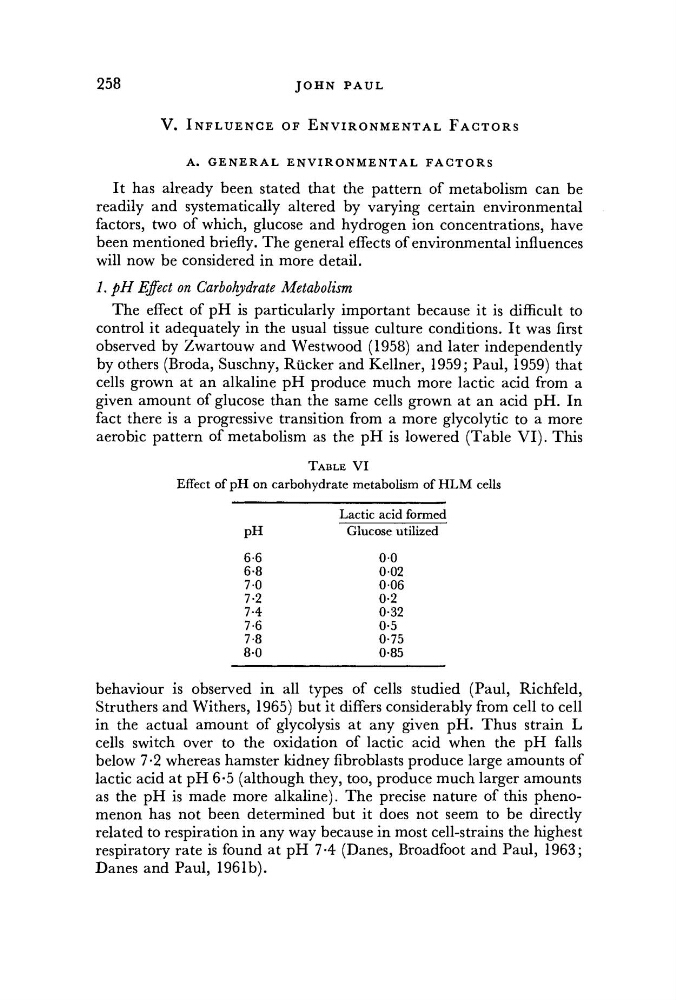
fact there is a progressive transition from a more glycolytic to a more
aerobic pattern of metabolism as the p H is lowered (Table V I ) . This
T A B L E V I
Effect o f p H o n carbohydrate metabolism o f H L M cells
Lactic acid formed
p H
Glucose utilized
6-6
0 0
6-8
0-02
7-0
0-06
7-2
0-2
7-4
0-32
7-6
0-5
7-8
0-75
8-0
0-85
behaviour is observed in all types of cells studied (Paul, Richfeld,
Struthers and Withers, 1965) but it differs considerably from cell to cell
in the actual amount of glycolysis at any given p H . Thus strain L
cells switch over to the oxidation of lactic acid when the p H falls
below 7-2 whereas hamster kidney fibroblasts produce large amounts of
lactic acid at p H 6-5 (although they, too, produce much larger amounts
as the p H is made more alkaline). The precise nature of this phenomenon has not been determined but it does not seem to be directly
related to respiration in any way because in most cell-strains the highest
respiratory rate is found at p H 7-4 (Danes, Broadfoot and Paul, 1963;
Danes and Paul, 1961b).
J O H N P A U L
V . I N F L U E N C E OF E N V I R O N M E N T A L F A C T O R S
A. G E N E R A L E N V I R O N M E N T A L F A C T O R S
It has already been stated that the pattern of metabolism can be
readily and systematically altered by varying certain environmental
factors, two of which, glucose and hydrogen ion concentrations, have
been mentioned briefly. The general effects of environmental influences
will now be considered in more detail.
1. pH Effect on Carbohydrate Metabolism
The effect of p H is particularly important because it is difficult to
control it adequately in the usual tissue culture conditions. It was first
observed by Zwartouw and Westwood (1958) and later independently
by others (Broda, Suschny, Rticker and Kellner, 1959; Paul, 1959) that
cells grown at an alkaline p H produce much more lactic acid from a
given amount of glucose than the same cells grown at an acid pH. In
fact there is a progressive transition from a more glycolytic to a more
aerobic pattern of metabolism as the p H is lowered (Table V I ) . This
T A B L E V I
Effect o f p H o n carbohydrate metabolism o f H L M cells
Lactic acid formed
p H
Glucose utilized
6-6
0 0
6-8
0-02
7-0
0-06
7-2
0-2
7-4
0-32
7-6
0-5
7-8
0-75
8-0
0-85
behaviour is observed in all types of cells studied (Paul, Richfeld,
Struthers and Withers, 1965) but it differs considerably from cell to cell
in the actual amount of glycolysis at any given p H . Thus strain L
cells switch over to the oxidation of lactic acid when the p H falls
below 7-2 whereas hamster kidney fibroblasts produce large amounts of
lactic acid at p H 6-5 (although they, too, produce much larger amounts
as the p H is made more alkaline). The precise nature of this phenomenon has not been determined but it does not seem to be directly
related to respiration in any way because in most cell-strains the highest
respiratory rate is found at p H 7-4 (Danes, Broadfoot and Paul, 1963;
Danes and Paul, 1961b).